

To understand how to add keywords to resume documents effectively, job seekers must systematically extract mandatory hard skills and technical qualifications from the employer's job description, strategically distributing those terms across four core document zones: the professional summary, core competencies grid, work experience achievements, and certifications. This structured keyword integration ensures your resume clears algorithmic Applicant Tracking System (ATS) search filters while presenting compelling, quantified career impact to human hiring managers.
Quick Verdict: Best Resume Keyword Optimization Tools
For algorithmic ATS diagnostic scanning that mirrors enterprise Workday and Taleo keyword parsers, Jobscan provides the most rigorous frequency-based keyword match report. If you want an integrated job tracking CRM with real-time AI keyword suggestions, Teal offers the cleanest free workflow. For job seekers requiring guaranteed ATS-compliant plain-text formatting and a one-time lifetime license, Rezi delivers precise keyword targeting without recurring subscription fees.
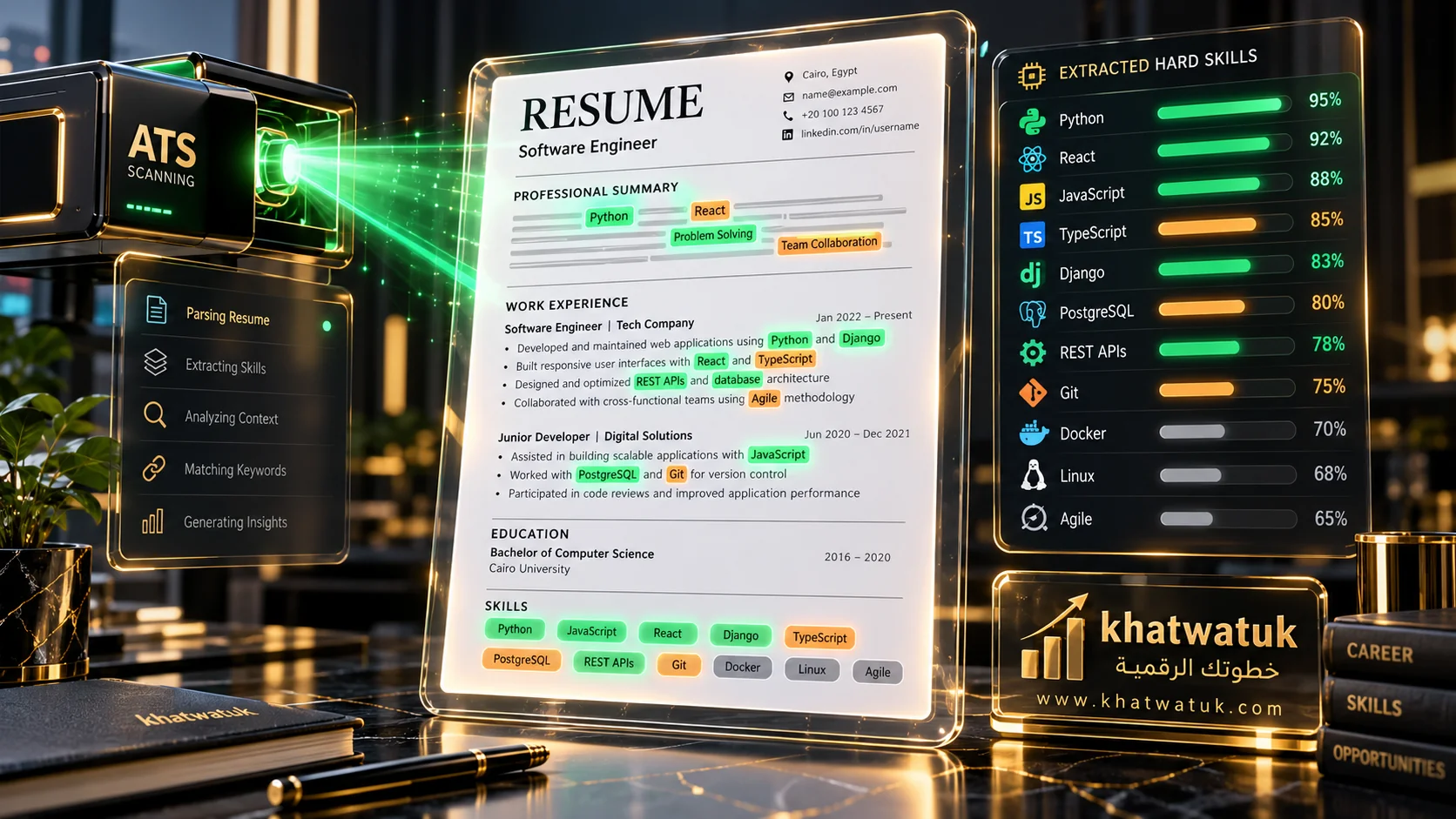
Adding target keywords to your resume bridges the gap between automated ATS search algorithms and human recruiter evaluation.
Comparison Matrix: Top 5 Tools to Audit and Add Keywords to Your Resume (2026)
Before manually adjusting your resume copy, utilizing an automated diagnostic tool allows you to isolate exact keyword discrepancies between your current document and target employer job requisitions. We evaluated five industry-leading platforms across core parsing capabilities, ATS simulation fidelity, and free-tier accessibility to help you select the optimal optimization assistant.
| Platform | Core Keyword Focus | ATS Simulation Model | Free Plan Allowance | Pricing Structure |
|---|---|---|---|---|
| Jobscan | Frequency & Hard Skill Gap Analysis | Workday, Taleo, Greenhouse, iCIMS | 5 free scans / month | $49.95/mo (or $89.85/quarter) |
| Teal | Job Tracker & In-line AI Keyword Writer | Modern Keyword Matching Index | Unlimited tracking & basic matching | Free tier / Teal+ at $29/mo |
| Rezi | ATS Structural Compliance & Score Audit | Proprietary 100-Point Rezi Score | 1 free resume export | $29/mo or $129 Lifetime License |
| Kickresume | Designer Templates & AI Extraction | Visual ATS Template Formatter | Limited basic templates | $19/mo or $96/year |
| Resume Worded | Executive Recruiter Line-by-Line Critique | Recruiter Behavioral Index | 1 high-level score scan | $49/mo or $89/quarter |
To select the right tool for your specific workflow: choose Jobscan if you are targeting enterprise corporate applications that require rigorous keyword frequency auditing against Workday or Taleo. Choose Teal if you are applying to dozens of jobs weekly and need an all-in-one Chrome extension to capture requisitions and tailor bullets on the fly. Choose Rezi if you want a guaranteed plain-text ATS resume builder with an affordable lifetime access model.
How ATS and Human Recruiters Actually Evaluate Resume Keywords
Modern corporate hiring operates as a two-stage screening funnel. Over 98% of Fortune 500 enterprises utilize Applicant Tracking Systems like Workday, Taleo, Greenhouse, and iCIMS to ingest hundreds of applications per open position. Understanding the mechanical differences between legacy keyword parsers and modern semantic algorithms prevents both under-optimization and accidental spam penalties.
When an application is submitted, the ATS parser strips graphical styling, tables, and multi-column layouts, converting the resume into an unstructured text stream. The software then performs entity extraction, mapping your text into predefined database fields: job titles, years of experience, educational degrees, hard technical skills, and industry certifications. When a corporate recruiter searches the database, they enter specific boolean search queries (such as "Python" AND "AWS" AND "Kubernetes"). If your document lacks those exact entity matches, your application remains unranked at the bottom of the candidate pool.
However, surviving the automated filter is only half the battle. Once your resume reaches the hiring manager's screen, eye-tracking research conducted by Ladders indicates recruiters spend an average of 6 to 7.4 seconds performing an initial visual scan. A resume stuffed with disconnected keyword lists will be dismissed instantly as artificial spam. As detailed in our comprehensive guide on how to compare resume to job description postings, successful candidates balance technical search density with authentic human storytelling.
The 80/20 Keyword Priority Rule: Focus 80% of your optimization efforts on mandatory hard skills (programming languages, SaaS tools, analytical frameworks, and technical methodologies). Dedicate only 20% to generic soft competencies ("leadership", "strategic thinking", "communication"). Applicant Tracking Systems rarely filter by generic soft skills because nearly all candidates list them.
The 4 Prime Real Estate Zones: Where to Put Keywords on Your Resume
To maximize both automated search relevance and human visual engagement, keywords must be distributed logically throughout your document rather than clustered into a single block. Implementing a four-zone structural architecture ensures that key technical terms register across multiple ATS database categories while keeping your resume clean and scannable.
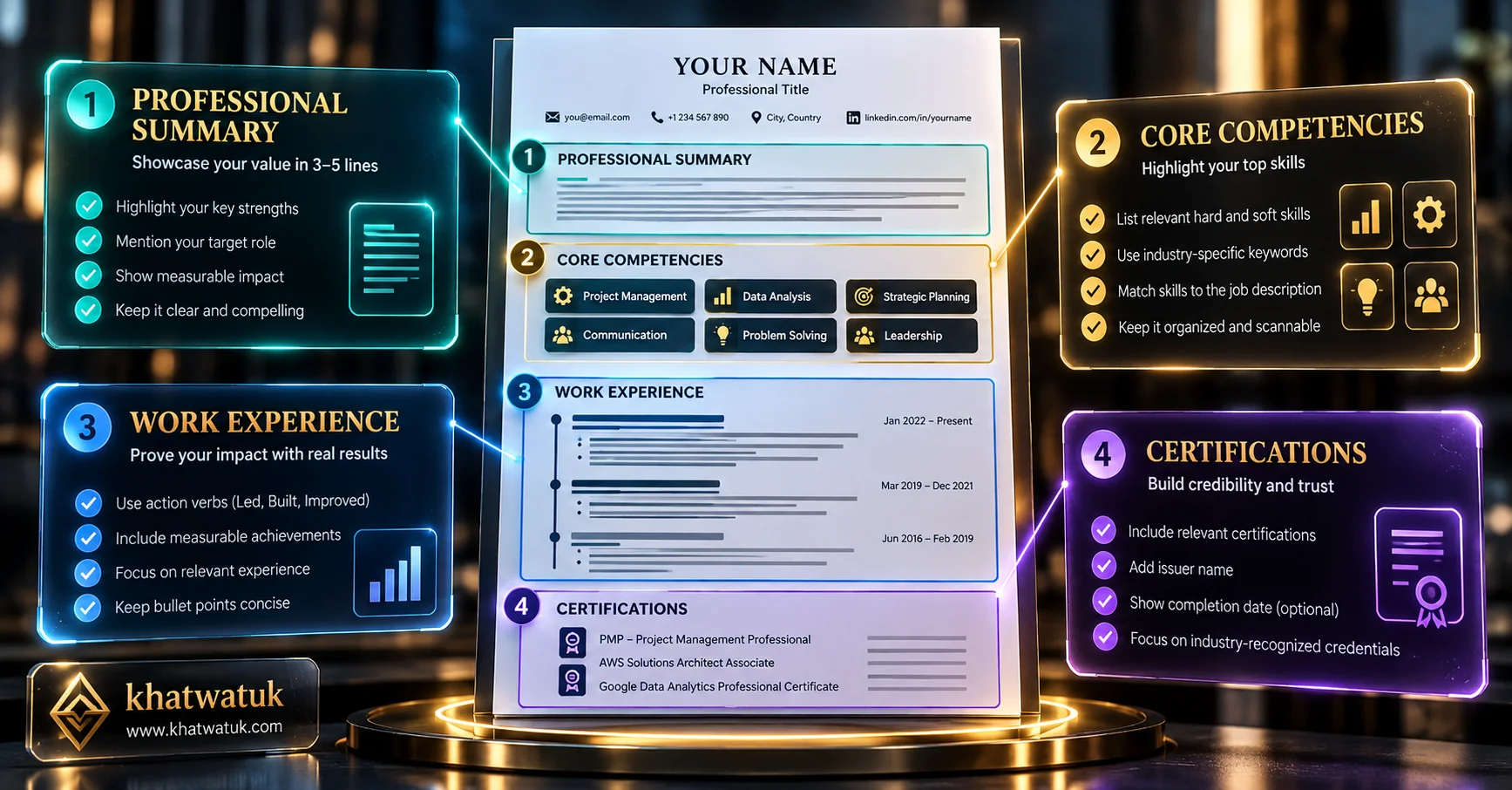
Distributing keywords across the Professional Summary, Core Competencies grid, Experience Bullets, and Certifications ensures complete ATS coverage.
Zone 1: Professional Summary (The Top-Third Hook)
The top third of your resume is the most valuable visual real estate. Your summary should consist of a tight 3 to 4 line paragraph that explicitly incorporates your primary target job title, your total years of experience, and 2 to 3 core hard skills listed as non-negotiable requirements in the employer's posting. For example: "Senior DevOps Engineer with 7+ years of experience architecting scalable AWS cloud infrastructure, specializing in Kubernetes container orchestration and Terraform CI/CD automation."
Zone 2: Core Competencies & Skills Grid (The ATS Fast-Track)
Positioned immediately beneath your summary, a dedicated Skills or Core Competencies section acts as an unambiguous parsing table for ATS scanners. Present your skills as clean text bullet points arranged in a simple 2 or 3-column layout. Avoid progress bars, percentage icons, or rating bubbles (e.g., "Python: 4/5 stars"), as ATS parsers cannot read graphical elements. For candidates building documents from scratch, utilizing a validated best ATS-friendly resume builder guarantees that section headers and skill tables parse cleanly without character encoding corruptions.
Zone 3: Work Experience Bullets (The Contextual Proof Engine)
This is the decisive section where keywords transform from passive claims into proven professional accomplishments. Recruiters scrutinize work experience bullets to verify how you applied the hard skills listed in your skills grid. Every high-priority keyword from the job posting should appear at least once within your work history, embedded naturally into an achievement statement that illustrates business impact.
Zone 4: Education, Certifications & Technical Tools
Certain industries (such as cloud computing, cybersecurity, nursing, and financial advisory) require non-negotiable professional licenses and software credentials. Always list the official formal name of the credential alongside its recognized industry acronym (for example: "Project Management Professional (PMP)" or "AWS Certified Solutions Architect – Associate"). Including both variations guarantees discovery regardless of whether a recruiter queries the full title or the short acronym.
The High-Impact Bullet Formula: Action Verb + Keyword + Metric
The most common tailoring mistake job seekers make is list-dumping keywords without operational context. Writing "Responsible for Google Ads and SEO" technically includes two keywords, but provides zero proof of competence. High-converting resumes utilize a proven modular achievement formula that embeds technical terms seamlessly into quantified results.

The most effective resume bullets combine a decisive action verb, an exact hard skill keyword, operational context, and measurable business impact.
The Universal Keyword-Integration Formula
[Decisive Action Verb] + [Target Hard Skill Keyword] + [Operational Context / Scope] + [Quantified Business Impact / Metric]
To see how this structural formula upgrades weak bullet points into authoritative career proof, examine these before-and-after transformations across four major employment sectors:
1. Software Engineering & Cloud Infrastructure
- Before (Passive): Handled Docker containers and AWS servers for company web app.
- After (Optimized): Architected scalable Docker container environments on AWS ECS, automating microservice deployments and reducing server latency by 28% across 1.2M daily active users.
2. Digital Marketing & Growth
- Before (Passive): Did paid search campaigns and managed marketing budget.
- After (Optimized): Orchestrated multi-channel Google Ads and Performance Max campaigns with a $45,000 monthly ad spend, decreasing Customer Acquisition Cost (CAC) by 22% while scaling inbound pipeline revenue by $310,000.
3. Healthcare & Clinical Management
- Before (Passive): Input patient records and monitored vitals in the ICU.
- After (Optimized): Administered acute clinical care and digitized patient records using Epic EHR software across a 24-bed ICU, maintaining 100% HIPAA compliance and cutting medication charting errors by 18%.
4. Financial Analysis & Modeling
- Before (Passive): Built Excel financial models and created quarterly budget reports.
- After (Optimized): Constructed three-statement dynamic financial models in Power BI and Advanced Excel, streamlining quarterly budget variance forecasting and identifying $420,000 in redundant operational overhead.
Notice how each optimized bullet seamlessly weaves in core technical keywords while providing hard numerical proof. When evaluating your resume bullets, comparing your phrasing directly against top-ranking benchmarks in our best AI resume builder in 2026 hub ensures your achievements reflect the high standards modern recruiters expect.
Keyword Stuffing vs Strategic Placement: Avoiding the Algorithmic Penalty
In the pursuit of high match scores, many candidates make the fatal mistake of keyword stuffing—artificially packing terms into their document without grammatical coherence. Algorithmic screening tools have evolved dramatically; repeating keywords unnaturally or attempting deceptive formatting tricks will severely damage your job search.
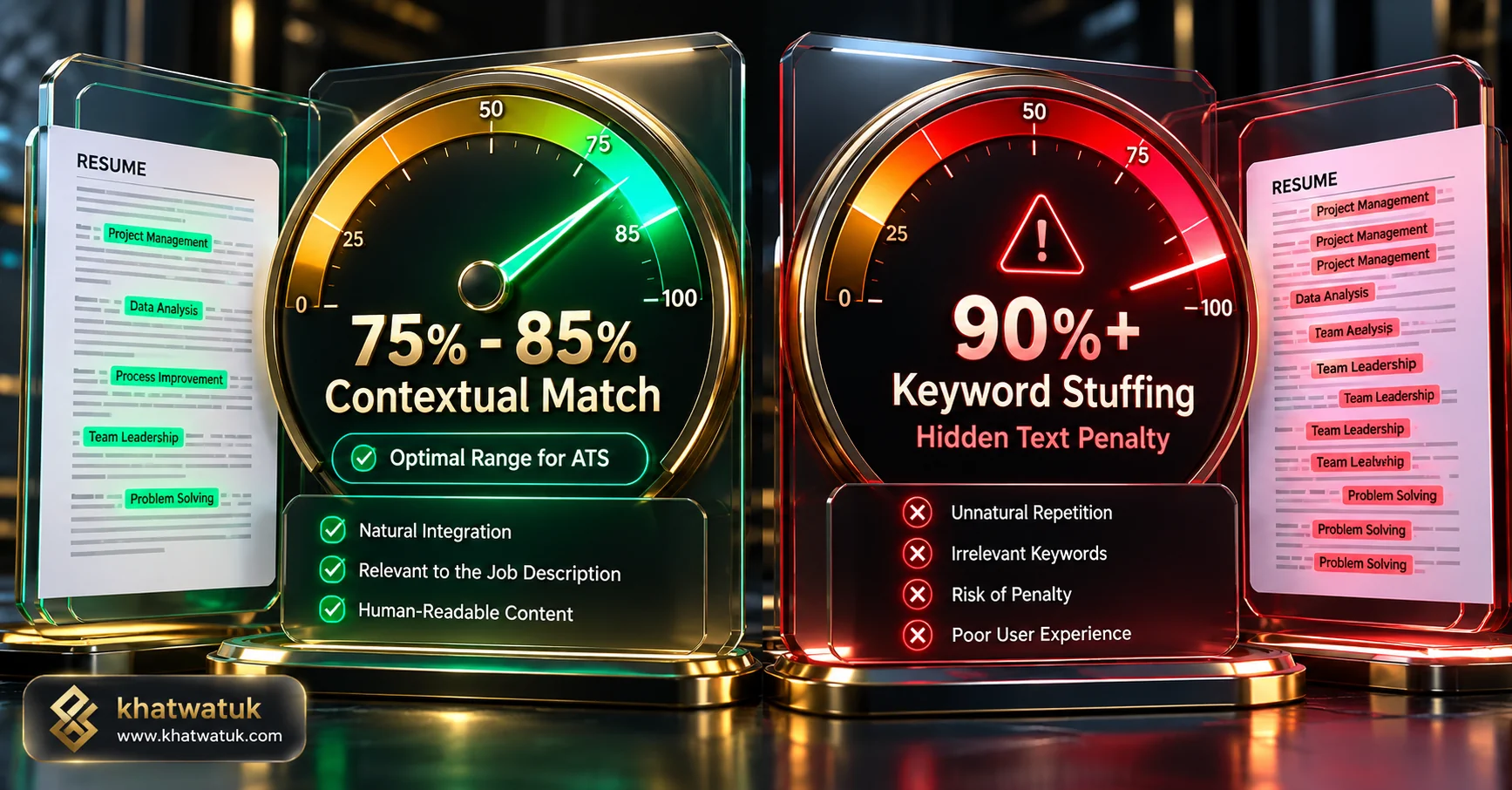
Over-optimizing with keyword stuffing triggers automated ATS parsing penalties, while contextual keyword integration achieves the optimal 75% to 85% match score.
Debunking the "White Font" Keyword Hack
A pervasive social media myth advises applicants to copy an entire job posting into their resume footer and change the font color to white in 1pt size. The theory suggests the ATS will read the invisible keywords while human eyes see nothing. In reality, modern ATS parsers (like Workday, Taleo, and Greenhouse) extract text into raw ASCII data strings, completely ignoring CSS styling, text colors, and font sizes. When a recruiter opens your parsed candidate profile, the entire copied job ad appears as a conspicuous block of unformatted text. This immediately triggers blacklisting for deliberate candidate deception.
The 75% to 85% Match Score Sweet Spot
When running your resume through diagnostic scanners like Jobscan, aim for an ATS match rate between 75% and 85%. Chasing a 95% to 100% score forces you to include marginal, irrelevant terms, resulting in an unnatural, robotic document. An 80% match score is more than sufficient to rank among the top 5% of applicants in an ATS database while preserving the authentic, human tone necessary to impress the hiring manager.
Keyword Frequency Benchmarks
How often should a keyword appear? A safe benchmark is to mention high-priority core technical skills 2 to 3 times across your entire resume (e.g., once in your Summary, once in your Skills grid, and once or twice inside your Work Experience bullets). Repeating any single keyword 7 or 8 times looks spammy and adds zero additional algorithmic weighting in modern semantic ranking engines.
Top Tools to Find, Extract, and Verify Resume Keywords
Extracting keywords manually can be time-consuming. You can combine traditional deconstruction methods with automated software to ensure comprehensive coverage before submitting your application.
To extract keywords manually without paying for software, collect 3 to 5 job descriptions for your target role. Paste the text into a free word cloud generator or spreadsheet, and identify terms that repeat across multiple postings. Highlight hard technical tools, required certifications, and core methodologies. Then, cross-reference this list against your current resume to spot critical omissions.
For automated precision, dedicated keyword scanners provide instant side-by-side match reports. As analyzed in our breakdown of Jobscan vs Teal, choosing between specialized frequency scanners and all-in-one job search CRMs depends largely on your application volume. If you prefer free standalone diagnostic tools, our evaluation of the best free ATS scanner platforms highlights accessible options that do not enforce rigid paywalls after your first scan.
Furthermore, if you are deciding between different resume builders, reviewing our side-by-side analysis of Teal vs Rezi will help you determine whether an interactive career management suite or a dedicated plain-text ATS generator best suits your career goals. Before submitting your optimized application, verify that your document parses cleanly without formatting traps by following our step-by-step tutorial on how to test your resume against ATS.
Frequently Asked Questions (FAQ)
Below are direct, expert answers to the most common questions job seekers ask about resume keywords and Applicant Tracking Systems:
Where is the best place to put keywords on a resume?
The best approach is distributing keywords across four key sections: the Professional Summary (for immediate recruiter hook), the Core Competencies grid (for easy ATS parsing), the Work Experience bullets (to prove context and measurable results), and the Education/Certifications section (for official credentials).
How many times should a keyword be repeated on a resume?
High-priority technical skills should appear 2 to 3 times across your document (e.g., once in your skills grid and once or twice inside achievement bullets). Repeating a keyword more than 4 or 5 times triggers keyword stuffing warnings and adds zero algorithmic benefit.
What is keyword stuffing on a resume and does ATS penalize it?
Keyword stuffing is the practice of loading a resume with repetitive, out-of-context terms or hidden text in an attempt to manipulate search rankings. Modern ATS parsers convert text to raw data strings, exposing spam blocks to recruiters and resulting in immediate candidate disqualification.
How do I find the right keywords in a job description?
Carefully review the 'Requirements', 'Qualifications', and 'Responsibilities' sections of the job posting. Look for hard skills, tools, programming languages, and industry methodologies that appear multiple times or are listed as non-negotiable minimum qualifications.
Can I put keywords in white font to trick the ATS?
No. ATS parsers strip all color and formatting, rendering white text completely visible as plain text in the recruiter's portal. This deceptive tactic is immediately flagged by hiring software and leads to automatic rejection.
What is the difference between hard skills and soft skills keywords?
Hard skills are teachable, measurable abilities such as Python, SEO, financial modeling, or AWS administration. Soft skills are interpersonal traits such as leadership or communication. Recruiters filter ATS databases primarily using hard skills; soft skills should be demonstrated through achievement results rather than simple word lists.
Should I use exact match keywords or synonyms for ATS?
Always prioritize exact phrasing as written in the job description (e.g., if the ad specifies 'Project Management', use that exact term). Where applicable, include both the full term and its acronym (e.g., 'Certified Public Accountant (CPA)') to cover both search methods.
Can AI tools like ChatGPT or Jobscan find resume keywords automatically?
Yes. Dedicated platforms like Jobscan and Teal compare your resume against a job description in seconds, generating a breakdown of missing hard skills and match percentages. General AI tools like ChatGPT can also extract keywords when prompted with the job description text.
