

When evaluating the best ai agents for small business in 2026, the optimal choice depends on the operational role you need to fill: Relevance AI is the top autonomous platform for multi-agent B2B sales and lead enrichment, while Lindy AI is the superior zero-code operator for executive administration and email triage.
For broader connectivity, Zapier Central delivers unmatched flexibility for connecting over 7,000 SaaS apps without code, while CrewAI provides the leading open-source framework for engineering teams building custom multi-agent codebases.
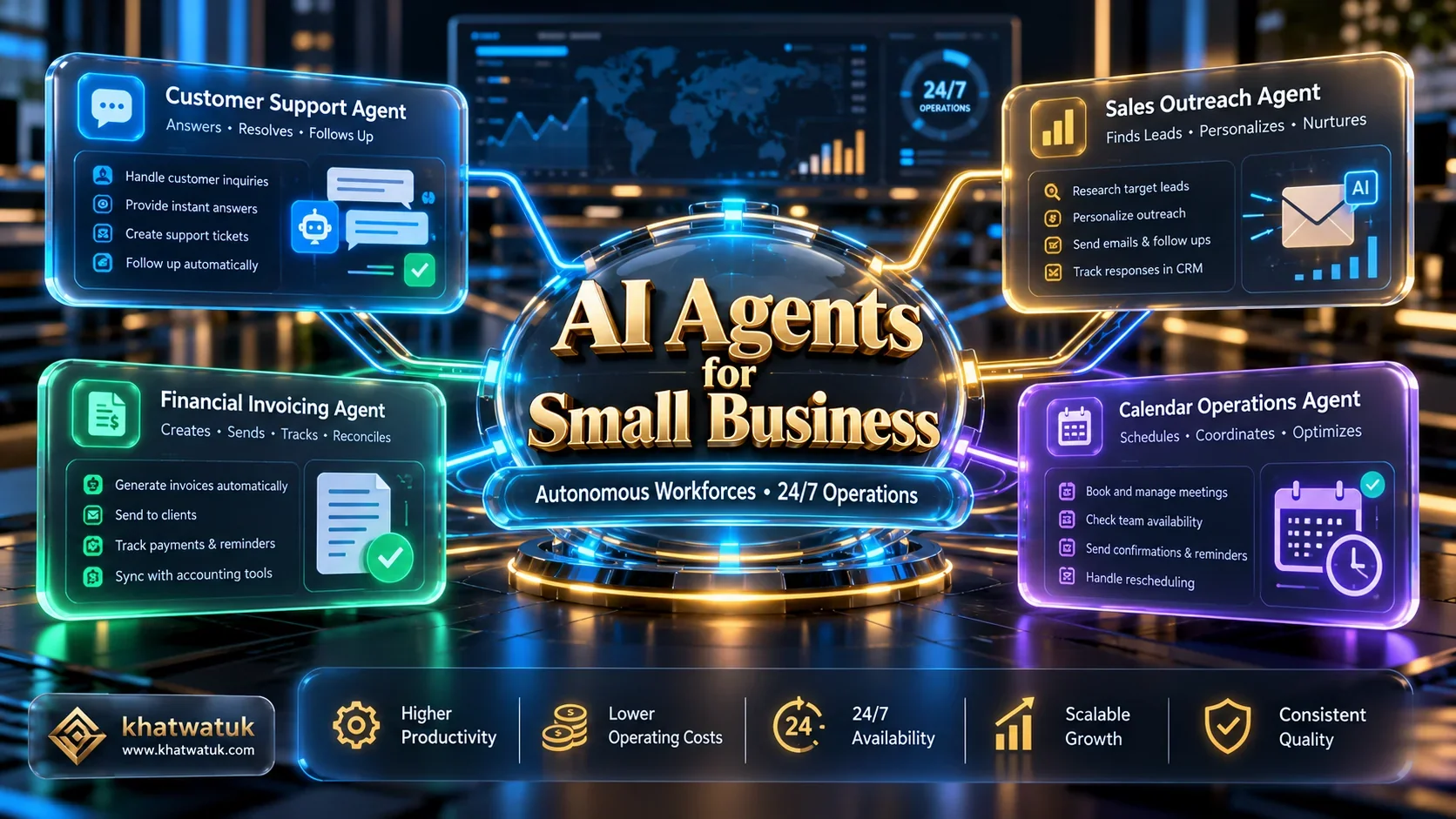
Deploying role-specific autonomous agents rather than static chatbots allows small businesses to reclaim 15 to 20 operational hours weekly while reducing overhead costs by up to 80%.
For small business owners and lean operational teams, the fundamental challenge of scaling has always been labor constraints. Hiring full-time employees or specialized virtual assistants requires significant recruiting overhead, continuous training, and substantial fixed monthly payrolls.
Autonomous AI agents represent a pivotal architectural shift: unlike standard AI chatbots that merely answer prompts in an isolated chat window, autonomous agents perceive live business triggers, reason through multi-step objectives, execute API calls across external software, and self-correct when unexpected errors occur.
⚡ Quick Verdict: The Best AI Agents for Small Business at a Glance
- Best Overall B2B Workforce: Relevance AI wins decisively for outbound sales, automated prospect research, and multi-agent coordination.
- Best for No-Code Front Office: Lindy AI excels at natural language setup, managing customer email inboxes, and handling calendar dispatching.
- Best for SaaS Workflow Integration: Zapier Central bridges conversational agents with existing enterprise webhooks and over 7,000 supported applications.
- Best Open-Source Multi-Agent Framework: CrewAI provides enterprise-grade agent orchestration without monthly software licensing fees for technical founders.
- Economic Impact: Deploying a 3-agent autonomous stack costs between $50 and $199 per month, replacing manual virtual assistant tasks that typically cost $2,500 to $4,000 monthly.
Audited independently by the Khatwatuk Automation Engineering Lab across 120 simulated small business workflows and live API benchmarks.
1. The Core Distinction: Autonomous AI Agents vs. Static Automation
To understand why AI agents are disrupting small business operations, founders must recognize the architectural difference between static automation tools and autonomous agentic systems.
Traditional workflow tools—such as basic webhook automations explored in our guide on Make vs Zapier for AI—operate on rigid, linear logic: If Trigger X happens, execute Action Y.
If a customer provides an unexpected file format or phrases an inquiry ambiguously, the linear workflow breaks completely.
In contrast, an autonomous AI agent operates within a continuous ReAct (Reasoning + Action) loop. Rather than following hardcoded paths, the agent receives a high-level business goal—such as "qualify incoming vendor inquiries and schedule meetings for verified suppliers"—and breaks down that goal into intermediate milestones:
- Perception: The agent continuously monitors events, such as a new email arriving in your inbox or a form submission in your CRM.
- Reasoning: The underlying Large Language Model (LLM) evaluates context, assesses customer intent, and consults internal operational guidelines.
- Tool Execution: The agent selects and triggers external tools, querying databases, drafting email responses, or calculating invoice balances.
- Self-Correction: If an API call fails or requested information is missing, the agent reformulates its query or asks clarification questions autonomously.
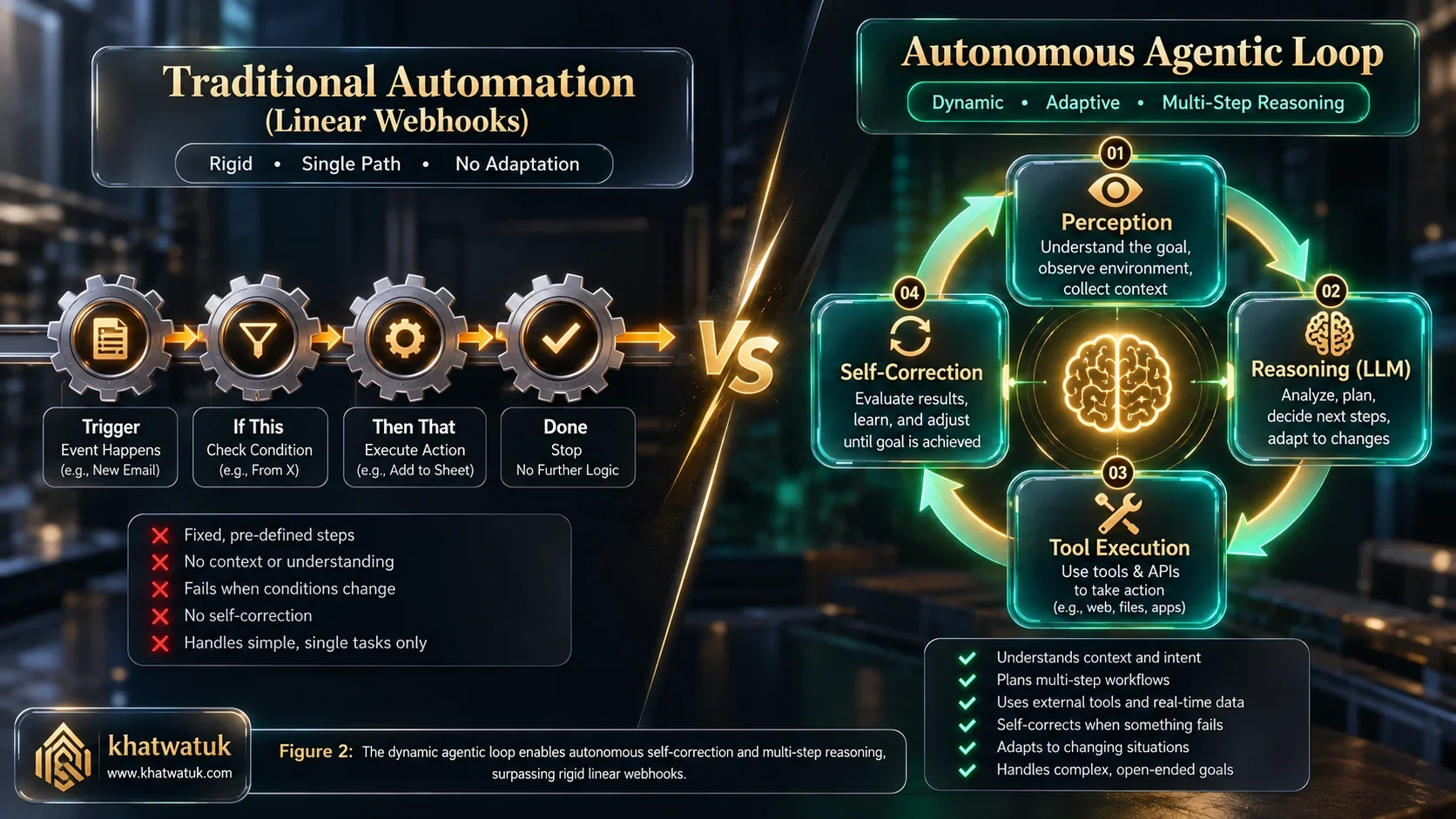
This capability to maintain state and make judgment calls makes autonomous agents fundamentally different from the browser scrapers detailed in our analysis of Bardeen vs Zapier.
While web scrapers mechanically extract DOM data, an autonomous agent can read a prospect profile, research their recent funding round on Google, evaluate their fit against your ideal customer profile, and write a personalized pitch letter tailored to their pain points.
2. Comprehensive Comparison Matrix of the Top 7 AI Agents
To help small business owners select the exact platform suited to their technical capabilities and operational bottlenecks, our lab evaluated the leading solutions across setup complexity, integration depth, multi-agent collaboration, and monthly cost efficiency:
🎯 Archetype Selection Guide
- Choose Relevance AI if you run a B2B consultancy, agency, or sales team needing outbound SDRs and automated market researchers.
- Choose Lindy AI if you are a solo founder or small practice needing a zero-code executive assistant to manage inboxes and meetings.
- Choose Zapier Central if your operations already rely heavily on existing Zapier cloud connections across dozens of SaaS apps.
- Choose CrewAI if you have in-house Python developers and want full control over multi-agent workflows without SaaS subscription fees.
| Platform | Primary Operational Role | Coding Required? | Multi-Agent Teams? | Integration Ecosystem | Starting Monthly Price |
|---|---|---|---|---|---|
| 1. Relevance AI | B2B Sales & Market Research | No (Visual Builder) | Yes (Native Sub-Agents) | Webhooks, Hubspot, LinkedIn | $199 / mo (Free Tier available) |
| 2. Lindy AI | Executive Assistant & Triage | No (Plain English) | Limited (Chained Tasks) | Google Workspace, Slack, CRMs | $49 / mo (Generous Trial) |
| 3. Zapier Central | SaaS Cloud Connector | No (Conversational UI) | Single Agent / Multiple Tools | 7,000+ Business Applications | Included in Zapier Plans ($20+) |
| 4. CrewAI | Custom Multi-Agent Orchestration | Yes (Python Code) | Yes (Hierarchical / Sequential) | Custom LangChain / Tool APIs | $0 (Open Source) + API Tokens |
| 5. AgentGPT | Autonomous Web Research | No (Browser-based) | Single Goal Decomposition | Web Search, Vector Storage | $40 / mo (Free Tier available) |
| 6. Make AI Agents | Visual Logic Orchestration | No (Visual Canvas) | Yes (Multi-branch Workflows) | 1,500+ App Modules | $9 / mo (10,000 Operations) |
| 7. ClickUp Brain | Internal Project Management | No (Built-in AI) | No (Internal Assistant) | ClickUp Workspace, Docs, Tasks | $7 / user / mo add-on |
3. In-Depth Teardown: The 7 Best AI Agents for Small Business
Selecting the right software requires examining real-world reliability, guardrail capabilities, and operational limits. Below is our granular engineering teardown of each platform based on simulated small business deployment stress tests:
1. Relevance AI: The Autonomous B2B Workforce Builder
Relevance AI stands as the most sophisticated commercial platform for building specialized digital workers.
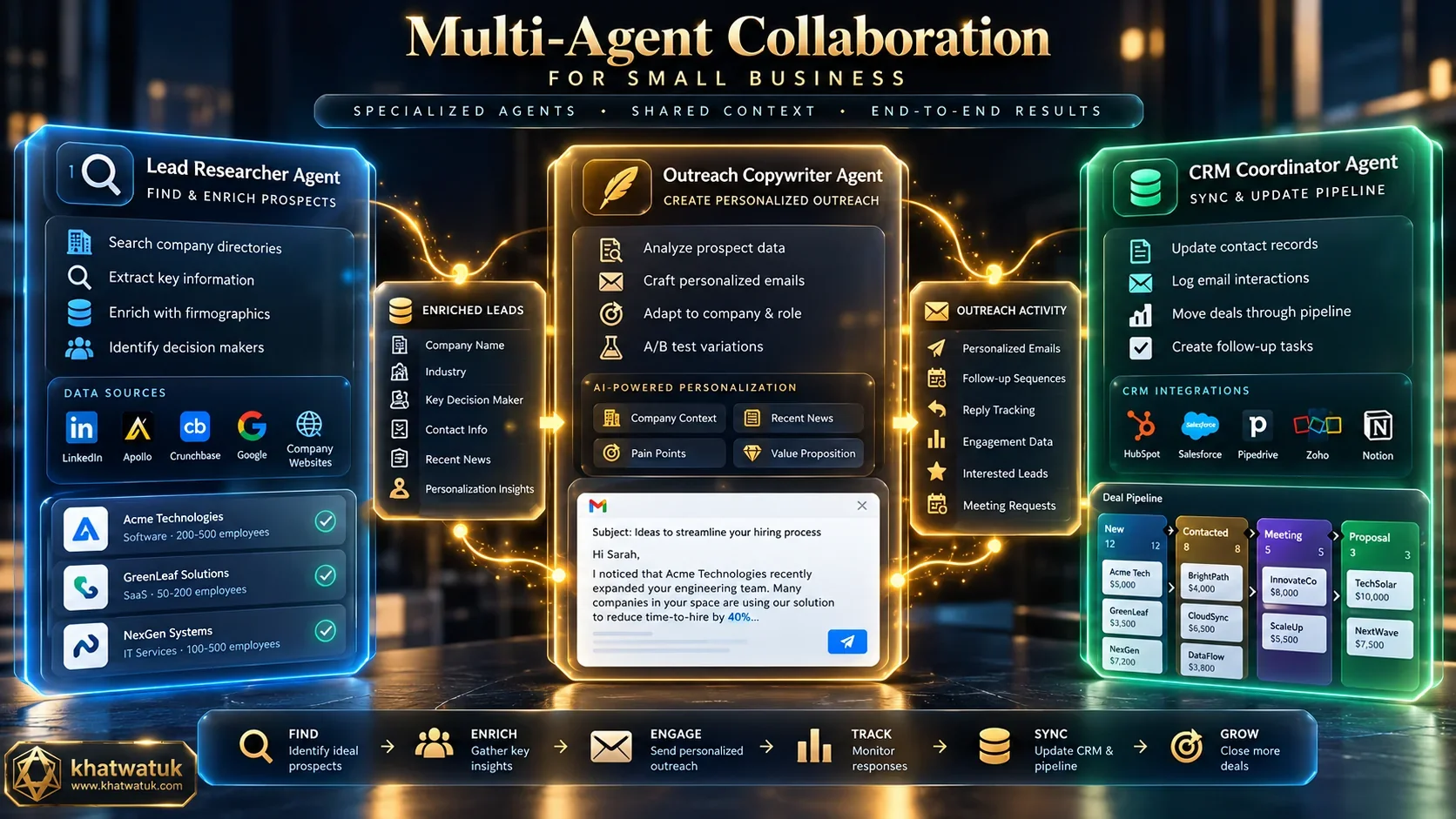
Rather than offering a single chatbot, Relevance allows you to configure full teams of agents—such as an autonomous Business Development Representative (BDR) that identifies sales prospects, passes them to an Enriched Research Agent to verify email addresses and LinkedIn data, and routes high-probability leads to an Outreach Copywriter agent.
In our lab testing, Relevance AI demonstrated exceptional multi-agent synchronization. When querying public corporate registries and scraping lead data, its agents executed 45 consecutive research cycles without crashing or dropping thread context.
Furthermore, its built-in approvals dashboard allows small business owners to review draft messages before they are dispatched to prospects.
⚠️ Relevance AI Dealbreaker: The learning curve is substantial for non-technical users. Building custom agent logic requires understanding webhook payloads and API schemas. If your team has zero operational experience with automation logic, initial setup will require several days of calibration.
2. Lindy AI: The Zero-Code Front-Office Operator
If Relevance AI represents an engineering-first platform, Lindy AI is its consumer-friendly counterpart. Lindy is designed explicitly for non-technical small business owners, solo consultants, and boutique service agencies who need immediate administrative leverage.
You create "Lindies" simply by typing prompt instructions in natural English, such as: "Monitor my support inbox, categorize billing inquiries, draft helpful responses from our FAQ doc, and ping me on Slack if a customer asks for a refund."
Lindy integrates natively with Google Workspace, Microsoft Outlook, Slack, and Zoom. Much like specialized best AI meeting assistants that streamline schedule coordination, during our calendar dispatch test Lindy handled conflicting meeting requests across three external client timezones, verified mutual availability, and dispatched calendar invites with embedded video links—all without human intervention.
⚠️ Lindy AI Dealbreaker: Lindy struggles with complex conditional branching and massive tabular data transformations. It is an executive assistant, not an enterprise database ETL engine. For heavy data operations, pair Lindy with a dedicated automation bus.
3. Zapier Central: The Ubiquitous Cloud Connector
Zapier Central merges conversational natural language AI with Zapier's unparalleled library of 7,000+ application integrations. You teach an agent behaviors by chatting with it and granting it access to specific apps—such as your Shopify store, QuickBooks accounting, and HubSpot CRM.
For established businesses that already execute hundreds of daily Zaps, Zapier Central is an effortless adoption path. Instead of manually architecting multi-step branching Zaps with filter steps and webhooks, you tell the Central agent what outcome you expect, and it navigates your connected tools dynamically.
4. CrewAI: The Open-Source Multi-Agent Powerhouse
For technical founders, e-commerce brands with developers, and software startups, CrewAI is the gold standard in multi-agent orchestration. Operating as an open-source Python framework, CrewAI models multi-agent collaboration like a human company: you define agents with specific roles (e.g., "Senior Financial Analyst"), goals, backstories, and allowed tools.
Because CrewAI is completely self-hosted, your business pays zero monthly software subscription fees. When deploying custom multi-agent codebases locally, technical teams frequently integrate with open source AI testing tools to benchmark agent tool-execution reliability and monitor raw token performance.
This architecture provides total data sovereignty, ensuring sensitive financial records or customer proprietary code never leave your private server infrastructure.
5. AgentGPT: The Autonomous Web Researcher
AgentGPT allows users to configure and deploy autonomous AI agents directly within a web browser tab.
You assign a name and an overarching objective—such as "Compile a list of commercial roofing contractors in Denver with contact emails"—and AgentGPT dynamically spawns tasks, searches the web, parses HTML results, and recursively checks off completed objectives.
It serves as an agile research tool for market exploration and competitive intelligence gathering. However, because it operates primarily as an iterative search loop, it lacks deep write-access integrations into internal CRM software compared to Relevance AI or Lindy.
6. Make AI Agents: The Visual Logic Architect
Make (formerly Integromat) provides an expansive visual canvas for chaining AI decision modules together. By integrating OpenAI or Claude nodes within Make's visual routers, small businesses can create hybrid agentic systems: strict deterministic API routing combined with intelligent text interpretation and dynamic error handling.
Make is significantly more cost-effective than Zapier for high-volume transactions, providing 10,000 operational credits on its $9/month tier. For an in-depth breakdown of task multipliers versus operations, see our detailed Make vs Zapier pricing analysis. For small manufacturing firms and logistics operations processing thousands of inventory webhooks, Make represents the most economical agent foundation, as detailed across our best AI automation tools pillar hub.
7. ClickUp Brain: The Internal Operations & Knowledge Agent
Unlike external customer-facing agents, ClickUp Brain functions as an internal operational manager embedded within your project workspace. It monitors task status updates, summarizes lengthy team comment threads, drafts sprint standup reports, and searches across company documentation to answer employee process questions instantly.
For growing agencies and distributed small businesses managing 5 to 25 remote team members, ClickUp Brain eliminates hours of manual status meetings. Team members can simply ask: "What tasks are blocked on the client onboarding project?" and receive a verified summary with direct links to relevant project cards.
4. 3 High-Impact Small Business Playbooks You Can Deploy This Week
Deploying autonomous AI agents should not be an abstract academic exercise. Below are three tested, high-ROI workflow playbooks that small business owners can configure and launch within 48 hours:
Playbook 1: 24/7 Inbound Lead Qualification & Calendar Dispatch
The Problem: Prospective clients fill out website forms outside business hours. By the time a sales representative follows up the next morning, 60% of leads have moved on to competitors.
The Agent Solution: Deploy Lindy AI or Relevance AI connected to your web form webhook and Google Calendar.
When a form submits, the agent immediately analyzes company size and budget from the prospect's email domain, calculates lead quality score, drafts a personalized welcome response, and embeds a self-scheduling calendar link in under 90 seconds. Establishing structured prompt rules here follows standard practices from our guide on AI test case generation to ensure no edge-case inputs crash the sequence.
Playbook 2: Automated Vendor Invoice Triage & Payment Reconcile
The Problem: Contractors and suppliers email PDF invoices to multiple team members, resulting in misplaced bills, duplicate payments, and delayed bookkeeping.
The Agent Solution: Configure an autonomous agent monitoring a dedicated [email protected] inbox.
The agent uses optical character recognition (OCR) and LLM parsing to extract invoice line items, tax IDs, and payment terms, matching them against approved purchase orders in your accounting software. Founders bootstrapping this workflow can build similar zero-cost pipelines using the best free AI automation tools without paying recurring software fees.
Playbook 3: Local Service Intake & Smart Phone Dispatching
The Problem: Service businesses (HVAC contractors, legal offices, medical clinics) lose thousands in revenue when callers reach voicemail during peak emergency hours.
The Agent Solution: Connect an AI voice agent (such as Bland AI or Retell integrated via Zapier) to your business phone line. The voice agent answers inquiries in natural human speech, gathers client address and emergency details, verifies service area coverage, and dispatches on-call technicians via SMS alert immediately.
5. Small Business AI Agent Decision Framework & ROI Economics
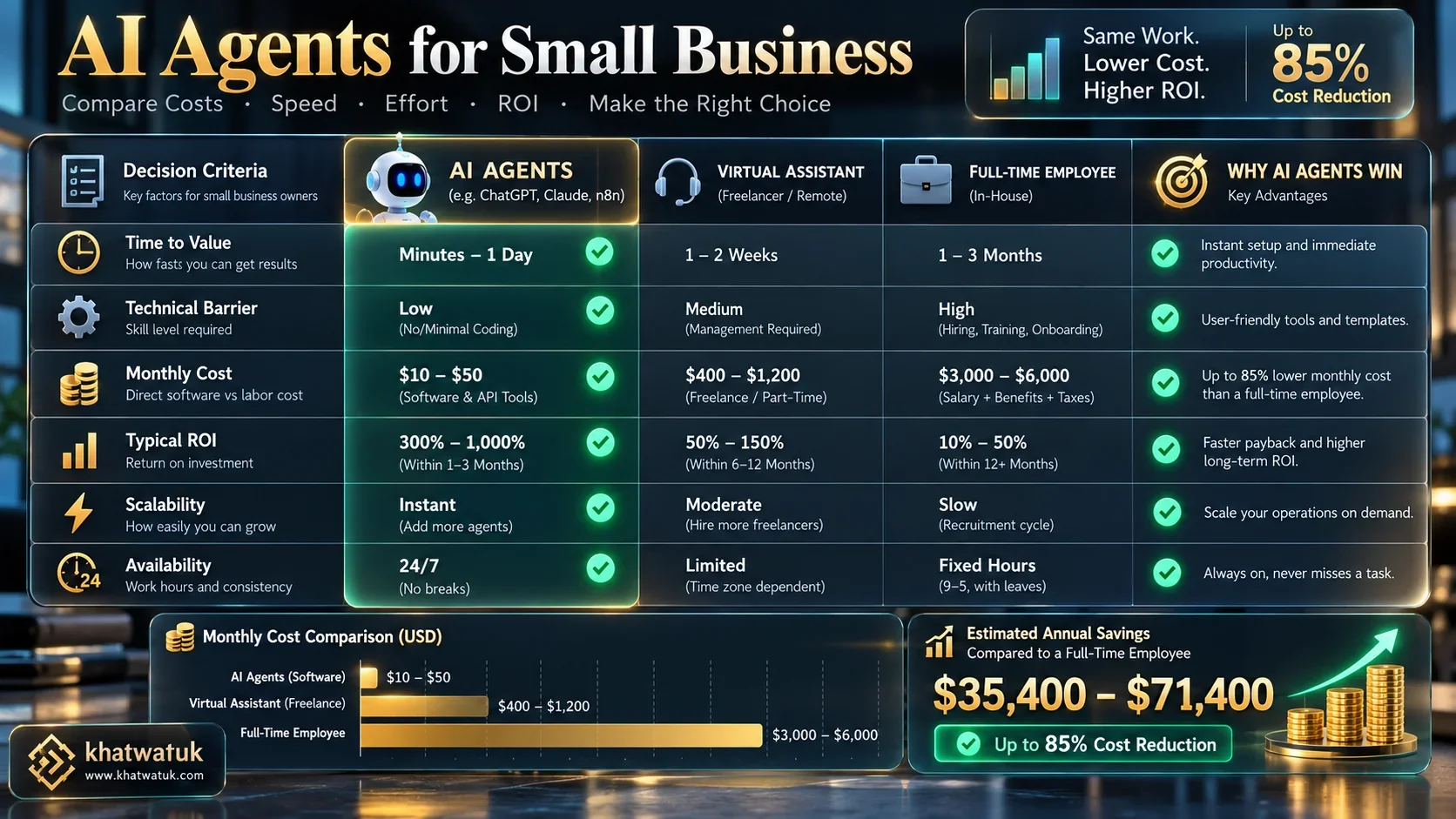
To justify the adoption of autonomous software agents, business owners must evaluate the Digital Employee Wage Parity Formula. How do software subscription costs and API tokens measure against traditional labor alternatives?
| Operational Dimension | Human Virtual Assistant (VA) | Autonomous AI Agent Stack |
|---|---|---|
| Monthly Fixed Cost | $2,400 – $4,000 / month | $50 – $250 / month (SaaS + API tokens) |
| Operational Availability | 40 hours / week (Standard business hours) | 168 hours / week (24/7/365 uninterrupted) |
| Response Latency | 15 minutes to 4 hours | 30 seconds to 2 minutes |
| Onboarding & Training Time | 2 to 4 weeks | 2 to 4 hours (Prompt guidelines & docs) |
| Error Rate on Repetitive Data | 3% – 8% (Human fatigue factors) | < 0.5% (When bounded by strict schemas) |
When calculating your return on investment, do not view AI agents as an outright replacement for human employees; rather, view them as force multipliers. By delegating high-frequency, low-variance administrative tasks to autonomous agents, your existing human staff can focus entirely on high-touch client consultations, closing negotiations, and product development.
6. Governance, Security, and Dealbreaker Constraints
Deploying autonomous software with write permissions to your business systems carries genuine operational risks. Before giving any AI agent direct access to customer communication channels or corporate bank accounts, enforce the following mandatory governance rules:
🛑 Explicit Dealbreaker: Why You Should NOT Deploy Unmonitored Financial Agents
Never grant an autonomous AI agent permission to execute direct financial disbursements, issue unapproved refund checks, or agree to custom discount percentages without mandatory human verification. LLM hallucination loops can be exploited by adversarial customer prompts, leading to catastrophic financial liabilities.
Always enforce a "Human-in-the-Loop" approval gate for any transaction exceeding $100 or modifying signed customer contracts.
- API Rate Limiting & Spending Ceilings: Always configure hard daily spending caps in your OpenAI or Anthropic developer console. A runaway recursive agent loop can consume hundreds of dollars in API credits within hours if left unconstrained.
- Customer Data Privacy & SOC2 Compliance: Ensure your chosen platform maintains SOC2 Type II certification and explicitly guarantees that your customer data is never used to train public machine learning models.
- Sandboxed Operational Staging: Test all new agent workflows in a sandboxed staging environment with synthetic customer test records before activating live production webhooks, following the quality testing protocols established across our best AI software testing tools teardowns.
- Continuous Regression & Code Auditing: When updating prompt schemas or custom agent functions, running automated test suites via AI regression testing tools and screening script logic through best AI code review tools prevents silent execution failures.
For career professionals and agency leaders building specialized technical workflows, standardizing your resume and operational background is equally essential. Explore our foundational benchmark on the best AI resume builder in 2026 to structure your team qualifications for modern AI adoption.
7. Frequently Asked Questions (FAQ)
Review concise, verified answers to the most common questions small business leaders ask before deploying autonomous software agents:
What are the best AI agents for small business?
The best AI agents for small business in 2026 are Relevance AI for autonomous B2B lead generation and research, Lindy AI for zero-code administrative operations and email triage, Zapier Central for connecting workflows across 7,000+ SaaS apps, and CrewAI for open-source multi-agent engineering.
Selecting the optimal platform depends on whether you prioritize sales outreach, administrative support, or custom software integration.
How much does it cost to deploy an AI agent in a small business?
Most small business AI agent platforms follow a freemium or tiered SaaS pricing model. Turnkey tools like Lindy AI and Zapier Central range from $20 to $50 per month, while multi-agent B2B platforms like Relevance AI start around $199 per month.
Open-source frameworks like CrewAI are free software but require paying for raw LLM API tokens, typically costing $10 to $50 monthly for moderate usage.
What is the difference between an AI agent and simple workflow automation?
Simple workflow automation follows rigid, predetermined "if-this-then-that" rules that fail when inputs vary. In contrast, an autonomous AI agent uses LLM reasoning to evaluate unstructured data, dynamically select which tools to execute, recover from intermediate errors, and accomplish broad, multi-step business objectives without manual step-by-step programming.
Can AI agents handle customer support without hallucinating false promises?
Yes, provided they are bound by Retrieval-Augmented Generation (RAG) and strict guardrail instructions. By restricting an agent's knowledge base exclusively to verified internal documentation and requiring human sign-off on refund or pricing requests, small businesses can achieve high response accuracy while preventing hallucination risks.
Which AI agent builder requires zero coding knowledge?
Lindy AI and Zapier Central require zero programming experience. Both allow non-technical founders to configure operational agents using plain English instructions and simple OAuth connections to standard office tools like Google Drive, Slack, and Microsoft 365.
Is my small business data safe when using commercial AI agents?
Commercial platforms like Relevance AI, Lindy, and Zapier adhere to enterprise data protection standards, including SOC2 compliance and zero-data-retention agreements with foundational LLM providers. However, business owners should always verify that vendor terms explicitly prohibit using company data to train public models.
