

In any direct comparison of make vs zapier pricing, Make is overwhelmingly more cost-effective across every volume tier. Make starts at $9/month for 10,000 operations, whereas Zapier charges $19.99/month for just 750 tasks. At 100,000 monthly executions, Make costs roughly $59/month compared to Zapier’s $489/month—an 88% reduction in recurring automation expenses.
Workflow automation software is the invisible engine powering modern digital enterprises. From lead routing and AI data enrichment to financial syncing and customer onboarding, automations execute hundreds of times per day. Yet, many organizations fall into the trap of evaluating automation software based purely on headline starting prices ($9/mo vs. $19.99/mo) without analyzing the fundamental underlying currency: Tasks vs. Operations. This oversight leads to punishing monthly overage charges, unexpected feature gating, and bills that inflate by thousands of dollars annually.
⚡ Quick Verdict: Make vs. Zapier Pricing at a Glance
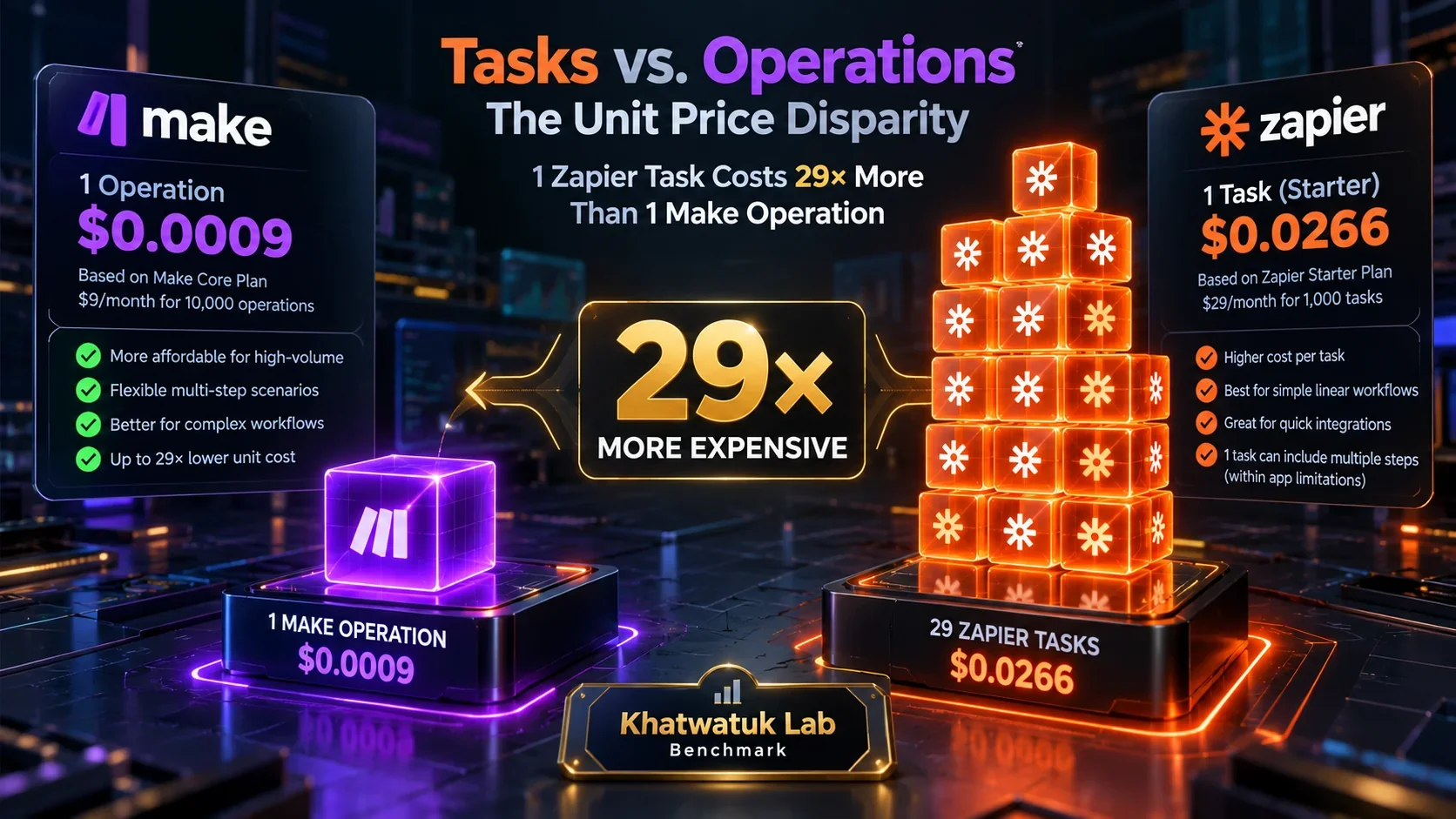
- Unit Price Difference: 1 Make Operation costs approximately $0.0009, while 1 Zapier Task costs approximately $0.0266 on introductory tiers (a 29x price disparity per unit).
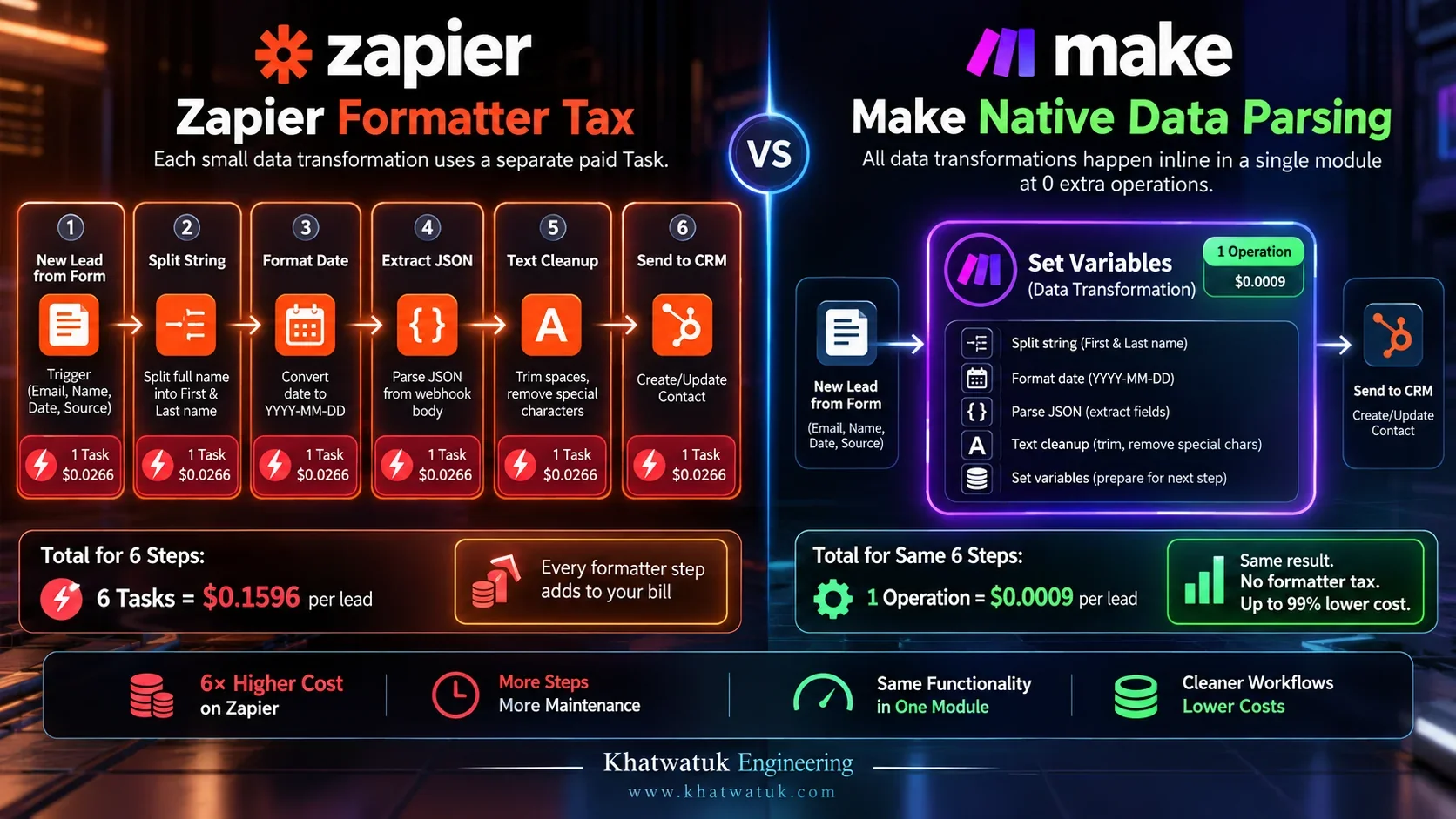
- The Formatter Tax: Zapier bills 1 task every time you use "Formatter by Zapier" to split text or format dates. Make performs all data manipulation inline at 0 extra operations.
- Feature Gate Lockouts: Custom webhooks and conditional branching (Paths) require Zapier’s $49/mo plan. Make includes both features in its free plan.
- Annual TCO Winner: Scaling to 100k monthly executions saves $5,160 every year on Make.
Audited independently by the Khatwatuk Financial & Systems Engineering Desk across published 2026 SaaS rate cards and verified billing statements.
Core Economic Currency: Tasks vs. Operations Defined
To understand why the pricing diverges so dramatically, one must examine how each platform measures work:
What Is a Zapier "Task"?
In Zapier, a Task is counted every time a Zap successfully performs an action step. Triggers (the initial event that starts a Zap) do not count as tasks. Furthermore, if a filter step stops a Zap from continuing, no subsequent tasks are consumed. However, every single action that follows—such as creating a spreadsheet row, sending a Slack message, formatting text, or making an API call—consumes exactly 1 billable task.
What Is a Make "Operation"?
In Make (formerly Integromat), an Operation is counted every time a module executes, including the trigger module and routing nodes. For example, if a scenario has 1 trigger and 3 action modules, running that scenario once consumes 4 operations. If a polling trigger checks for new emails and finds none, that poll still consumes 1 operation (instant webhooks, however, consume 0 operations when idle).
The Unit Price Reality: Why Operations Win
Because Make counts trigger executions, some beginners mistakenly assume Zapier is cheaper. However, the basic mathematics disproves this immediately when you calculate the Unit Cost Per Execution:
- Zapier Starter Tier: $19.99 for 750 tasks = $0.0266 per task.
- Make Core Tier: $9.00 for 10,000 operations = $0.0009 per operation.
A Zapier task is 29.5 times more expensive per unit than a Make operation! Even if a complex workflow on Make consumes 6 operations compared to 4 tasks on Zapier, the Make execution costs $0.0054, while the Zapier execution costs $0.1064. That is an exponential price difference on every single transaction.
Comprehensive Tier-by-Tier Comparison Matrix
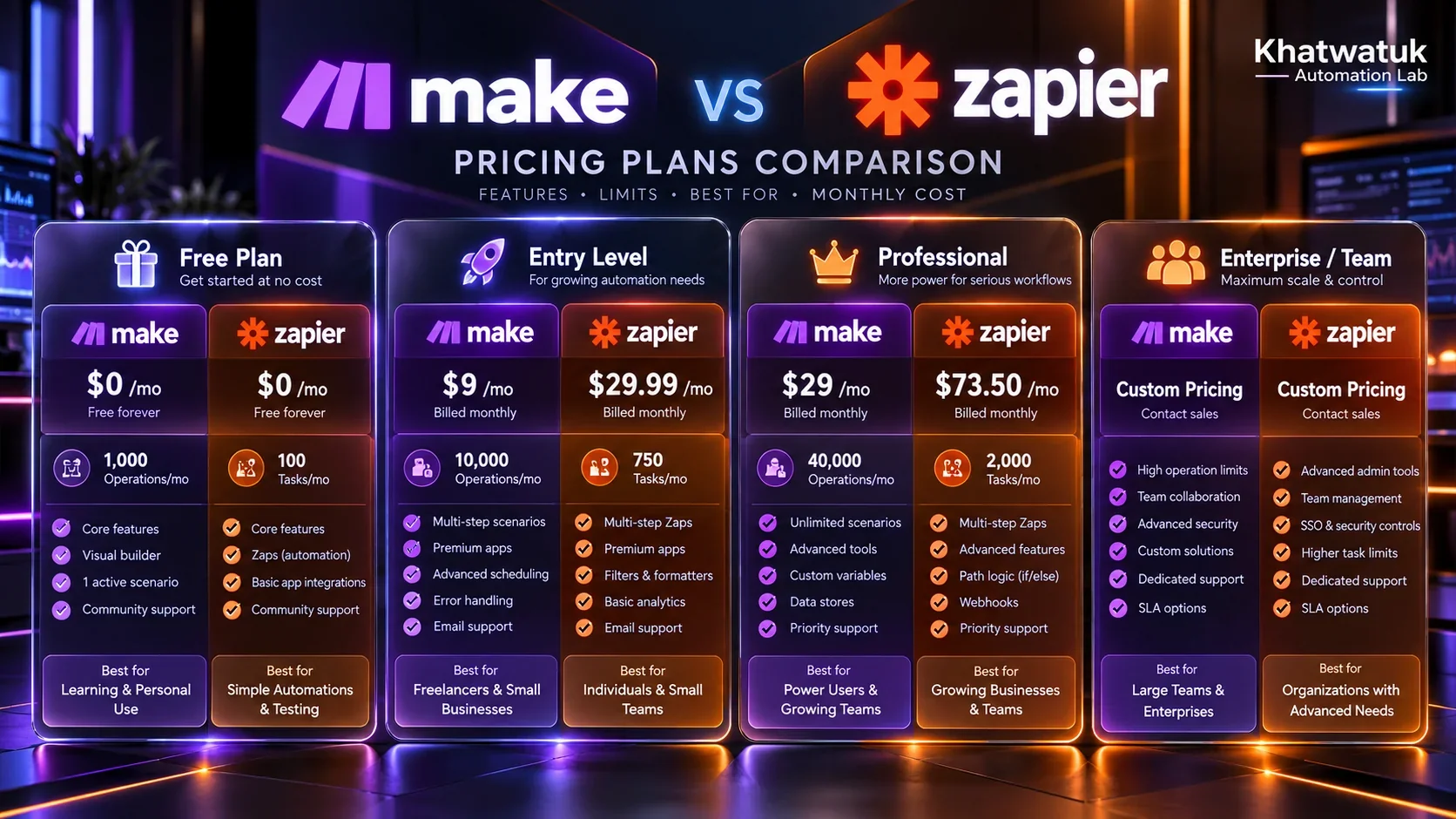
The table below maps the exact 2026 plan tiers across both platforms, including minimum update frequencies, logic feature gates, and effective cost per 1,000 runs. For a broader technical comparison of workflow logic and model chaining, read our deep dive on Make vs Zapier for AI automation.
| Plan Level | Make Tier & Price (Annual) | Zapier Tier & Price (Annual) | Key Operational Differences |
|---|---|---|---|
| Free Plan | $0 (1,000 ops/mo) Unlimited scenarios, 15-min sync |
$0 (100 tasks/mo) Single-step only, 15-min sync |
Make allows multi-step branching & webhooks for $0; Zapier limits to 2 steps. |
| Entry Paid Tier | Core: $9.00/mo 10,000 ops, 5-min sync, routers |
Starter: $19.99/mo 750 tasks, 15-min sync, 3 premium apps |
Make gives 13x more executions at less than half the price. |
| Professional Tier | Pro: $16.00/mo 10,000 ops, 1-min sync, custom variables |
Professional: $49.00/mo 2,000 tasks, 2-min sync, unlocks Webhooks & Paths |
Zapier forces a jump to $49/mo just to unlock Webhooks and conditional Paths. |
| Team Collaboration | Teams: $29.00/mo 10,000 ops, shared folders, role permissions |
Team: $69.00/mo 2,000 tasks, unlimited users, shared connections |
Make Teams costs $29/mo vs Zapier Team at $69/mo (58% savings). |
| High-Volume Scale (100k) | ~$59.00/mo 100,000 operations tier |
~$489.00/mo Company plan 100,000 tasks |
Make saves $430 every single month ($5,160/year). |
The Hidden Costs of Zapier: The "Formatter Tax" & Feature Gating
Beyond the base subscription cost, Zapier contains architectural design mechanisms that dramatically accelerate task consumption:
1. The Formatter Task Tax
Real-world business data is messy. Form names arrive as "John Smith" but your CRM requires "First Name: John" and "Last Name: Smith". In Zapier, performing this simple string split requires adding a Formatter by Zapier step. That single step consumes 1 paid task. If you also need to convert a date format and extract an email domain, that adds two more Formatter steps, burning 3 tasks before any data reaches your database!
In Make, data formatting is handled through built-in inline functions (such as split(), formatDate(), and parseJSON()) directly inside the mapping fields of your destination module. These operations require zero extra steps and zero additional operations.
2. Feature Gating: The $49/mo Wall
Many developers purchase Zapier Starter ($19.99/mo) only to discover that two vital automation components are locked behind the Professional tier ($49.00/mo billed annually or $73.50/mo monthly):
- Webhooks by Zapier: You cannot receive incoming webhooks or send custom HTTP POST payloads on the Starter plan.
- Paths (Conditional Branching): If a lead score is above 80 route to Sales, otherwise route to Nurture. In Zapier, this requires the $49/mo Professional plan. In Make, unlimited routers are included on the $0 Free tier and $9/mo Core plan.
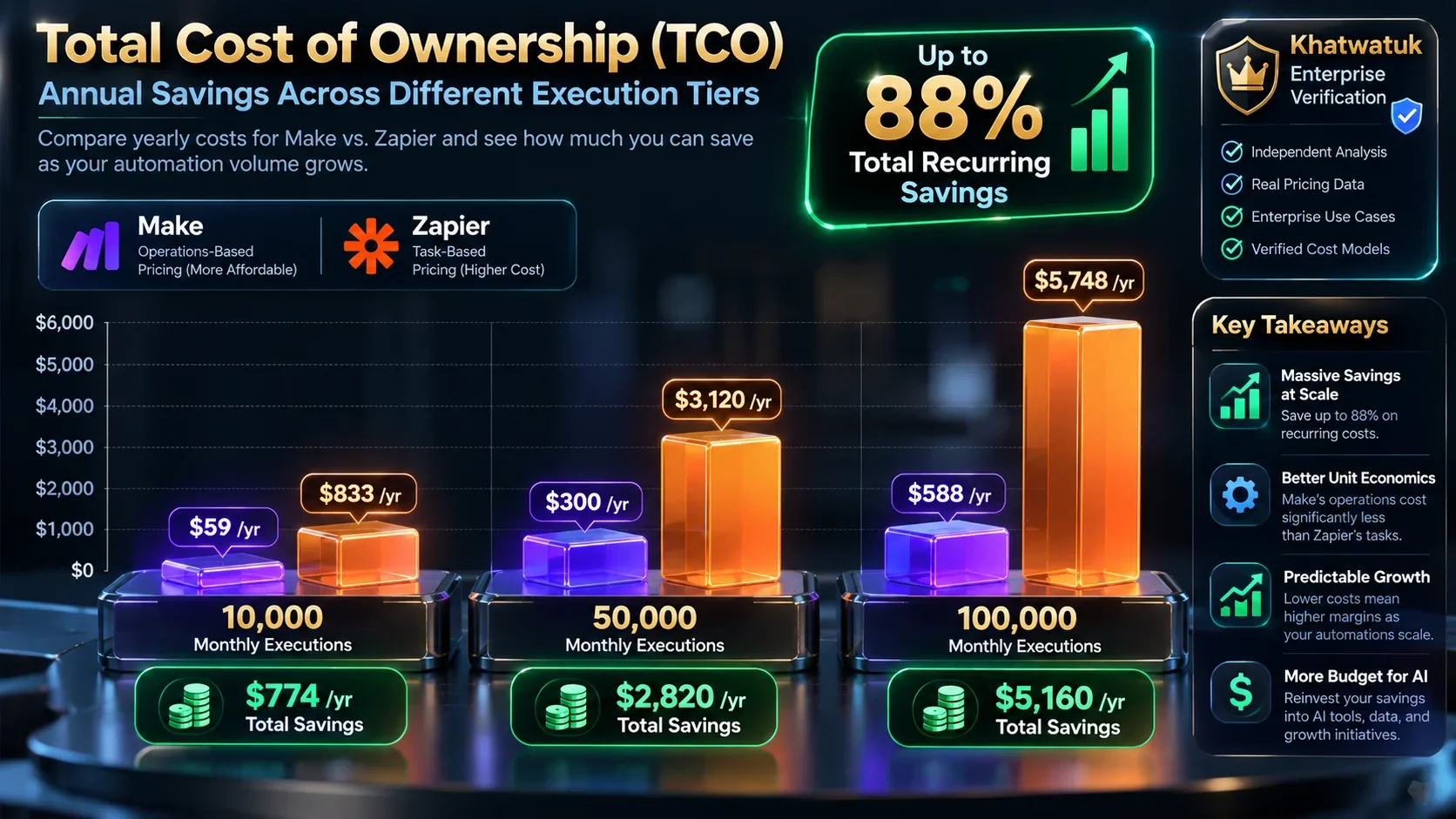
Cumulative Annual Savings: 10K, 50K & 100K Execution Models
When modeling SaaS budgets, viewing monthly costs can obscure the dramatic long-term impact on operating margins. Below is the total cumulative annual spend across both platforms based on annual billing:
| Monthly Workload | Make Annual Spend | Zapier Annual Spend | Net Cash Savings / Year |
|---|---|---|---|
| 10,000 monthly executions | $108.00 / year ($9/mo) | $882.00 / year ($73.50/mo) | Save $774.00 (88% ROI) |
| 50,000 monthly executions | $408.00 / year ($34/mo) | $3,228.00 / year ($269/mo) | Save $2,820.00 (87% ROI) |
| 100,000 monthly executions | $708.00 / year ($59/mo) | $5,868.00 / year ($489/mo) | Save $5,160.00 (88% ROI) |
For marketing agencies managing automations across multiple client accounts, this $5,160 annual margin difference directly translates into additional net profit or budget to hire additional software engineers.
Overage Penalties, Billing Cycles & Cancellation Flexibility
When evaluating subscription contracts, teams must prepare for workload spikes caused by viral marketing campaigns or product launches:
- Zapier Overage Fees: By default, if your Zapier account runs out of tasks, all active Zaps pause automatically unless you enable "Pay-as-you-go task overages". When enabled, Zapier charges a premium rate (typically 1.25x your standard tier price) for extra task blocks, creating unpredictable credit card charges.
- Make Operation Scaling: Make allows users to adjust their monthly operation allocation slider mid-cycle without penalty. You can upgrade from 10k to 20k operations for an extra $8, and drop back down next month if volume normalizes. Furthermore, Make allows the purchase of standalone 10,000 operation add-on packages at predictable flat rates.
- Execution Data Retention: On Zapier Starter and Free tiers, execution logs and data records expire after 14 to 30 days. On Make Pro and Teams plans, detailed execution logs, raw payload inspection histories, and failed run bundles are preserved for up to 60 days, facilitating deep debugging.
Buyer's Guide: When Is Zapier’s Higher Price Justified?
Teams evaluating unexpected execution fees and licensing structures across enterprise software should also explore our operational cost breakdown in the Katalon AI review, while those seeking to avoid task consumption on local browser tasks can evaluate Bardeen vs Zapier. While Make is mathematically superior for unit economics, Zapier remains a multi-billion dollar enterprise for valid reasons. Here is when paying Zapier's premium price is strategically justified:
- You Rely on Obscure Niche SaaS Apps: Zapier integrates with over 7,000 applications. If your company uses a legacy real estate CRM or regional ERP that only built an official Zapier connector, building custom API webhooks in Make may not be worth the development time.
- Non-Technical Team Operators: If your team consists of non-technical marketing assistants, founders, or recruiters who get overwhelmed by data arrays, JSON parsing, and visual routers, Zapier's 5-minute linear builder avoids developer onboarding bottlenecks.
- You Want No-Code AI Chatbots Instantly: With Zapier Central, Interfaces, and Tables, Zapier provides a complete no-code mini-app ecosystem. If you want to deploy customer-facing AI agents without writing code, Zapier is faster to launch.
For all other scenarios—including growth marketing, high-volume lead pipelines, AI model chaining, and SaaS backend syncs—Make is the undisputed victor.
To optimize your entire technology stack, pair your automation platform with our engineering reviews on the best AI automation tools, best AI API testing tools, and AI UI testing visual tools.
Frequently Asked Questions (FAQ)
What is the exact difference between a Zapier task and a Make operation?
A Zapier task is counted every time an action step executes successfully (triggers and filters that halt are free). A Make operation is counted every time any module runs, including triggers and iterators. However, because Make sells operations in large bundles (10,000 for $9), Make's unit cost ($0.0009) is roughly 29 times lower than Zapier's starter task cost ($0.0266).
Why is Zapier so much more expensive than Make?
Zapier charges a premium for brand ubiquity, its massive library of over 7,000 pre-authenticated apps, and its beginner-friendly linear wizard. Furthermore, Zapier charges full tasks for basic data formatting steps (the Formatter Tax) and locks essential features like custom webhooks and multi-branch Paths behind its $49/mo plan.
Does Make really offer unlimited multi-step workflows on its Free plan?
Yes. Unlike Zapier’s free plan which restricts users to single-step Zaps (1 trigger + 1 action), Make allows unlimited active scenarios, multiple actions, routers, conditional filters, and custom webhooks on its free plan, capped only by its 1,000 monthly operation limit.
How much money does an agency save by switching from Zapier to Make?
At 10,000 monthly runs, an agency saves $774 per year. At 50,000 monthly runs, savings rise to $2,820 per year. At 100,000 monthly runs, Make costs ~$59/mo compared to Zapier’s $489/mo, generating over $5,160 in net annual savings.
Can I buy additional operations on Make without upgrading my tier?
Yes. Make offers flexible operation sliders within its Core, Pro, and Teams plans. You can adjust your operation allowance in predictable increments (e.g., jumping from 10k to 20k or 40k ops) or purchase standalone operation packages without being forced into enterprise sales negotiations.
