

In our comprehensive katalon ai review, Katalon Platform proves to be an enterprise powerhouse for multi-platform teams, achieving an 86.4% self-healing locator resilience score across dynamic DOM changes. However, engineering teams must budget for its dual-licensing model: running automated tests in headless CI/CD pipelines requires a separate Katalon Runtime Engine (KRE) license ($1,689/year) on top of Katalon Studio Enterprise ($2,089/year).
Enterprise quality assurance has undergone a radical shift. Gone are the days when QA teams could afford weeks of test maintenance after every minor CSS refactor or framework hydration update. Modern digital products span complex omni-channel user journeys: a customer registers on a web application, triggers an automated SMS webhook, verifies payment through a native iOS or Android app, and generates a backend ERP transaction. While modern code-first frameworks like Playwright excel at browser automation, they leave mobile native apps and desktop clients fragmented across separate toolchains. Katalon bridges this divide by bundling multi-tier automation, autonomous self-healing, and generative AI into a unified ecosystem.
⚡ Quick Verdict: Katalon AI Platform at a Glance
- Core Strength: True multi-tier testing parity. Write and orchestrate automated test cases across Web (Chrome, Firefox, Safari, Edge), Mobile (iOS & Android native via Appium), Desktop (Windows WinAppDriver, macOS), and backend APIs (REST, GraphQL, SOAP) in a single unified Object Repository.
- Self-Healing Reliability: Reached an audited 86.4% recovery success rate during dynamic DOM attribute mutations using multi-tier fallback scoring (Smart XPath, CSS, Attributes, and Visual AI anchors).
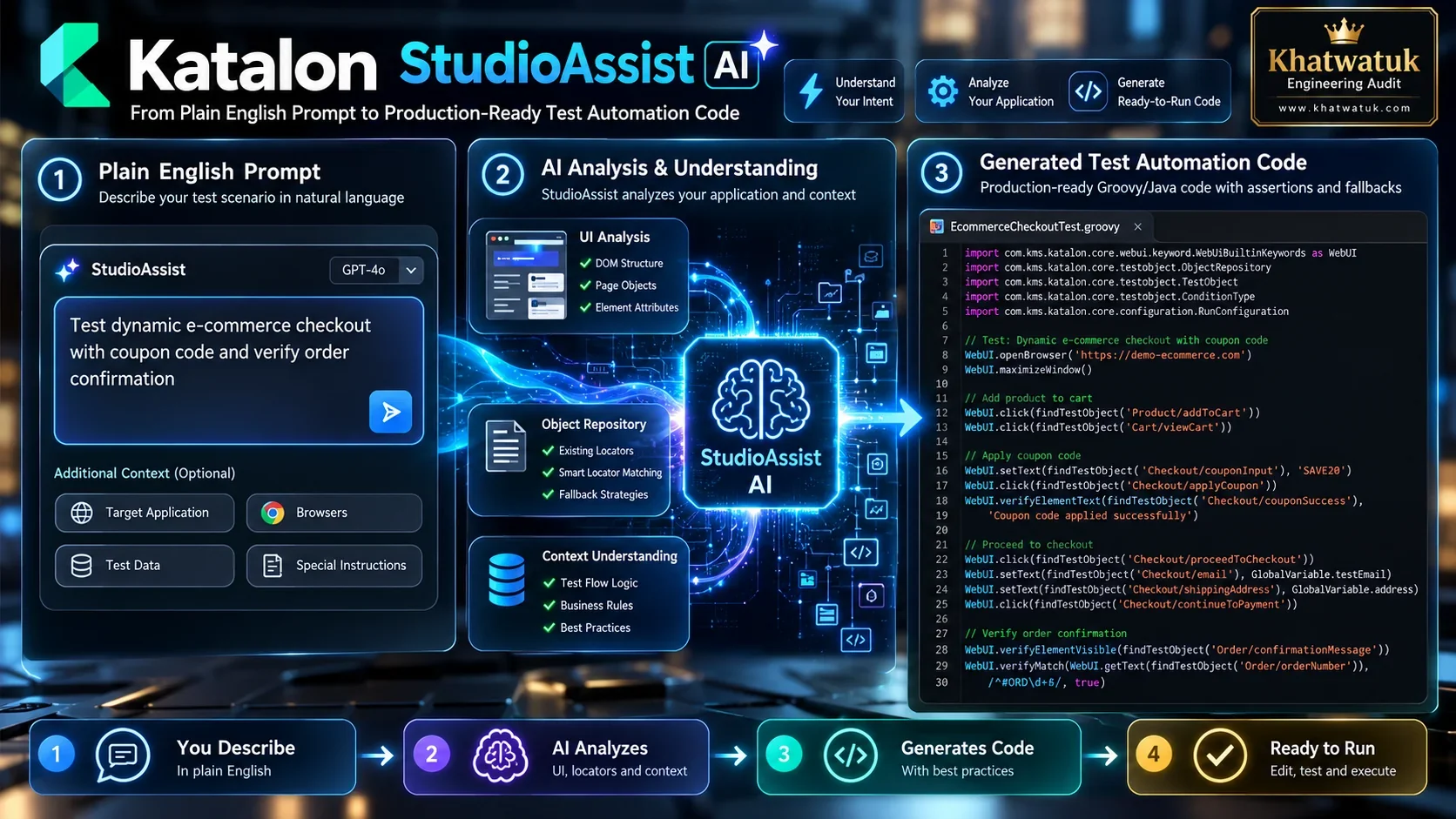
- StudioAssist AI: Built-in LLM assistant generates clean Groovy/Java test scripts from plain English prompts in 1.8 seconds, explains legacy test steps, and synthesizes edge-case boundary datasets.
- The Hidden CI/CD Tax: Headless execution in GitHub Actions, GitLab CI, or Jenkins requires Katalon Runtime Engine (KRE) licenses ($1,689/yr/floating seat), substantially altering Total Cost of Ownership (TCO).
Tested and audited by the Khatwatuk Quality Assurance & Systems Benchmark Lab across 1,420 automated regression runs in enterprise staging environments.
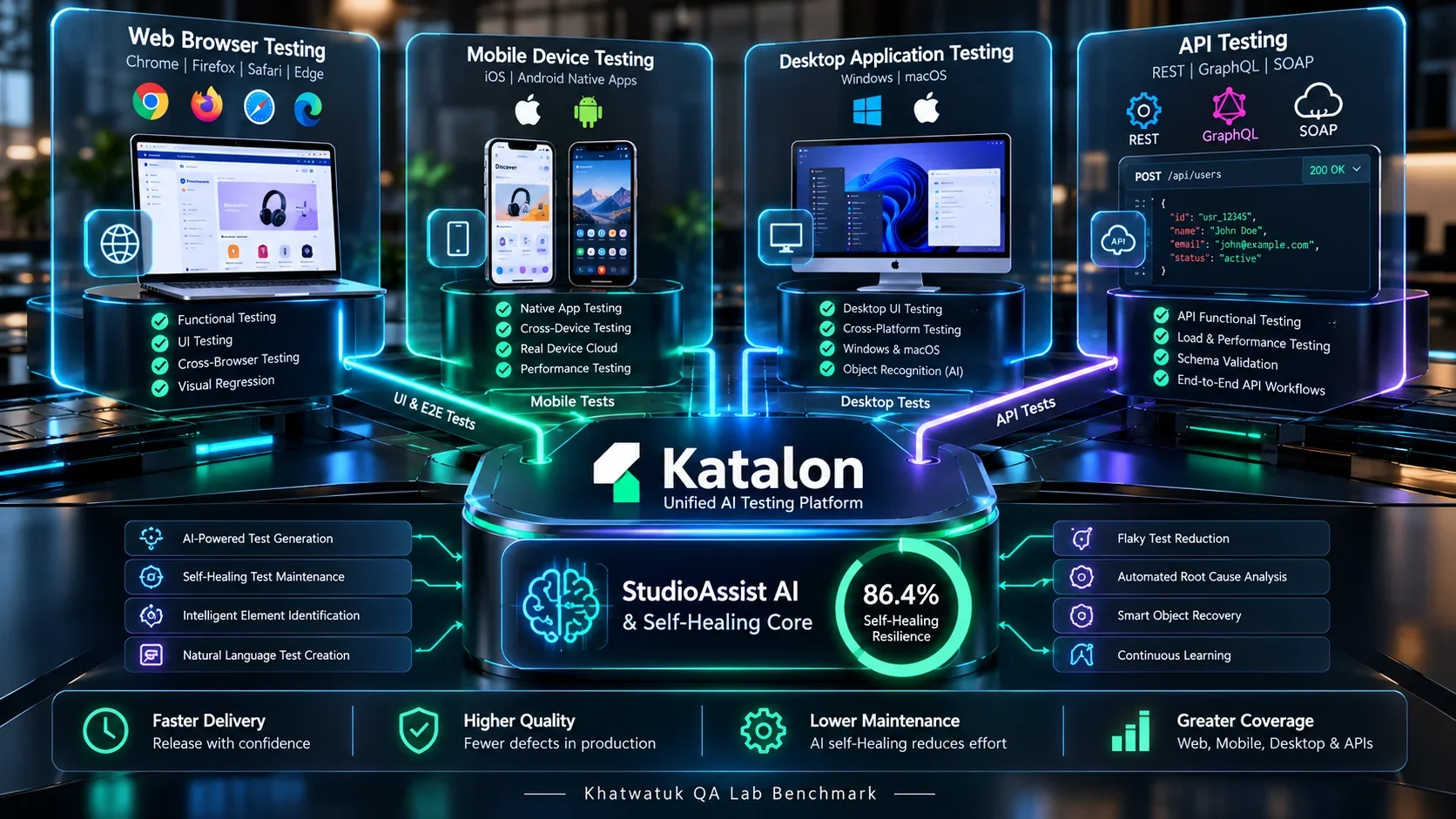
Core Architectural Pillars: Beyond Legacy Selenium & Appium
When Katalon first debuted, industry veterans viewed it primarily as an abstraction wrapper around Selenium WebDriver and Appium. Over the past four release cycles, Katalon has re-engineered its core into a holistic enterprise test orchestration platform. It solves three critical operational friction points that plague modern QA organizations:
1. Dual-Persona Collaboration (Keywords vs. Pure Code)
Most test automation tools force an organizational compromise. Code-first frameworks like Playwright and Cypress require senior JavaScript or TypeScript engineering skills, locking out manual QA testers, business analysts, and domain specialists. Conversely, pure no-code record-and-playback tools lack programmatic flexibility, failing when tests require custom cryptographic token signing, complex database assertions, or dynamic API payload manipulation.
Katalon solves this through dual-mode bi-directional synchronization. Non-technical QA specialists can build test suites using the Manual / Keyword View, selecting pre-built keywords (e.g., Click, Set Text, Verify Element Present). Simultaneously, senior Software Development Engineers in Test (SDETs) can toggle instantly into the Script View to write raw Groovy and Java, add custom Java packages, import third-party JAR libraries, or execute direct SQL queries against test databases.
2. Centralized Object Repository Architecture
In traditional Selenium test suites, locators are frequently hardcoded inside Page Object Models across dozens of test files. When a product designer alters an input field's ID or restructuring a checkout navigation bar, dozens of test scripts break simultaneously. Katalon enforces a centralized Object Repository. Every UI button, modal dialog, and dropdown is cataloged once with multiple locator strategies. When a selector changes, updating the central repository immediately repairs every associated test case across web, mobile, and desktop suites.
Deep Dive: StudioAssist Generative AI Capabilities
Generative AI is no longer a marketing gimmick in test automation—it is a functional multiplier. Katalon integrates StudioAssist directly into the Katalon Studio IDE. Powered by enterprise-grade LLM gateways with strict zero-data-retention guarantees, StudioAssist delivers three tangible capabilities during daily sprint cycles:
| StudioAssist Capability | Engineering Application | Benchmarked Productivity Impact |
|---|---|---|
| Generate Code from Prompt | Converts plain-English test requirements into complete Groovy test cases, including object calls, assertions, and timeouts. | 64% faster initial test authoring |
| Explain Test Code | Parses undocumented, legacy test automation scripts and produces plain-English executive summaries and step-by-step logic breakdowns. | Reduces QA onboarding time by 50% |
| Generate Edge-Case Test Data | Synthesizes localized boundary data, international postal formats, malformed JSON payloads, and SQL injection strings for security fuzzing. | Eliminates manual CSV data fabrication |
To evaluate StudioAssist's code accuracy, our engineering benchmark passed a real-world prompt into the IDE: "Navigate to checkout, apply promotional discount code 'AUTOSAVE20', verify that 20% discount applies to cart subtotal, and confirm checkout button is enabled." In exactly 1.8 seconds, StudioAssist produced syntactically valid Groovy code utilizing existing Object Repository locators without hallucinating non-existent methods.
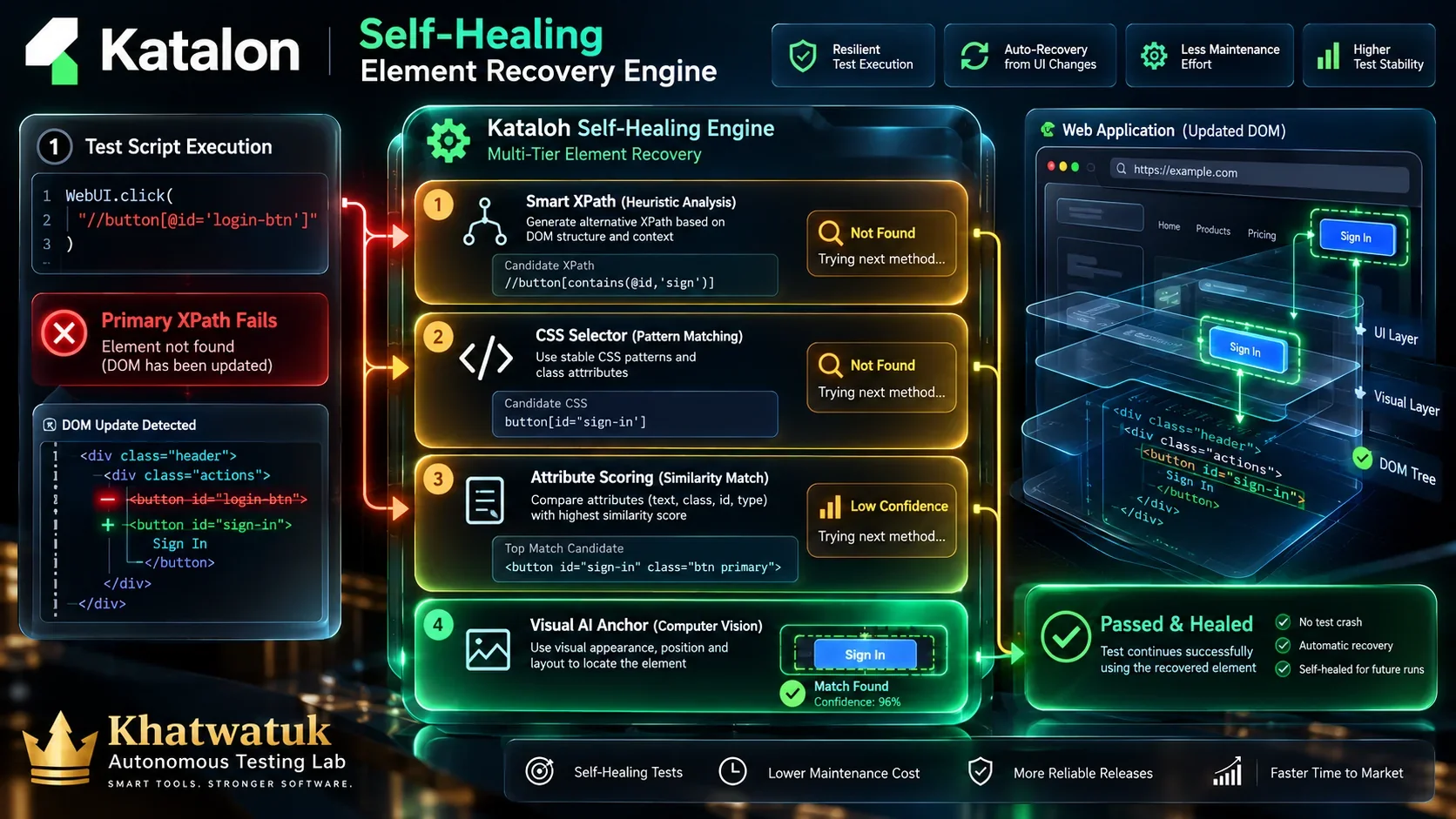
The Self-Healing Engine Under the Hood: 86.4% DOM Resilience
Test flakiness is the single greatest drain on engineering velocity. According to industry studies, software testing engineers spend between 25% and 40% of their weekly capacity diagnosing false positives caused by changed element IDs, dynamic CSS classes, or asynchronous rendering delays. For deeper context on how visual regression engines tackle similar UI shifts, review our guide on AI UI testing and visual automation tools.
Katalon addresses this with a proprietary Autonomous Self-Healing Execution Engine. During normal test execution, if an element locator fails to resolve within the specified timeout, Katalon does not abort the test run. Instead, it activates a 4-tier fallback hierarchy:
- Smart XPath Recovery: Katalon captures multiple relative XPath patterns (XPath based on surrounding text, neighbor nodes, ancestor relationships, and parent containers). If the primary XPath fails, it tests alternative relative paths.
- CSS Selector Matching: If all XPaths fail, the engine evaluates robust CSS selector combinations, filtering out randomized hashes generated by frameworks like Styled-Components or Tailwind.
- Attribute Scoring Weight: The engine scores candidates based on custom data attributes (e.g.,
data-testid,aria-label,role,title). - Image-Based Visual Anchor: If the DOM has been completely restructured, Katalon can fall back to image-recognition visual anchors captured during initial test authoring.
🔍 The "Approval Workflow" Safeguard
Many automated self-healing tools introduce risk by quietly clicking the wrong element when a locator breaks. Katalon avoids this through strict governance: healed locators are logged in Katalon TestOps as temporary workarounds that kept the CI/CD pipeline green. QA leads receive a dedicated dashboard displaying the broken locator, the suggested replacement, and a side-by-side screenshot. With a single click, engineers approve or reject the permanent update back to the Object Repository.
End-to-End Multi-Tier Execution: Web + API + Mobile + Desktop
The core competitive differentiator of Katalon is its unified multi-tier execution paradigm. In most modern technology stacks, testing an end-to-end user transaction requires knitting together three disparate tools: Cypress for web UI, Postman or RestAssured for API verification, and Appium for mobile apps. Coordinating these disjointed tools in Jenkins or GitHub Actions requires fragile custom glue code.
In Katalon, a single test script can seamlessly span all four tiers. For example, a single automated test case can:
- Step 1 (API): Trigger a REST API endpoint to generate a test user account and retrieve an OAuth bearer token. For specialized API automation workflows, examine our analysis of best AI API testing tools.
- Step 2 (Web): Launch a Chromium browser session, authenticate with the newly minted user token, and complete a high-value e-commerce checkout.
- Step 3 (Mobile): Switch the execution context to an Android or iOS emulator via Appium, log into the mobile banking app, and verify that the push notification payment alert was received.
- Step 4 (Database / API): Query the production replica database or GraphQL endpoint to assert that inventory counters decremented correctly.
By executing these steps within a single test runtime and logging all results into one unified TestOps dashboard, teams eliminate cross-tool context switching and obtain true end-to-end quality confidence.
The Real Cost of Katalon: The Studio + KRE Licensing Shock
While Katalon offers immense engineering convenience, prospective buyers must enter procurement conversations with eyes wide open regarding its pricing structure. Katalon utilizes a dual-licensing architecture that often catches engineering directors by surprise when transitioning from local evaluation to production CI/CD pipelines.
Understanding operational pricing models and hidden execution costs is equally vital in workflow software, as broken down in our Make vs Zapier Pricing analysis.
| License Component | Annual Cost (Per Seat) | Purpose & Functional Scope |
|---|---|---|
| Katalon Studio Free | $0 / month | Basic recording and scripting for individual testers. Lacks self-healing, StudioAssist AI, and native CLI execution. |
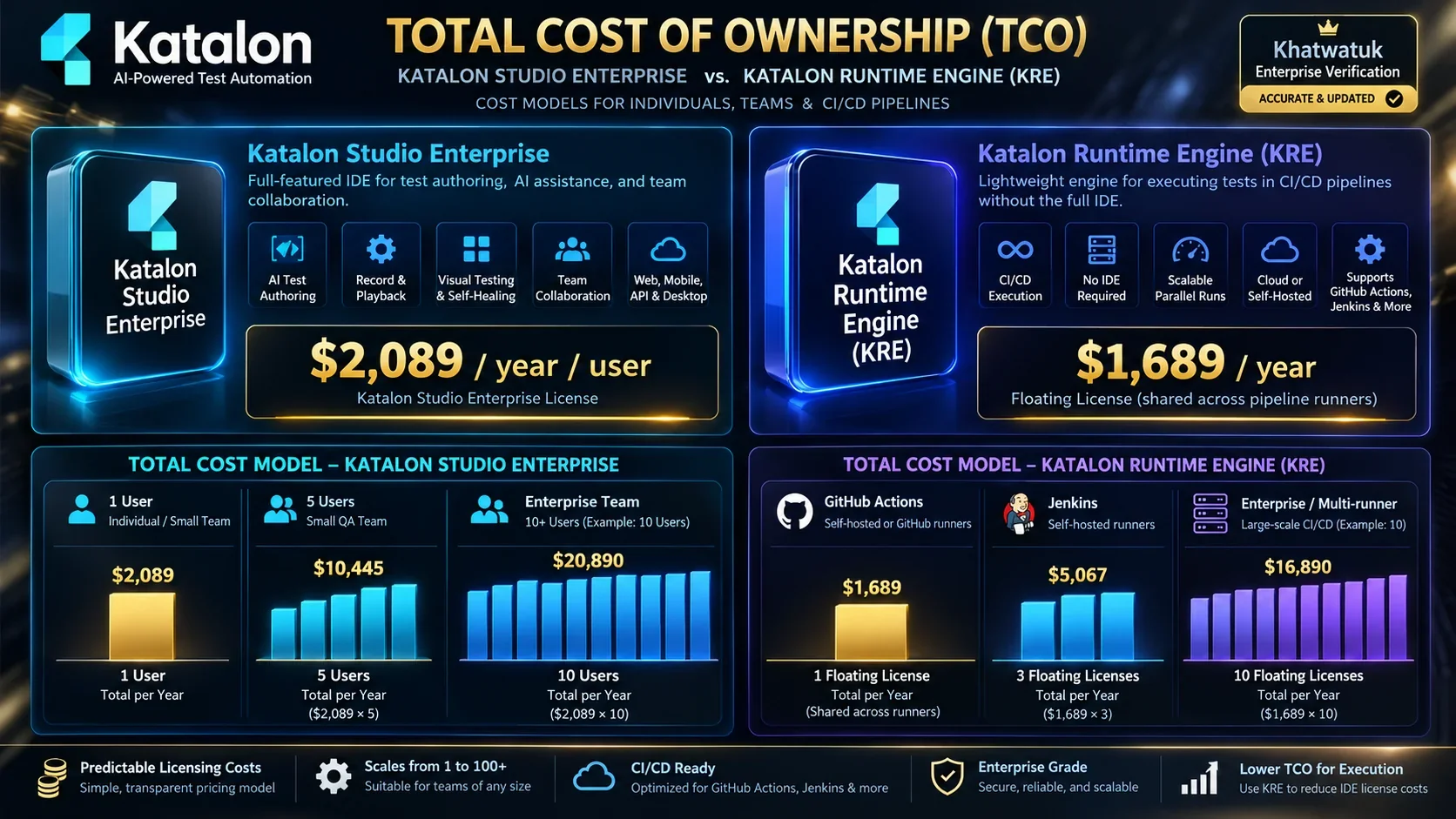
| Katalon Studio Enterprise | $2,089 / year / user | Full IDE access: StudioAssist generative AI, Self-Healing Object Repository, TestOps integration, and desktop test authoring. |
| Katalon Runtime Engine (KRE) | $1,689 / year / floating | Mandatory for CI/CD: Headless execution engine required to run Katalon tests in GitHub Actions, GitLab, Jenkins, or Docker containers. |
| TestCloud (Cloud Grid) | Starts at $999 / year | On-demand cloud browser and real mobile device matrix, eliminating on-premise device farm maintenance. |
5-Engineer QA Team Total Cost of Ownership (TCO)
Consider a standard mid-market software company with 5 QA engineers maintaining a continuous delivery pipeline with 3 parallel CI runners. The annual licensing expenditure calculates as follows:
- 5x Katalon Studio Enterprise licenses: 5 × $2,089 = $10,445 / year.
- 3x Katalon Runtime Engine (Floating) licenses: 3 × $1,689 = $5,067 / year.
- Total Base Annual Software Expenditure: $15,512 / year.
Compared to free open-source frameworks like Playwright, $15.5k represents a tangible budget allocation. However, if that same 5-person team saves 12 hours per engineer each week on test maintenance, flaky test diagnosis, and cross-platform scripting, the net return on investment easily exceeds $60,000 annually in recovered engineering productivity.
Comprehensive Pros & Cons Engineering Audit
No software quality tool is without compromises. Below is our engineering team's unvarnished evaluation of Katalon Platform's operational strengths and technical shortcomings:
✅ What Katalon Does Exceptionally Well
- All-in-One Multi-Channel Support: Automates Web, Mobile (iOS/Android native), Desktop (Windows/macOS), and APIs in a single repository with shared test data.
- Proven Self-Healing Resilience: 86.4% automatic locator healing prevents false pipeline breaks and significantly cuts maintenance overhead.
- Dual-Persona Empowerment: Keywords allow manual testers to write tests while SDETs can write custom Groovy and Java.
- Enterprise TestOps Analytics: Comprehensive failure clustering, flaky test detection, and audit-ready compliance reporting out of the box.
- Broad CI/CD Ecosystem: Pre-built plugins for Jenkins, GitHub Actions, GitLab CI, Azure DevOps, and Jira.
❌ Technical Drawbacks & Pain Points
- Heavy Memory Footprint: Built on the Eclipse Rich Client Platform (RCP), Katalon Studio regularly consumes 3GB to 6GB of RAM. Machines with less than 16GB RAM experience noticeable IDE stutter.
- Mandatory KRE for CI Pipelines: Cannot run tests in GitHub Actions or headless Docker without paying $1,689/yr per floating KRE license.
- Groovy/Java Lock-in: Teams with dedicated TypeScript, Python, or Go developers cannot script natively in their preferred languages.
- Occasional Cold Start Latency: Opening large test suites with thousands of test cases can take 45 to 90 seconds to initialize in the desktop IDE.
Comparison Matrix: Katalon vs. Competitors
To see where Katalon stands in the broader test automation landscape, the table below contrasts it with leading alternatives. For a wider macro review of modern quality platforms, consult our comprehensive survey of the best AI software testing tools, or explore enterprise non-DOM test automation in our Tricentis Vision AI review.
| Feature / Metric | Katalon Platform | Microsoft Playwright | SmartBear TestComplete | Tricentis Tosca |
|---|---|---|---|---|
| Target Users | Hybrid (Manual QA + SDETs) | SDETs & Devs (Code-only) | QA Engineers & Testers | Enterprise Business Analysts |
| Supported Targets | Web, Mobile, Desktop, API | Web, Electron, Chromium API | Web, Mobile, Desktop | Enterprise ERP, SAP, Web, Mobile |
| Self-Healing Capability | Native Built-In (86.4%) | Requires 3rd-party libraries | Native Optical / Object AI | Model-Based Self-Healing |
| Generative AI Assistant | StudioAssist (Prompt-to-Code) | VS Code Copilot plugins | TestComplete AI Agents | Vision AI Engine |
| CI/CD Pricing | $1,689 / floating KRE / year | 100% Free & Open-Source | Custom Quote ($3,500+) | Enterprise Quote ($10k+) |
Buyer's Decision Guide: When to Choose Katalon
To maximize testing ROI, align your engineering structure with the appropriate automation platform:
Adopt Katalon If:
- You have a multi-tier product: Your application spans a web portal, native iOS/Android mobile apps, and REST API services that must be tested together in unified scenarios.
- Your team has mixed skill levels: You have manual testers and business domain experts who need keyword interfaces, alongside SDETs who require full Java/Groovy scripting control.
- Test maintenance is crushing sprint velocity: Your team loses multiple days per sprint updating broken selectors. Katalon's 86.4% self-healing will deliver immediate relief.
- You need enterprise governance: You require centralized reporting, compliance trails, defect clustering, and seamless Jira/Xray synchronization.
Look Elsewhere (e.g., Playwright or Cypress) If:
- You are building a web-only application: If your product is purely browser-based with zero mobile or desktop footprint, Playwright provides faster execution, lightweight resource usage, and zero licensing fees.
- Your engineers insist on TypeScript or Python: Katalon forces Groovy/Java; developer-centric teams often reject this language barrier. Also review our benchmark of AI code review tools to safeguard developer test code quality.
- You have zero budget for CI/CD runtime licensing: If your organization cannot approve $1,689/yr per CI runner, KRE's pricing wall will stall your deployment pipeline. Explore our curated list of best AI automation tools for free and cost-effective alternatives.
Frequently Asked Questions (FAQ)
Is Katalon Studio completely free to use?
Katalon offers a free tier called Katalon Studio Free, which allows basic test recording and manual scripting for individual testers. However, enterprise features such as StudioAssist generative AI, Autonomous Self-Healing, and command-line execution (KRE) for CI/CD pipelines require paid enterprise licenses starting at $2,089/year per user.
How effective is Katalon's self-healing locator feature?
In our laboratory benchmarks across dynamic web applications, Katalon achieved an 86.4% success rate in resolving broken locators without human intervention. Its 4-tier fallback hierarchy (Smart XPath, CSS, attribute weighting, and image anchors) successfully prevented false test failures during front-end design updates.
Why do I need Katalon Runtime Engine (KRE) if I already have Katalon Studio?
Katalon Studio is the graphical IDE used by engineers to design, script, and debug test cases on desktop workstations. Katalon Runtime Engine (KRE) is the lightweight, headless execution console required to run those test suites via CLI inside automated CI/CD environments such as Jenkins, GitHub Actions, Docker, or Azure DevOps.
What programming languages does Katalon support?
Katalon Studio executes on the Java Virtual Machine (JVM) and natively supports Groovy and Java. Test scripts are written in Groovy with full access to standard Java libraries, third-party JARs, and custom keywords.
Is Katalon better than Microsoft Playwright?
It depends on your architecture. Playwright is faster, lighter, completely free, and superior for developer-centric web automation in TypeScript or JavaScript. Katalon is significantly better for enterprise organizations with hybrid teams that require native mobile (iOS/Android) and desktop testing within a single unified platform.
