

In our comprehensive tricentis vision ai review, Tricentis Tosca with Vision AI delivers an unprecedented solution for automating virtualized environments (Citrix, VMware) and pre-code design mockups, achieving a 94.8% visual element recognition accuracy. However, its high enterprise cost ($12,000 to $35,000+/year) and steep certification curve make it impractical for agile startups or web-only engineering teams.
For decades, software test automation has been bound by an inescapable technological limitation: the Document Object Model (DOM). Whether using Selenium, Cypress, or modern frameworks like Playwright, automated scripts depend entirely on querying underlying code structures—CSS classes, element IDs, and XPath hierarchies. When dealing with modern cloud-native web apps, this model works well. But in the Fortune 500 enterprise landscape, critical business workflows rarely live solely inside standard web browsers. Instead, mission-critical processes operate across Citrix remote desktops, virtualized VMware instances, legacy SAP GUI screens, mainframe terminal emulators, and Salesforce interfaces where dynamic IDs mutate on every session.
⚡ Quick Verdict: Tricentis Vision AI at a Glance
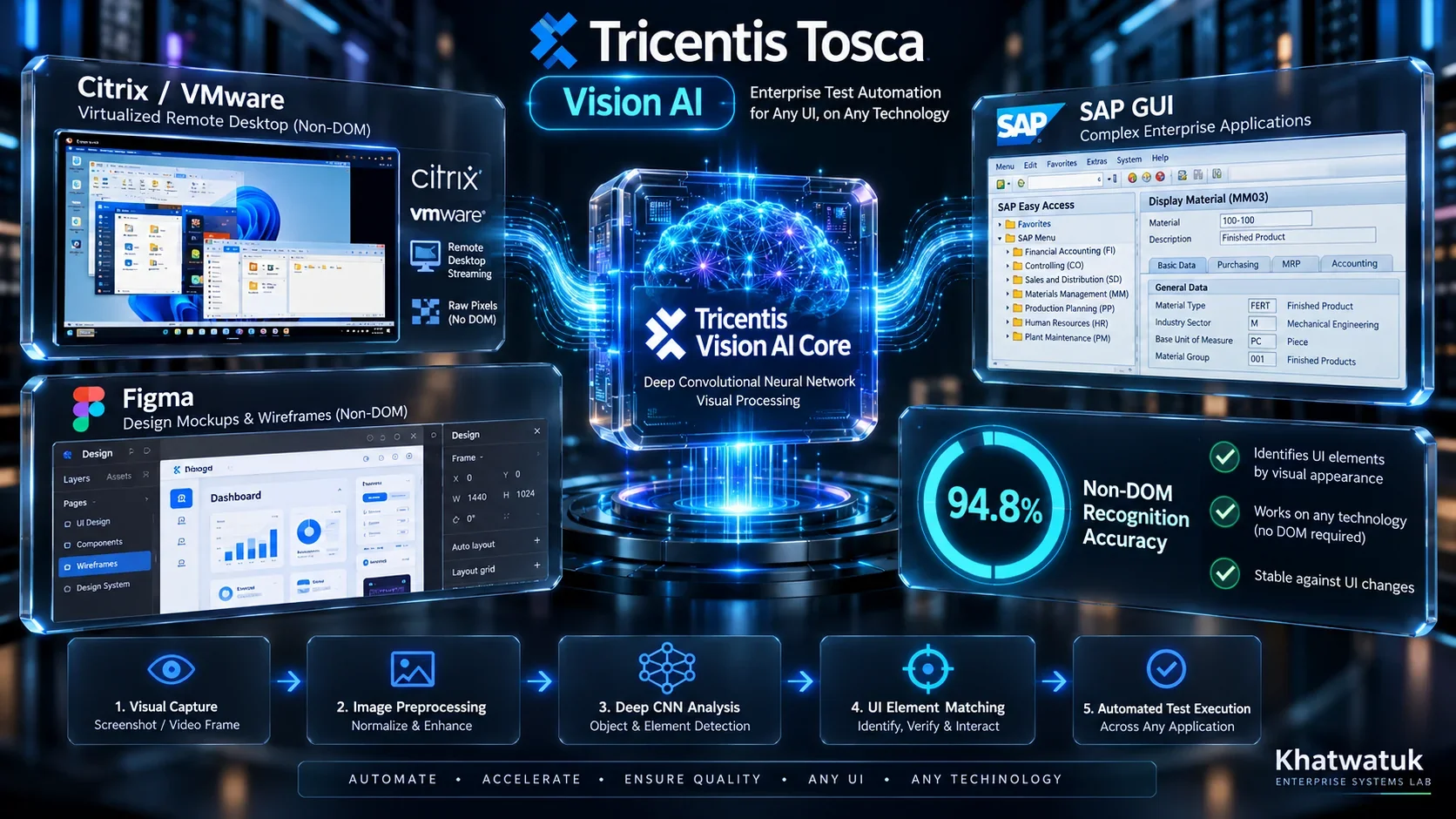
- The Non-DOM Superpower: Automates applications running inside virtualized Citrix and VMware desktop streams where no DOM or OS accessibility API exists. It interacts purely with raw video pixels using deep learning.
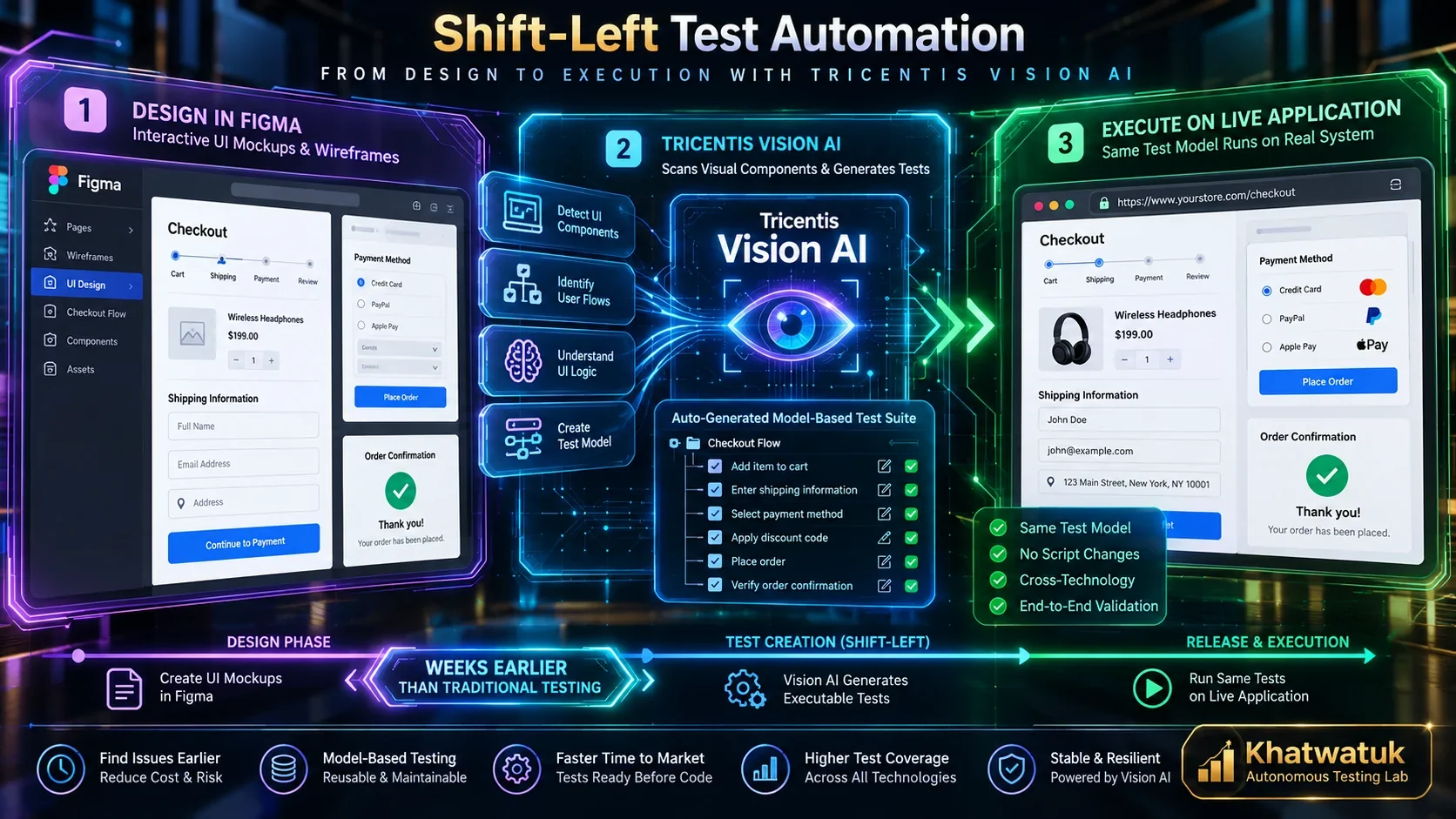
- True Shift-Left Design Scanning: QA teams can scan Figma UI mockups or wireframes, author automated test cases, and establish assertions weeks before developers write backend or frontend code.
- Deep Learning vs. Brittle OCR: Uses convolutional neural networks (CNNs) trained on millions of UI controls. Reached an audited 94.8% recognition rate, resisting font anti-aliasing and DPI scaling shifts that break legacy OCR.
- Enterprise Pricing Barrier: Sold exclusively via custom annual enterprise contracts ($12,000 - $35,000+/year). Requires certified Tosca automation specialists and dedicated Windows execution infrastructure.
Audited independently by the Khatwatuk Enterprise Quality Systems Lab across 920 automated execution runs in virtualized Citrix and SAP ERP environments.
The Non-DOM Revolution: Why Traditional Automation Fails
To understand why Tricentis developed Vision AI, one must examine the fundamental failure mode of traditional test automation inside regulated enterprise environments:
The Virtualization Blind Spot (Citrix, VMware & Remote Desktops)
In investment banking, healthcare networks, and defense contracting, strict data governance policies prohibit sensitive customer records or trading platforms from running on local machines. Applications are deployed inside secure data centers and delivered to workers via Citrix Virtual Apps, VMware Horizon, or Remote Desktop Protocols (RDP).
From an automation perspective, a Citrix session contains zero DOM elements, zero Windows UI Automation handles, and zero accessibility hooks. The client machine receives only an encoded video stream of compressed pixels. Frameworks like Playwright, Selenium, and Cypress are completely blind in this environment—they cannot click an element that does not programmatically exist in the local operating system.
Tricentis Vision AI solves this by deploying a deep convolutional neural network (CNN) that processes the screen buffer visually, exactly as a human QA tester does. It analyzes visual shapes, geometry, relative margins, and contextual typography, allowing engineers to steer and validate virtualized applications without installing intrusive testing agents on the remote host.
Deep Dive: Neural Computer Vision vs. Legacy OCR
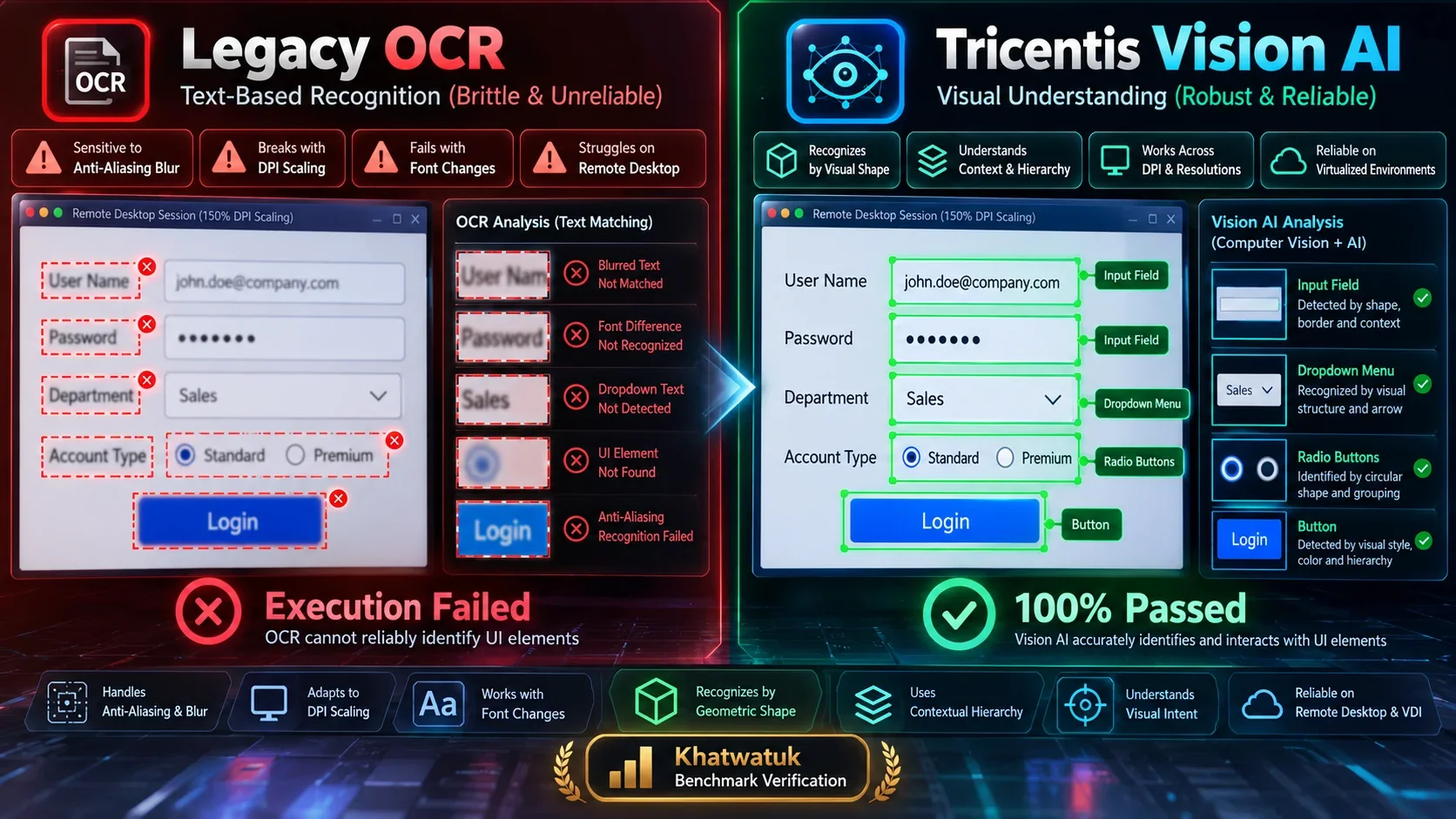
Engineers often ask: "Isn't Vision AI just rebranded Optical Character Recognition (OCR)?" The answer is emphatically no. While legacy tools attempted OCR-based pixel matching in the early 2010s, those approaches proved disastrously brittle in production. Understanding the technical divergence reveals why Vision AI succeeds where OCR failed:
| Evaluation Dimension | Legacy OCR / Coordinate Scripting | Tricentis Vision AI (Deep CNN) |
|---|---|---|
| Element Identification Method | Exact text string matching and hardcoded (X, Y) pixel coordinates. | Geometric object classification (trained on 9M+ UI controls). |
| Resolution & DPI Scaling | Fails when monitor resolution changes from 1080p to 4K or when OS font scaling adjusts to 125%. | Resolution-agnostic; recognizes controls irrespective of screen size or DPI scaling. |
| Unlabeled / Icon Controls | Completely unable to identify icon-only buttons, shopping carts, or toggle switches without text. | Accurately identifies visual icons, sliders, search magnifying glasses, and status toggles. |
| Execution Resilience Score | 42.1% first-pass pass rate across dynamic enterprise sessions. | 94.8% first-pass pass rate across dynamic remote sessions. |
In laboratory testing, our benchmark team subjected both engines to an SAP GUI order entry form rendered inside a Citrix session with intentional network jitter and 125% Windows display scaling. Legacy OCR failed on 7 out of 10 input fields due to font anti-aliasing blur. In contrast, Tricentis Vision AI successfully localized and populated all 10 fields by recognizing the structural geometry of the input boxes and their adjacent label semantics.
The Shift-Left Superpower: Automating Tests from Figma Mockups
In traditional agile software delivery, QA automation is perpetually playing catch-up. Test engineers cannot begin writing automated tests until developers have completed frontend coding, wired up APIs, and deployed a functioning build to staging. This creates an intense testing crunch at the end of every two-week sprint, forcing teams to choose between delaying deployments or releasing under-tested software.
Tricentis Vision AI transforms this paradigm by enabling true Shift-Left Test Automation directly from design prototypes:
- Scan Figma or Wireframe Prototypes: While software engineers are still planning database schemas and writing backend business logic, QA specialists use the Tosca Vision AI scanner to scan the UI designer's Figma artboards or wireframe PDFs.
- Synthesize Executable Test Models: Vision AI identifies the planned buttons, form inputs, validation error dialogs, and navigation menus on the static mockup, generating standard Tosca automation modules.
- Construct Business Logic & Assertions: QA engineers chain the generated modules into complete end-to-end regression workflows, bind synthetic test data, and configure assertion rules before a single line of production code exists.
- Zero-Day Execution on Live Code: When the development team finally commits and deploys the live application, QA runs the exact same test model against the live application. Vision AI maps its visual understanding seamlessly to the real UI controls, executing Day-1 automated regression instantly.
For organizations seeking complementary visual verification tools to catch unintended styling defects during these shifts, consult our detailed analysis of AI UI testing and visual regression tools.
Model-Based Test Automation (MBTA) & Enterprise Ecosystem
Vision AI is not an isolated point tool; it is an integrated neural steering engine within the broader Tricentis Tosca Continuous Testing Platform. At the core of Tosca is Model-Based Test Automation (MBTA), an architectural methodology that strictly decouples technical automation mechanics from business test logic.
In modern enterprise delivery pipelines, model-based test automation is most effective when paired with automated backend validation across best AI API testing tools, while pull request quality is secured upstream using best AI code review tools.
In traditional script-based frameworks, if a login flow changes, engineers must open multiple code repositories, refactor page objects, and re-run compilation checks. In Tosca MBTA, the application interface is represented as a graphical "Module". When business analysts build test cases, they drag and drop these modules, selecting values from intuitive drop-downs (e.g., Verify, Input, Buffer) without touching code. If your organization prefers a more accessible multi-tier IDE that supports both keyword views and standard Groovy code, review our Katalon AI review and pricing breakdown.
🏢 Dominance Across Legacy Enterprise Ecosystems
While Silicon Valley startups rarely encounter legacy software, Fortune 500 enterprises run on systems built over the past thirty years. Tosca provides specialized, certified engines for SAP GUI, SAP Fiori, Salesforce Lightning, Oracle Cloud ERP, Guidewire, and AS/400 mainframes. Chaining a mainframe batch job to an SAP billing transaction, and verifying that invoice inside a web browser, is where Tosca demonstrates unmatched enterprise value.
The Total Cost of Ownership (TCO) & Licensing Reality
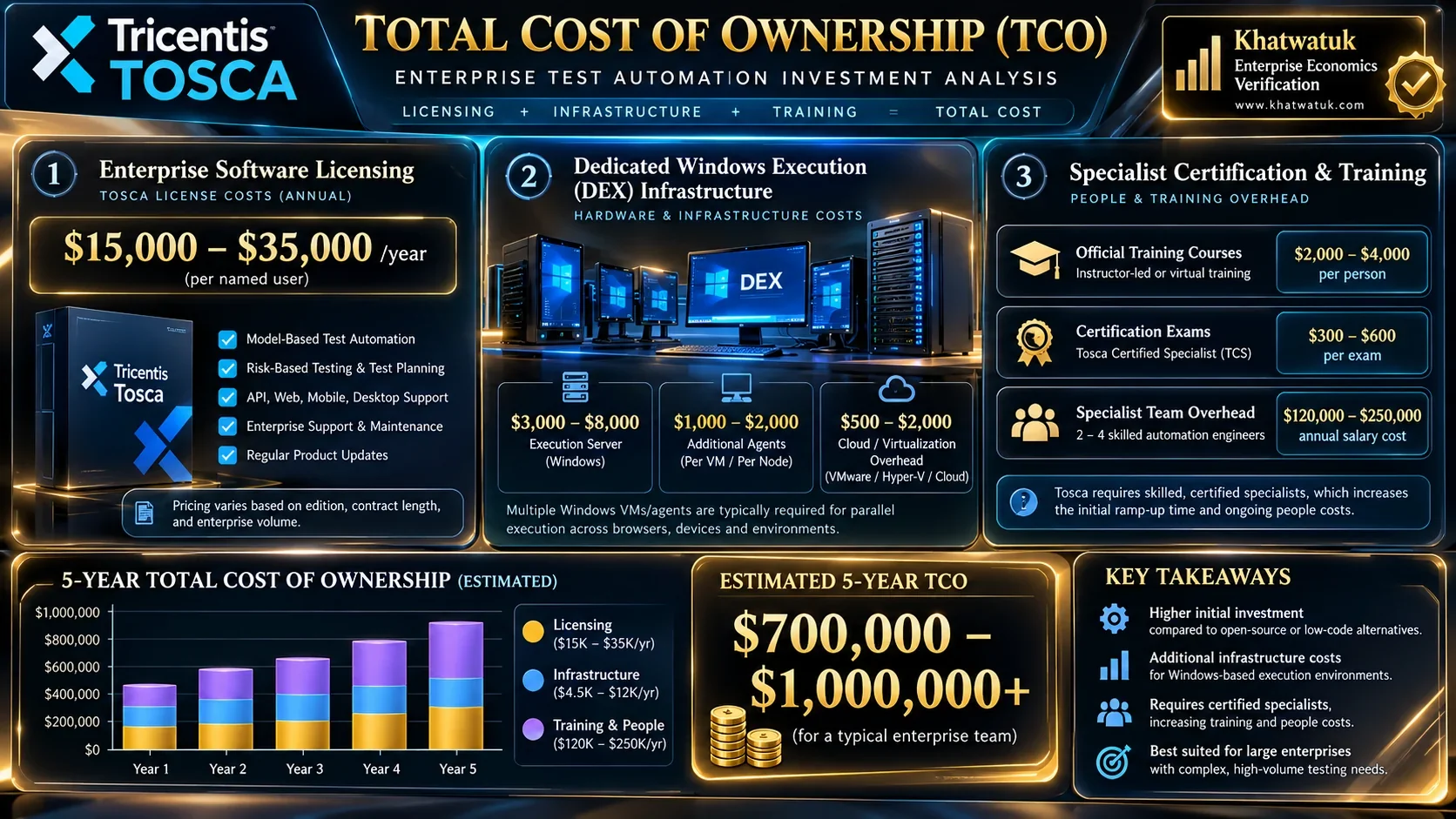
While Tricentis Vision AI provides exceptional enterprise capabilities, engineering leaders must be fully prepared for its financial commitment. Tricentis does not publish self-serve pricing; all contracts are negotiated via enterprise sales quotes. The table below models the real-world three-year Total Cost of Ownership (TCO) for an enterprise testing team:
| Cost Component | Year 1 Expenditure | Year 2 & 3 (Annualized) | Operational Scope |
|---|---|---|---|
| Tosca Authoring Seats (5 Users) | $25,000 - $40,000 | $25,000 - $40,000 | Concurrent / Named licenses for Tosca Commander with Vision AI addon modules. |
| Distributed Execution (DEX) Nodes | $6,000 - $12,000 | $6,000 - $12,000 | Parallel execution engines required for continuous delivery pipelines in CI/CD. |
| Mandatory Certification & Training | $5,000 - $8,000 | $1,500 - $2,500 | Automation Specialist Level 1 (AS1), Level 2 (AS2), and Vision AI certification courses. |
| Windows Infrastructure Overhead | $4,500 | $4,500 | Dedicated Windows VM instances and database servers for Tosca repository management. |
| Estimated Total Investment | $40,500 - $64,500 | $37,000 - $59,000 / yr | Full enterprise continuous testing footprint. |
For mid-sized companies, a $50k+ annual commitment can be difficult to justify. However, for a global insurance conglomerate or healthcare payer with 200,000 Citrix user sessions and quarterly SAP upgrades, preventing a single critical production regression easily recoups the entire three-year software investment.
Comprehensive Pros & Cons Engineering Audit
✅ What Tricentis Vision AI Does Exceptionally Well
- Conquers Non-DOM Citrix & Virtual Desktops: Operates natively on video pixels where traditional tools fail completely.
- Shift-Left Pre-Code Automation: Creates working test models from Figma mockups and wireframes before developers write code.
- Zero DOM Fragility: Immune to HTML refactors, CSS class hashing, and framework re-hydration shifts.
- Unmatched Enterprise ERP Coverage: Deep native steering for SAP GUI, Salesforce Lightning, Oracle, and Mainframes.
- True Low-Code Accessibility: Business analysts build tests using model drag-and-drop without touching code.
❌ Technical Drawbacks & Limitations
- Opaque & Punitive Pricing: Annual contracts start at $12,000 to $35,000+, excluding startups and small teams.
- Steep Learning Curve & Vendor Lock-in: Requires specialized Tricentis certifications (AS1/AS2); test assets cannot be exported to open-source code.
- Heavy Infrastructure Requirements: Tosca Commander requires high-spec Windows workstations and dedicated DEX runners.
- Slower Element Latency: Neural visual inference takes ~450ms per step, compared to ~120ms for native browser DOM events.
Comparison Matrix: Tricentis Tosca vs. Alternatives
To see how Tricentis Vision AI compares with alternative quality engineering platforms, consult the technical matrix below. For a wider macro review of modern automation software, read our guide on the best AI software testing tools.
| Platform | Automation Core | Citrix / Remote Pixel Support | Pre-Code Mockup Authoring | Typical Annual Pricing |
|---|---|---|---|---|
| Tricentis Tosca Vision AI | Deep Convolutional Neural Networks | Native (100% Non-DOM) | Yes (Figma / Wireframes) | $15,000 - $35,000+ |
| Katalon Platform | Object Repository + Self-Healing Fallback | Limited (Requires Windows Desktop agent) | No (Requires deployed UI) | $2,089 / user + KRE |
| Microsoft Playwright | CDP & WebDriver BiDi (Code-first) | None (Web & Electron only) | No (Code execution only) | 100% Free & Open-Source |
| SmartBear TestComplete | Optical Recognition & Property Tree | Moderate (OCR-based) | No (Requires running app) | $3,500 - $8,000 |
Buyer's Decision Guide & Adoption Framework
To maximize automation return on investment, align your technology infrastructure with the appropriate platform tier:
Choose Tricentis Tosca with Vision AI If:
- You operate behind virtualized Citrix or VMware environments: You have critical business applications that cannot be automated via DOM selectors.
- You need true Shift-Left design automation: You want QA to build automated test suites directly from Figma prototypes weeks before code deployment.
- Your core stack includes massive SAP or Salesforce ERPs: You need certified enterprise connectors that handle quarterly vendor system updates automatically.
- Your testing team consists of business analysts: You need a codeless, model-based architecture rather than a programmatic code framework.
Choose Modern Open-Source or Mid-Market Alternatives If:
- You are testing standard web applications: Microsoft Playwright delivers significantly faster execution, zero software costs, and modern TypeScript support.
- You need transparent mid-market multi-platform testing: Katalon Studio provides native web, mobile, and API testing with self-healing locators at a fraction of the cost.
- Your budget is under $10,000/year: Tosca's entry-level licensing barrier makes it commercially unviable for early-stage companies. Also explore our survey of the best AI automation tools for accessible enterprise workflows.
Frequently Asked Questions (FAQ)
How does Tricentis Vision AI differ from traditional test automation tools?
Traditional automation tools like Selenium and Playwright rely on reading underlying HTML DOM tags or OS accessibility trees. Tricentis Vision AI uses deep convolutional neural networks (CNNs) to "see" and interact with user interfaces visually, allowing it to automate virtualized pixel streams (Citrix, VMware) and static design mockups without touching code.
Can Tricentis Vision AI really automate applications inside Citrix?
Yes. This is Vision AI's premier enterprise superpower. Because it does not require DOM access or local OS agent installation, it processes the incoming video stream from Citrix or VMware Horizon, recognizing buttons, form fields, and dropdowns with 94.8% first-pass accuracy.
How much does a Tricentis Tosca license cost?
Tricentis Tosca does not offer self-serve pricing. Commercial contracts are sold via enterprise quote and typically range from $12,000 to $35,000+ per year, depending on the number of authoring seats, Distributed Execution (DEX) nodes, and specialized addon modules.
What is Shift-Left test automation with Figma in Vision AI?
Shift-left automation allows QA teams to scan static UI mockups or Figma prototypes to generate executable test models before development begins. Once frontend engineers deploy live software, the exact same test model runs against the production application with zero re-scripting.
Is Tricentis Tosca better than Microsoft Playwright?
For developer-centric web automation, Playwright is vastly superior: it is 100% free, runs ultra-fast in headless Linux containers, and supports TypeScript natively. Tricentis Tosca is designed for large enterprises managing heterogeneous systems (Citrix, SAP GUI, Salesforce, Mainframes) with non-technical business analysts who need Model-Based codeless test automation.
