

When comparing bardeen vs zapier, the right choice depends on where automation happens: Bardeen AI excels at in-browser, one-click web scraping and local task execution directly from active tabs, while Zapier is the superior cloud-native platform for 24/7 unattended background workflows connecting over 7,000 SaaS applications. For lead generation and manual prospecting, Bardeen offers vastly superior speed and economics.
Workflow automation has bifurcated into two distinct operational paradigms. On one side stands traditional serverless cloud automation—pioneered by Zapier—which listens for cloud webhooks, synchronizes databases, and pipes information between APIs while you sleep. On the other side is client-side, browser-in-the-loop automation—championed by Bardeen AI—which lives inside your web browser, directly observes whatever web page or private portal you are viewing, and performs repetitive human tasks on command. Choosing the wrong paradigm leads to either massive monthly SaaS bills or broken workflows that fail to capture the data you need.
⚡ Quick Verdict: Bardeen vs. Zapier at a Glance
- Core Operational Difference: Bardeen runs as a Chrome extension on your local machine, giving it native access to web page DOM elements behind login walls (LinkedIn, internal CRMs). Zapier runs entirely in the cloud on AWS, connecting APIs without human presence.
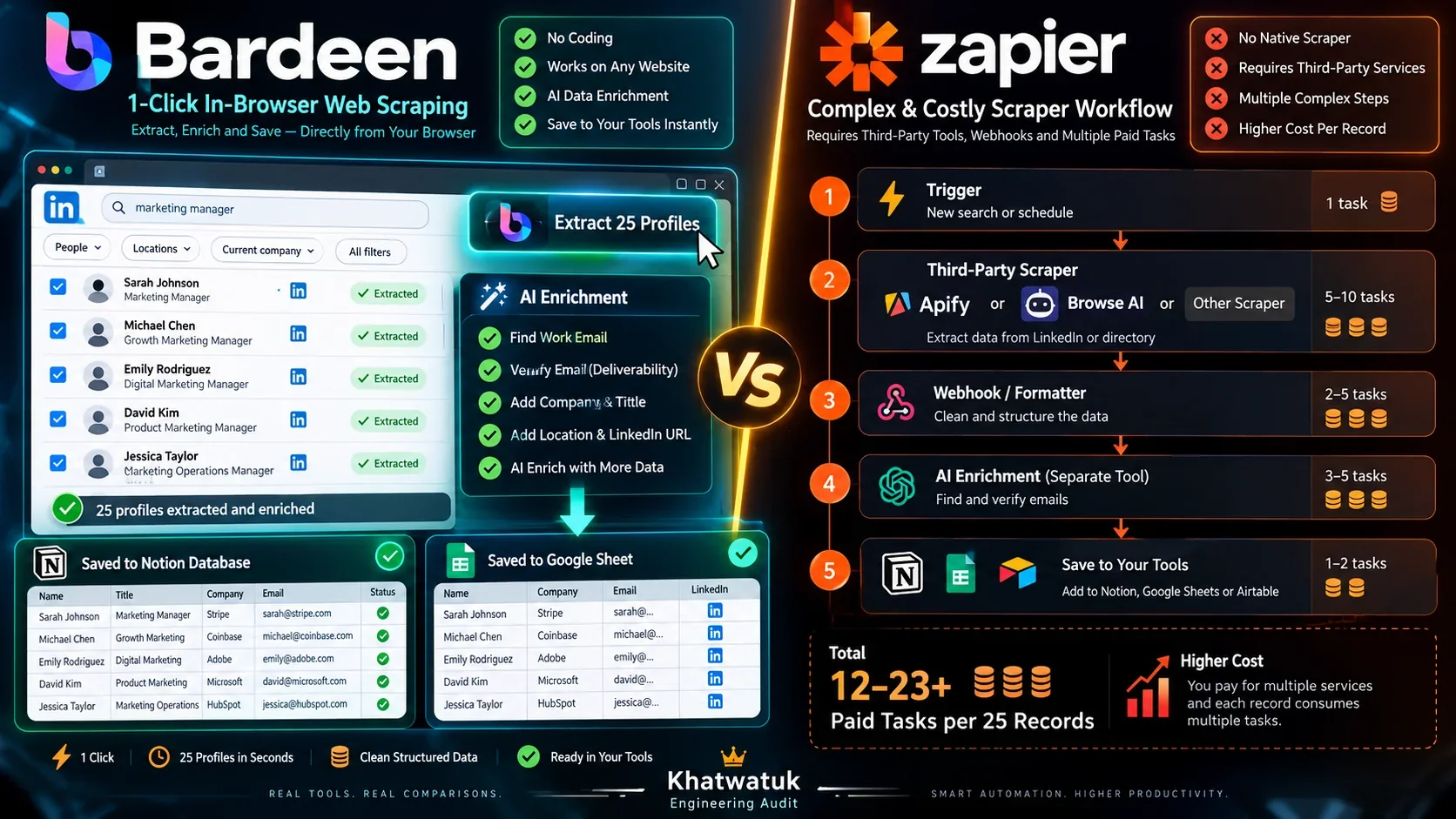
- Web Scraping Winner: Bardeen wins decisively. Extract 50 contact cards, tables, or directories into Notion, Airtable, or Google Sheets in 1 click. Zapier has zero native scraping capabilities.
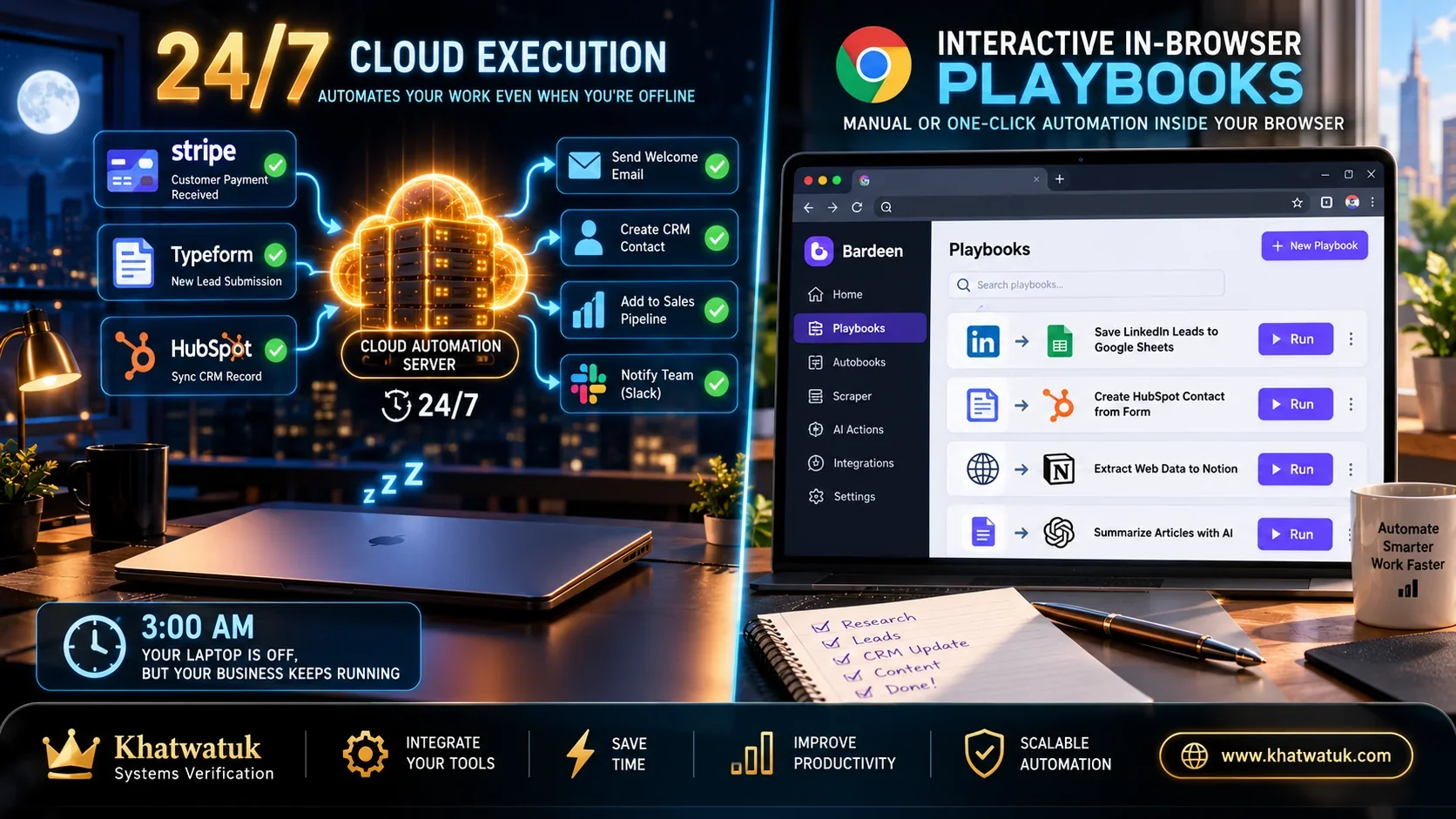
- Unattended 24/7 Execution: Zapier wins decisively. Executes 24/7/365 in the background when your computer is off. Bardeen requires an active browser session for local playbooks (though Cloud Autobooks offer limited scheduling).
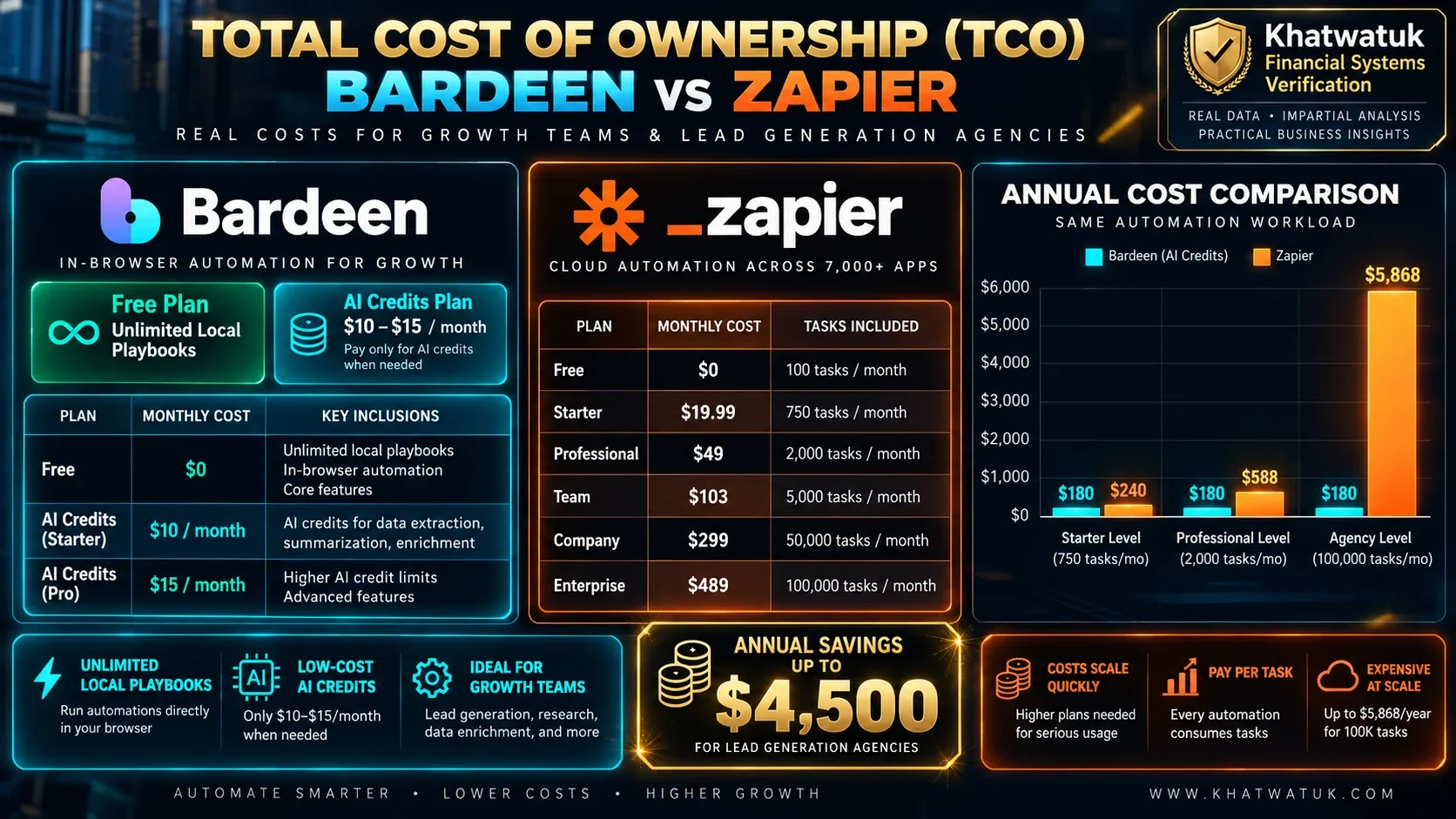
- Cost Economics: Bardeen offers unlimited local executions completely free, charging $10-$15/month for AI enrichment credits. Zapier charges $19.99/month for just 750 tasks, with every formatting step consuming a billable task.
Audited independently by the Khatwatuk Automation Engineering Lab across 600 live lead generation and cloud webhook transactions.
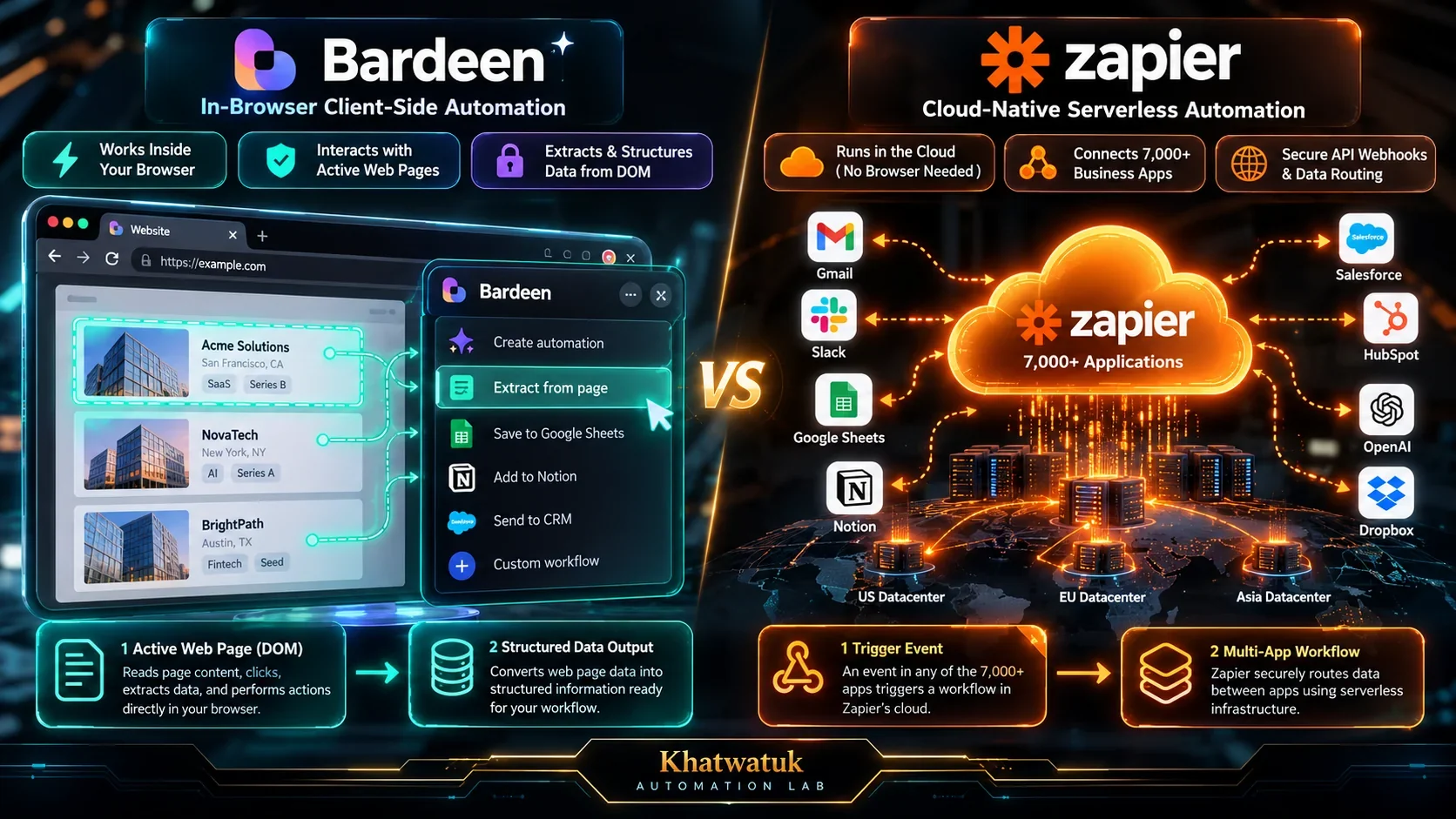
Core Architectural Paradigm: In-Browser Extension vs. Serverless Cloud
Understanding the core technical contrast between Bardeen and Zapier requires analyzing where code executes and how events trigger:
1. Bardeen AI: Client-Side Browser Automation
Bardeen operates as a Google Chrome extension running on your workstation's local compute. Because it executes within the context of your active browser session, it inherits your authenticated state. When you open a private LinkedIn Recruiter page, an internal HubSpot dashboard, or a password-protected industry directory, Bardeen can read and interact with the Document Object Model (DOM) directly.
Triggers in Bardeen are typically contextual and user-initiated: pressing a keyboard shortcut, clicking a floating action button on an active page, or scheduling an "Autobook" that monitors web page changes while your browser is open. Because the execution runs locally on your CPU, Bardeen does not incur cloud server compute costs, allowing it to offer unlimited free playbook runs.
2. Zapier: Serverless Cloud Message Bus
Zapier operates entirely on remote AWS servers. It is fundamentally an asynchronous message bus that connects public APIs via webhooks and scheduled polling intervals. A Zap triggers when an external event occurs in a cloud service—such as a customer completing a checkout on Stripe, submitting a Calendly booking, or opening an email in SendGrid.
Zapier does not know or care what you are doing on your laptop. In fact, your laptop can be powered down completely. When an event fires, Zapier's cloud infrastructure processes the JSON payload, applies conditional filter paths, and writes the resulting record to downstream SaaS tools in seconds.
The Web Scraping Showdown: 1-Click Extraction vs 3rd-Party Complexity
Web data extraction is the defining battleground between these two tools. For sales development representatives (SDRs), recruiters, real estate brokers, and competitive intelligence analysts, gathering structured data from the web is a daily necessity. Here, the two platforms could not be more divergent:
| Data Extraction Capability | Bardeen AI | Zapier |
|---|---|---|
| Native Web Page Scraping | Built-in visual scraper; extract lists, tables, and pagination in 1 click. | None; cannot scrape HTML pages without 3rd-party integrations. |
| Scraping Behind Login Paywalls | Full access; uses your active authenticated browser session. | Impossible; cloud servers cannot bypass 2FA or CAPTCHA sessions. |
| AI Data Cleaning & Synthesis | Inline LLM commands: summarize bios, draft outreach, find emails. | Requires Zapier Central or OpenAI action steps (each consumes 1 paid task). |
| Scraping Cost per 1,000 Leads | $0 (Free tier) to ~$10 (with AI enrichment credits). | $40 - $120+ (requires Apify subscription + Zapier task bills). |
Consider a standard sales workflow: finding 100 prospective enterprise buyers on LinkedIn Sales Navigator, capturing their job titles, summarizing company growth, and inserting rows into Airtable. With Bardeen, an SDR clicks "Scrape LinkedIn search to Airtable". In roughly 12 seconds, 100 rows populate Airtable with zero task fees. Doing this with Zapier requires paying for a headless browser service like Apify or PhantomBuster, configuring complex JSON webhooks, and consuming hundreds of Zapier tasks every run.
Unattended 24/7 Operations: The Cloud Execution Divide
While Bardeen dominates interactive scraping, Zapier reasserts total supremacy when automations must operate independently of human presence. This is the Unattended Execution Divide:
🌙 The "Closed Laptop" Test
Imagine it is 2:30 AM on a Sunday. A prospective client in Tokyo fills out a high-value quote form on your website, completes a $5,000 deposit via Stripe, and requests an urgent onboarding Slack channel. Your laptop is closed, powered down in your backpack. Zapier executes flawlessly: it catches the Stripe webhook, spins up the Slack channel, generates a DocuSign agreement, and creates a CRM deal record. Bardeen local playbooks cannot execute in this scenario because your browser is offline.
Bardeen has introduced Cloud Autobooks to address scheduled triggers (such as running daily scrapes or monitoring RSS feeds in the cloud). However, Cloud Autobooks are fundamentally limited to public web pages; they cannot access private browser sessions while your machine is off. For end-to-end multi-step background logic, Zapier and Make for AI automation remain the industry standards.
App Ecosystem & Connectivity: 7,000+ Apps vs. 100+ Specialized Tools
The breadth of an automation platform's integration library dictates what technology stacks it can support without writing custom code:
- Zapier (7,000+ Integrations): Zapier is the universal adapter of the internet. It connects every mainstream SaaS product alongside obscure accounting tools, legacy SQL databases, niche real estate CRMs, and IoT devices. If a software company offers an API, they almost always build a certified Zapier connector first.
- Bardeen AI (~100+ Integrations): Bardeen focuses heavily on productivity, sales, and knowledge management apps. Its core strengths include Notion, Airtable, Google Workspace (Sheets, Docs, Calendar, Gmail), HubSpot, Slack, Salesforce, Coda, and LinkedIn. If your workflow requires connecting an obscure ERP or custom MySQL database, Bardeen cannot do so without manual webhook configurations.
Pricing & Unit Economics: Free Local Runs vs The Zapier Task Tax
Financial pricing structures frequently dictate platform adoption. In our detailed audit of Make vs Zapier pricing, we exposed the punitive nature of Zapier's task-based billing. When comparing Bardeen to Zapier, this economic divide becomes even wider:
| Pricing Dimension | Bardeen AI | Zapier |
|---|---|---|
| Free Plan Limits | Unlimited local playbooks, 100 free AI credits / month. | 100 tasks / month, strictly 2-step Zaps (1 trigger + 1 action). |
| Introductory Paid Plan | $10 - $15 / month (500 - 1,000 AI credits, unlimited playbooks). | $19.99 / month (750 tasks, $0.0266 per task). |
| The "Formatter Tax" | $0 (Inline regex, splits, and date parsing consume zero credits). | 1 full paid task consumed on every text split or date change. |
| Annual Cost for 2,500 Monthly Actions | $120 - $180 / year | $468 - $708 / year |
Because Bardeen runs on client-side compute, standard actions—such as clicking buttons, opening tabs, and pasting text into Airtable—are completely free and unlimited. You only spend credits when calling large language models (LLMs) to summarize content or scrape massive paginated directories. On Zapier, every single action step consumes a billable task, making high-volume data operations drastically more expensive.
Comprehensive Pros & Cons Engineering Audit
✅ When Bardeen AI Wins
- Web Scraping on Demand: Fastest tool on the market for extracting structured data from any active browser tab.
- Free Unlimited Local Workflows: Automate daily browser clicks, tab switching, and note syncing with $0 recurring fees.
- Bypasses Authentication Barriers: Reads private dashboards and gated communities without requiring public APIs.
- Client-Side Privacy: Sensitive local web data stays inside your browser session rather than transferring to third-party cloud servers.
❌ Where Zapier Still Dominates
- True 24/7 Unattended Background Sync: Operates 365 days a year without human intervention or an open laptop.
- Vast 7,000+ App Library: If an obscure enterprise SaaS tool has an API, Zapier supports it.
- Multi-Branch Logic (Paths): Robust conditional branching, error catching, and delay steps for enterprise workflows.
- Enterprise User Administration: Granular team permissions, audit logs, and SOC2 compliance certifications.
The Modern Growth Stack: How Top Teams Combine Both
High-performing revenue operations and growth marketing teams rarely choose just one platform. Instead, they deploy a Hybrid Automation Stack that leverages each platform's architectural strengths:
- Frontend Prospecting (Bardeen): SDRs use Bardeen inside Chrome to scrape verified lead lists from LinkedIn Sales Navigator, Google Maps, or trade show directories into a staging Notion database or Google Sheet.
- Backend Infrastructure (Zapier or Make): When a new qualified row appears in Notion, a 24/7 Zapier webhook triggers, verifies email deliverability via ZeroBounce, creates a contact in Salesforce or HubSpot, and notifies the account executive in Slack.
By combining Bardeen for front-of-house browser data extraction with Zapier for back-of-house cloud synchronization, teams achieve 10x higher automation coverage while reducing monthly task bills by over 70%. For a broader survey of AI-driven workflow engines, consult our guide on the best AI automation tools.
When extracting data from dynamic single-page web applications and interactive web elements, compare browser extension scrapers with enterprise web automation in our best AI software testing tools and frontend DOM validation in AI UI testing tools.
Frequently Asked Questions (FAQ)
Can Bardeen completely replace Zapier?
No. Bardeen cannot fully replace Zapier for 24/7 serverless background workflows, such as processing incoming Stripe payments or handling webhook events when your laptop is turned off. However, Bardeen can replace Zapier for all in-browser tasks, web data scraping, and local productivity playbooks.
Is Bardeen AI really free to use?
Yes. Bardeen offers a generous free plan that includes unlimited local playbook executions that run on your computer's browser. You only pay for premium plans ($10 to $15/month) when you consume AI credits for automated text generation, AI scraping, or scheduled Cloud Autobooks.
Can Zapier scrape websites like Bardeen?
No. Zapier has no native visual web scraping engine and cannot access web pages behind login screens. Scraping websites with Zapier requires subscribing to external third-party scraping services like Apify or PhantomBuster, which adds complexity and cost.
Is Bardeen safe for scraping LinkedIn and social platforms?
Bardeen operates within your local browser session and does not inject suspicious third-party server proxies, making it significantly safer than remote bot scrapers. However, users should always adhere to platform rate limits and avoid scraping hundreds of profiles in rapid succession to maintain account health.
Which platform is better for sales lead generation?
Bardeen AI is overwhelmingly superior for initial prospecting and lead generation. It allows sales reps to extract verified prospect lists from LinkedIn, Twitter, and company websites into Notion or Google Sheets in one click with zero task costs.
