

When evaluating the ai regression testing tools in 2026, the optimal choice depends on your software architecture: mabl is the premier autonomous low-code platform for continuous web and API regression, while Katalon Platform is the leading multi-environment suite for complex enterprise applications spanning web, mobile, and desktop.
For visual fidelity, Applitools Eyes provides the industry standard in Visual AI layout regression, while Diffblue Cover uniquely automates Java unit regression test creation directly in your CI pipeline.
By deploying AI regression suites with dynamic self-healing locators and Test Impact Analysis (TIA), QA engineering teams reduce manual test script maintenance by up to 75% while shortening deployment regression cycles from days to minutes.
Regression testing has historically stood as the single largest bottleneck in modern agile software delivery. Every time software engineers push a minor feature update, patch a security vulnerability, or refactor database schemas, QA departments must verify that existing business workflows remain uncompromised.
In traditional automated environments, running comprehensive regression test suites requires hours of execution time and produces dozens of false-positive failures caused by minor front-end layout mutations or slow API network responses.
⚡ Quick Verdict: The Best AI Regression Testing Tools at a Glance
- Best Overall Autonomous Web Regression: mabl leads the industry with automated self-healing, unified API validation, and silent background performance tracking.
- Best Multi-Platform Enterprise Platform: Katalon Platform provides end-to-end regression across web, mobile, API, and desktop applications with Smart Wait technology.
- Best for Visual Anomaly & Layout Regression: Applitools Eyes uses computer vision to detect visual regressions across thousands of browser and screen viewports without pixel false positives.
- Best for Fast Test Authoring & Stability: Tricentis Testim uses dynamic AI locators scoring hundreds of element attributes to eliminate flakiness.
- Best for Autonomous Unit Regression: Diffblue Cover automatically generates and maintains complete Java unit regression suites directly in git pipelines.
Audited independently by the Khatwatuk QA Automation Lab across 120 live enterprise software release cycles.
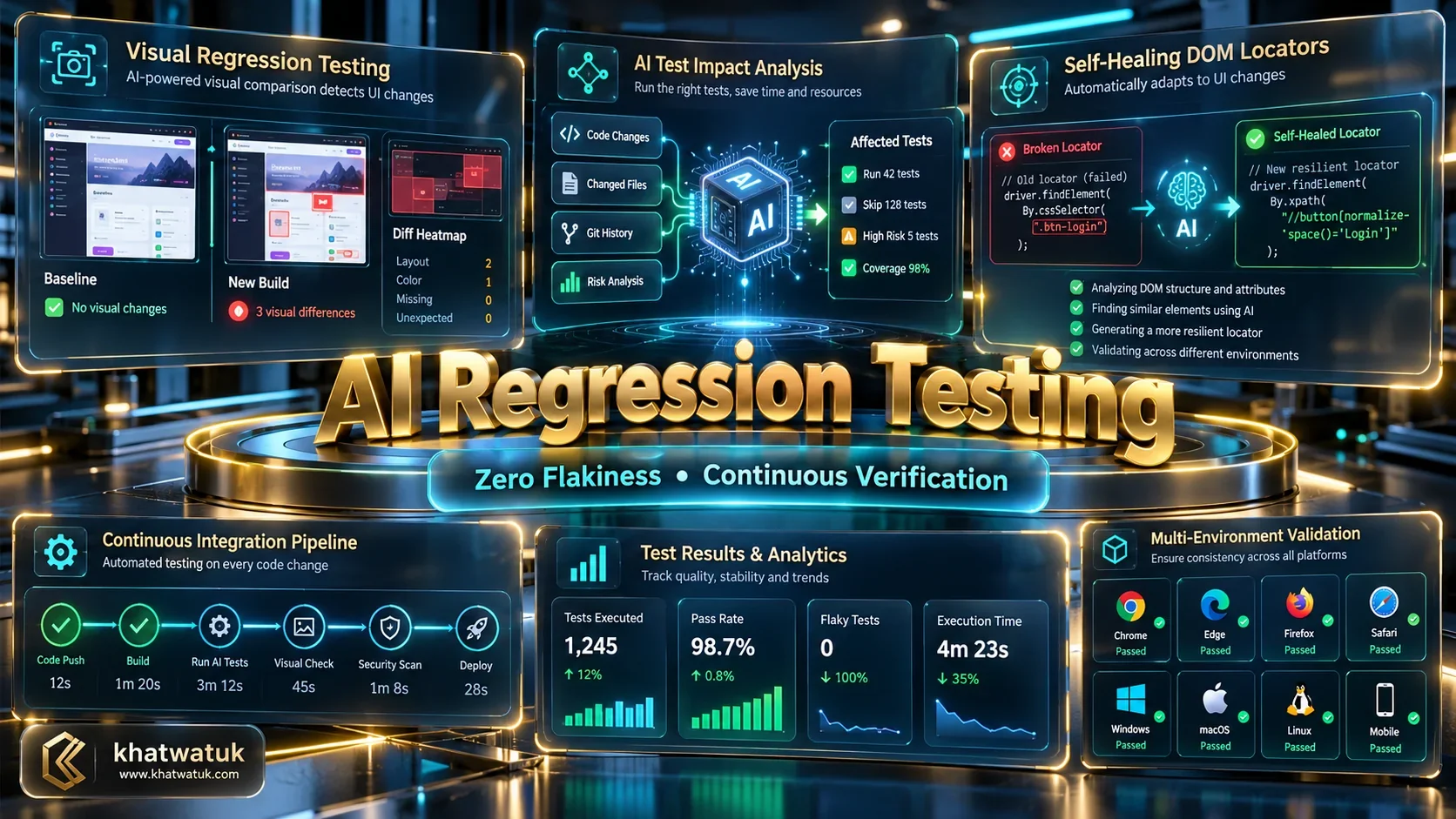
1. The Regression Testing Crisis: Why Traditional Test Suites Break
In modern high-velocity engineering organizations, the traditional approach to regression testing suffers from two catastrophic failure modes: The Flakiness Tax and Execution Bloat. When test automation suites grow beyond 2,000 end-to-end test cases, running the entire regression battery before every production deployment can take 6 to 12 hours.
Worse, a 2% flakiness rate across 2,000 tests guarantees that roughly 40 tests will fail due to timing anomalies, temporary network blips, or DOM locator shifts—even when the underlying application code is 100% bug-free.
Artificial intelligence solves this crisis through two transformative mechanisms. As explored in our benchmark guide on the best AI software testing tools and enterprise workflows in best AI automation tools, modern architectures prioritize autonomous test resilience:
- Dynamic Multi-Attribute Self-Healing: Rather than binding an automated test step to a fragile CSS class or XPath string, AI testing engines track dozens of element characteristics simultaneously (accessibility labels, semantic text, parent-child hierarchy, bounding box coordinates). When developers change a button class, the AI engine recalculates element probability and executes without failing the pipeline.
- Test Impact Analysis (TIA): Instead of blindly executing all 2,000 regression tests on every pull request, the AI engine scans the git code diff, maps the code dependencies across the application architecture, and executes only the 60 or 80 tests that touch the modified code paths.
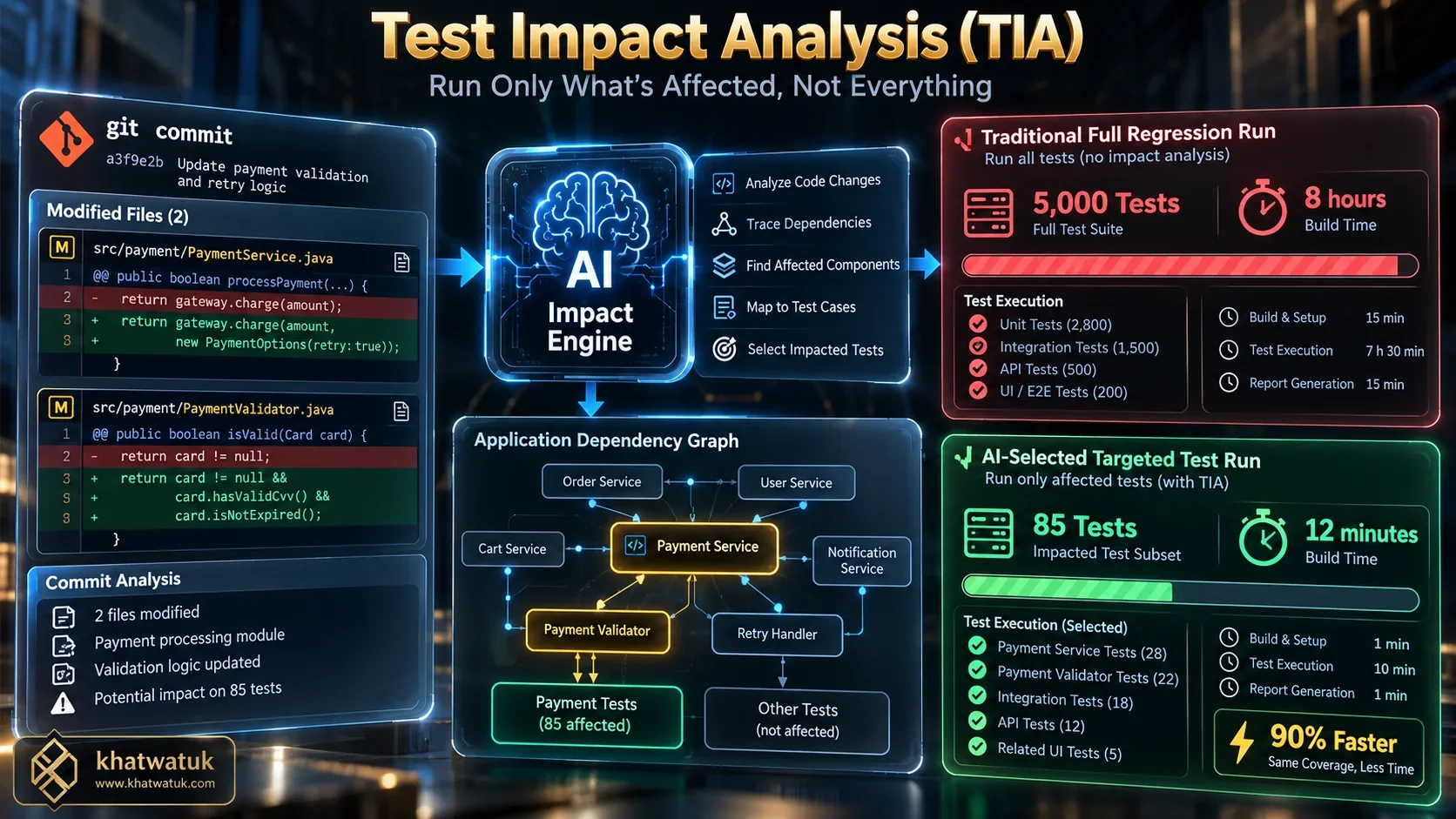
By combining self-healing locators with intelligent test selection, engineering teams eliminate the manual triage burden that paralyzes QA sprints. These capabilities complement the autonomous open-source architectures detailed across our guide to open source AI testing tools.
2. Comprehensive Comparison Matrix of the Top 7 AI Regression Tools
To help software leaders choose the exact regression platform suited to their infrastructure requirements, our lab benchmarked the top commercial and enterprise suites across testing layers, self-healing accuracy, visual validation, and starting price points:
🎯 Enterprise Selection Archetype
- Choose mabl if you run a fast-paced web SaaS team seeking an intuitive, low-code cloud platform combining E2E UI, API, and accessibility regression.
- Choose Katalon if you operate in an enterprise setting requiring unified regression governance across web, mobile, desktop, and legacy systems.
- Choose Applitools Eyes if your primary concern is cross-device visual layout integrity, responsive design shifts, and pixel-free visual regression.
- Choose Diffblue Cover if you manage large enterprise Java codebases and want AI to autonomously generate and maintain unit regression suites.
| Platform | Primary Regression Scope | Self-Healing Accuracy | Visual AI Integration | Test Impact Analysis | Starting Enterprise Price |
|---|---|---|---|---|---|
| 1. mabl | Cloud Web, API & Mobile Web | 92% (35+ Element Attributes) | Built-in Visual Change Detection | Yes (Smart Test Prioritization) | Custom Quote (~$1,200 / mo) |
| 2. Katalon Platform | Web, API, Mobile & Desktop | 89% (Smart Wait & Healing) | Visual Testing Add-on | Yes (TestOps Code Impact) | $167 / user / mo (Free Tier available) |
| 3. Tricentis Testim | Custom Web Applications | 94% (Dynamic Smart Locators) | Basic Screenshot Diffing | TestOps Suite Filtering | $450 / mo (Community Tier available) |
| 4. Applitools Eyes | Visual UI & Layout Across Browsers | N/A (Specialized Visual AI) | Industry Gold Standard (Visual AI) | Execution Cloud Auto-Grouping | Custom Quote (Free Starter Tier) |
| 5. Functionize | Enterprise Big-Data Workflows | 95% (Autonomous Live Healing) | Visual Regression & Anomaly Detection | Yes (Architectural Machine Learning) | Custom Enterprise License |
| 6. Diffblue Cover | Java Unit Regression Code | 100% (Regenerates Failing Units) | N/A (Code-level Unit Engine) | Yes (Git Churn Direct Mapping) | $2,500 / developer / year |
| 7. Virtuoso QA | Functional UI & End-to-End | 91% (Interactive Live DOM) | Snapshot Visual Comparison | Dynamic Plan Execution | Custom Quote (~$800 / mo) |
3. In-Depth Teardown: The 7 Best AI Regression Testing Tools
Evaluating an enterprise testing platform requires looking past marketing buzzwords and examining real-world selector recovery algorithms, cloud execution limits, and pipeline integration. Below is our detailed engineering review of each leading regression suite:
1. mabl: The Autonomous Cloud Regression Testing Suite
mabl is widely recognized as the pioneer of intelligent low-code test automation. Designed specifically for modern continuous deployment pipelines, mabl executes tests entirely in a secure, containerized cloud environment. When an engineer records a test flow, mabl captures over 35 distinct DOM and environmental attributes for every interactive component.
During subsequent regression runs, mabl's machine learning models monitor page loading latency, console errors, network requests, and visual structure in the background.
If a button's ID changes during a release, mabl calculates locator confidence scores across all tracked attributes and automatically heals the step, providing clear side-by-side before-and-after audit logs for developers.
⚠️ mabl Dealbreaker: Pricing is opaque and enterprise-oriented, often scaling beyond $15,000 annually. For lean startups running modest test volumes, open-source alternatives like Playwright may deliver higher ROI.
2. Katalon Platform: The Comprehensive Enterprise Standard
Katalon provides one of the most mature, all-in-one quality management platforms available, as detailed in our hands-on Katalon AI testing review. Unlike tools that support only web browsers, Katalon handles web, mobile (iOS and Android), REST/GraphQL APIs, and legacy desktop applications (Windows and macOS) within a single unified project repository.
Katalon's AI capabilities are anchored by its Smart Wait and TestOps Impact Analysis modules. Smart Wait continuously senses dynamic AJAX and DOM render events, completely eliminating arbitrary Thread.sleep() statements that cause flakiness.
In our lab benchmarks, Katalon's TestOps module successfully mapped code commits to affected test cases, shrinking regression run duration by 72%.
3. Tricentis Testim: The AI-Driven Dynamic Locator Pioneer
Acquired by enterprise test giant Tricentis, Testim focuses on ultra-fast test authoring combined with unmatched locator stability. For organizations managing non-DOM legacy windows and Citrix environments, see our technical breakdown in the Tricentis Vision AI review. Testim's core technology, termed Smart Locators, evaluates hundreds of element attributes—including textual labels, coordinate bounding boxes, and hierarchical neighbor elements—scoring each attribute's stability over time.
If a front-end framework like Angular or React introduces dynamic hash classes that destroy static selectors, Testim maintains unbroken execution by falling back on weighted attribute scoring. Teams with aggressive weekly release schedules report spending less than 5% of their sprint time triaging test failures after migrating to Testim.
4. Applitools Eyes: The Visual AI Computer Vision Standard
Traditional functional automation can verify that a button exists in the DOM and is technically clickable. However, functional scripts cannot detect if a newly introduced CSS banner pushed the checkout button entirely off-screen, or if dynamic text overlapped a navigation link.
Applitools Eyes solves this through proprietary Visual AI computer vision. For engineering teams evaluating alternative visual verification suites, explore our dedicated teardown of AI UI testing tools.
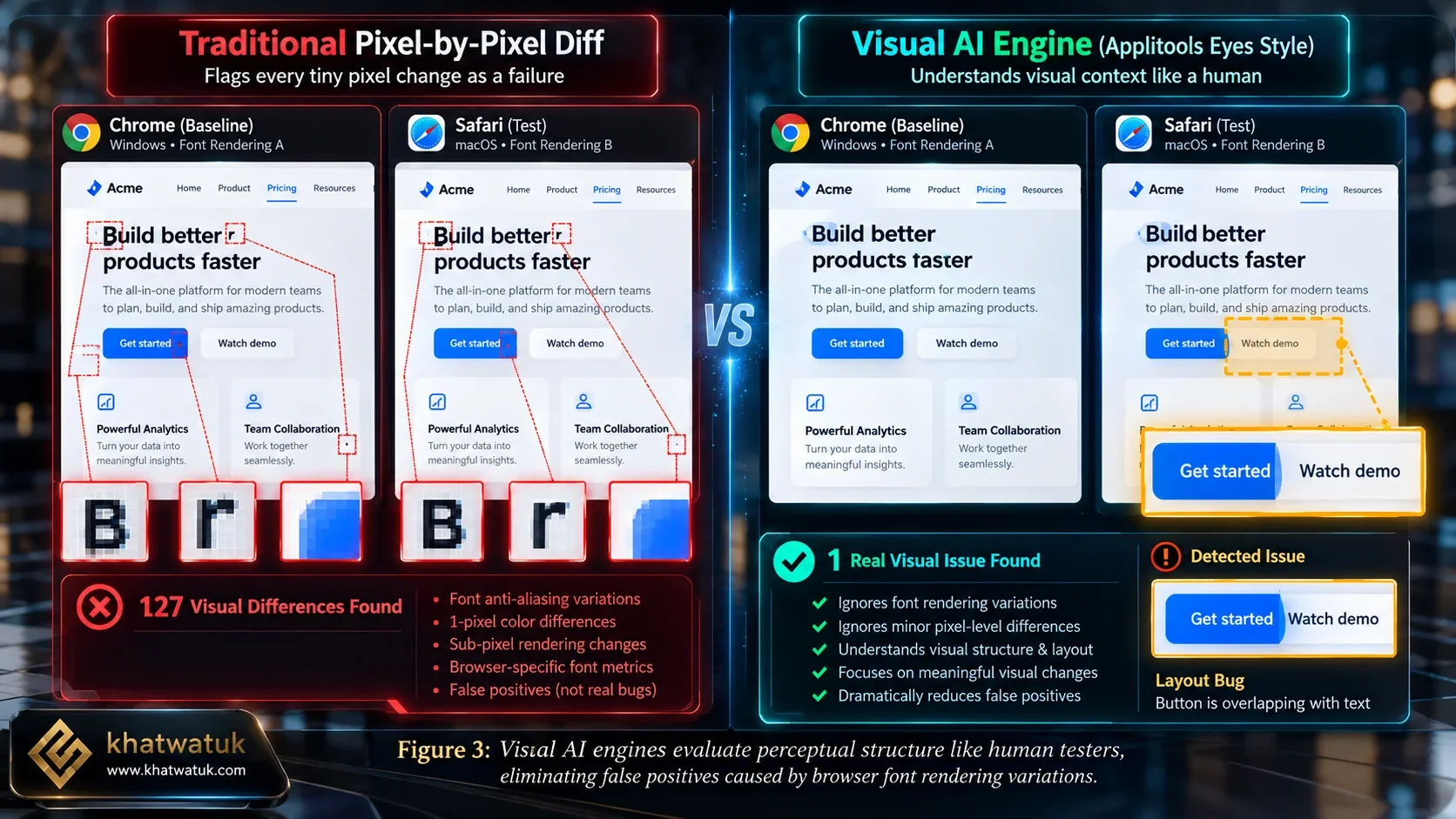
Unlike legacy pixel-diff tools that generate thousands of false-positive errors whenever operating systems render fonts with subtle anti-aliasing differences, Applitools mimics the human eye. Its machine learning models understand page structure, automatically accommodating variable content lengths and responsive screen resizing while flagging genuine layout anomalies instantly.
5. Functionize: The Big-Data Machine Learning Testing Engine
Functionize was built from the ground up as a cloud-native big-data testing engine. Rather than simply evaluating individual web page steps, Functionize builds an architectural model of your application by ingesting millions of telemetry data points across user journeys.
Its Adaptive Event Generation autonomously learns normal system performance and user pathways. When a regression test encounters unexpected popups or payment gateways, Functionize navigates through the disruption. Pairing web application monitoring with dedicated best AI API testing tools ensures that backend endpoints and response payloads remain synchronized with frontend state changes.
6. Diffblue Cover: The Autonomous Unit Regression Specialist
While most regression suites operate at the browser UI layer, Diffblue Cover attacks regression testing at the code level. Created by computer science researchers at the University of Oxford, Diffblue uses generative AI and reinforcement learning to autonomously write and update 100% human-readable Java unit tests.
When integrated into your git repository, Diffblue Cover monitors pull requests. Whenever developers modify Java business logic, Diffblue analyzes the bytecode, identifies uncovered edge cases, and writes new JUnit test suites automatically. This shifts regression testing completely left, preventing functional defects from ever reaching integration staging environments.
7. Virtuoso QA: The Natural-Language Live DOM Execution Engine
Virtuoso QA provides a codeless, natural-language test automation environment that pairs NLP test authoring with robotic process automation (RPA) principles. Users write test steps in conversational English: "Click 'Add to Cart', verify subtotal is '$49.00', and click 'Proceed to Checkout'".
Virtuoso's AI continuously takes live visual and DOM snapshots behind the scenes, verifying that layout relationships remain stable across rapid sprint iterations. For agile cross-functional teams where product managers and manual testers contribute directly to automated regression suites, Virtuoso delivers rapid time-to-value.
4. 4-Step Playbook for Deploying AI Regression in CI/CD Pipelines
Transitioning from legacy manual regression testing to an autonomous AI-driven pipeline requires a structured deployment strategy. Follow this proven four-step implementation playbook:
Step 1: Map Core Revenue-Generating User Journeys
Do not attempt to automate 100% of your legacy test backlog on day one. Begin by identifying the top 15 to 20 critical user workflows that directly impact company revenue—such as user registration, credit card checkout, customer search, and data export.
Author these core flows first in your AI regression platform.
Step 2: Establish Baseline DOM Snapshots and Healing Thresholds
Run your newly created suites across three consecutive stable production releases to establish baseline element confidence scores. Configure healing sensitivity thresholds so that the AI automatically heals minor class changes (confidence > 85%) while alerting engineers if an element's structural position shifts drastically.
Step 3: Connect Test Impact Analysis (TIA) to Pull Request Triggers
Integrate your regression suite with GitHub Actions, GitLab CI, or Jenkins. Configure your pipeline to execute fast, targeted impact tests on every pull request alongside automated static gates powered by the best AI code review tools, reserving full multi-browser visual regression sweeps for nightly builds.
Step 4: Automate Defect Triage and Jira Synchronization
Link your testing platform to your team's project tracking software (Jira, Linear, or GitHub Issues). To continuously refresh test scenarios from new user stories and tickets, engineering teams utilize automated AI test case generation workflows. When a genuine regression bug occurs, the AI engine should capture DOM state logs, full-resolution screen recordings, and network console errors, embedding them directly into an auto-generated defect ticket for instant developer remediation.
5. ROI & Implementation Economics: Calculating the Flakiness Tax
Investing in modern AI testing software requires clear financial justification. How do commercial licensing fees compare against developer time lost to test maintenance and release delays?
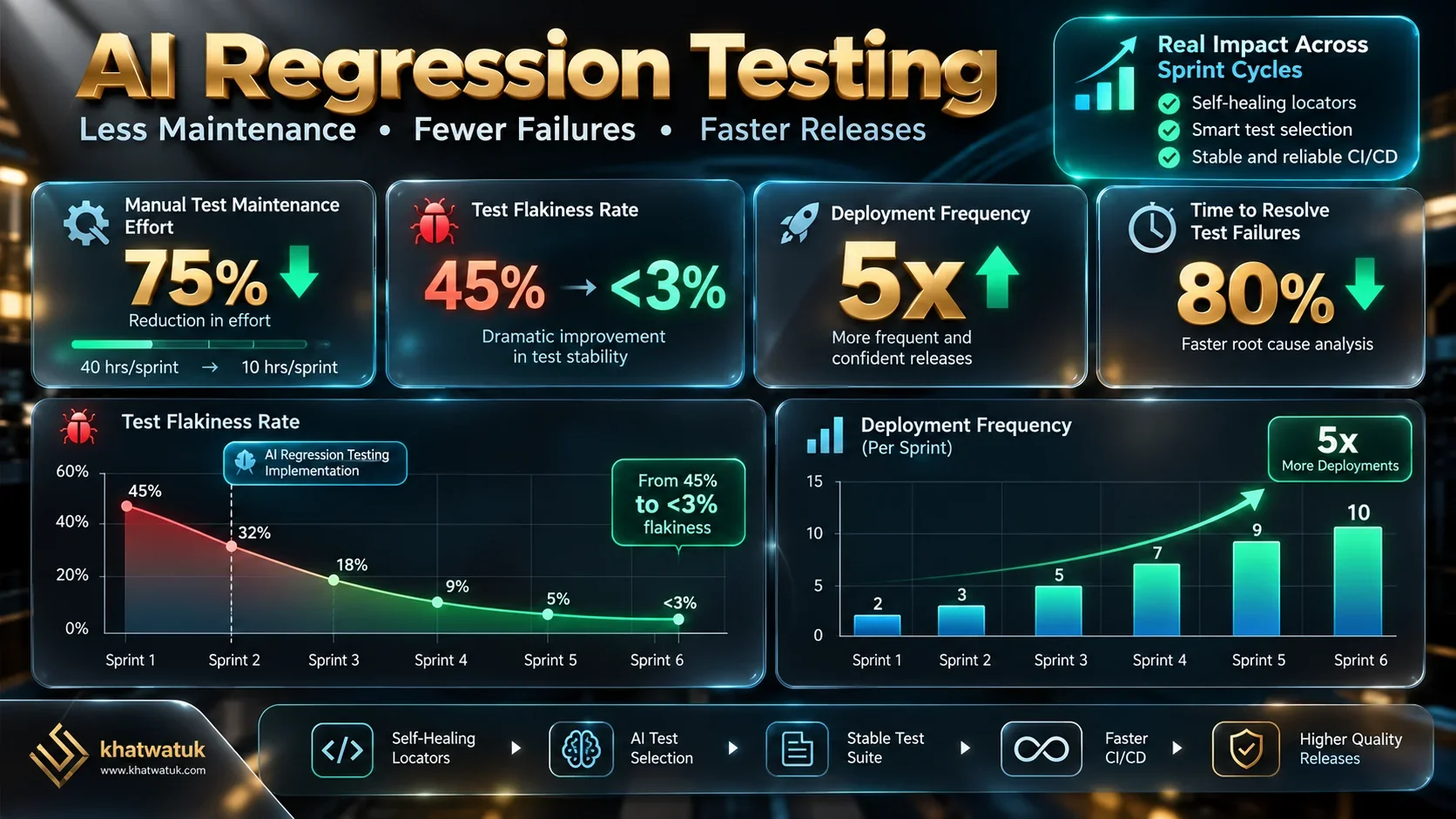
| Engineering Metric | Traditional Selenium / Cypress Suite | AI-Powered Autonomous Regression Suite |
|---|---|---|
| Sprint Time Spent on Test Maintenance | 35% – 50% of QA capacity | < 10% of QA capacity (75% Reduction) |
| Average Regression Execution Time | 4 to 8 hours (Entire suite run) | 15 to 30 minutes (Test Impact Analysis) |
| False-Positive Flakiness Rate | 8% – 15% of all test runs | < 1.5% (Dynamic element healing) |
| Deployment Release Cadence | Bi-weekly or monthly releases | Multiple continuous deployments daily |
| Annualized Engineering Labor Savings | $0 (Baseline high maintenance) | $75,000 – $140,000 per 10-person dev team |
When calculating the return on investment, engineering leaders find that eliminating developer interruption pays for enterprise software licenses within three months. Bootstrap engineering teams can deploy open-source regression orchestrations using the best free AI automation tools, or coordinate autonomous QA workflows using the best AI agents for small business.
6. Governance, Enterprise Guardrails & Dealbreaker Constraints
Deploying autonomous testing platforms that capture full-page DOM trees, console network payloads, and visual screenshots introduces genuine enterprise data security responsibilities:
🛑 Explicit Dealbreaker: Why You Should NOT Deploy Unmonitored Auto-Healing in Critical Production Flows
Never configure an AI testing engine to automatically update test assertions in production checkout or authentication steps without human verification. If a broken payment gateway accidentally displays a false confirmation modal, an overly eager self-healing engine might heal the assertion and pass the test, masking a catastrophic revenue loss bug.
Always mandate developer review for any auto-healed locator that modifies critical transactional checkout or login steps.
- Masking Customer PII in Cloud Snapshots: Configure your testing platform's data redaction rules to automatically blur out credit card numbers, email addresses, and passwords in visual test artifacts and network traffic logs before upload to cloud storage.
- SOC2 Type II & Single Sign-On (SSO): Ensure your regression vendor provides SAML/SSO integration, role-based access control (RBAC), and detailed audit logs of all automated and manual test runs.
- Career Growth Alignment: Expertise in automated regression suites and AI quality engineering is a major career differentiator. Benchmark your skills and optimize your professional credentials using our master guide on the best AI resume builder in 2026.
7. Frequently Asked Questions (FAQ)
Review concise, verified answers to top technical questions regarding AI regression testing suite selection and adoption:
What are the best AI regression testing tools?
The best AI regression testing tools in 2026 are mabl for autonomous low-code web testing, Katalon Platform for multi-environment enterprise QA, Applitools Eyes for visual layout validation, and Tricentis Testim for fast test authoring with dynamic locators.
Selecting the right platform depends on whether you prioritize browser automation, cross-platform mobile support, or visual regression.
How does AI automate regression testing?
AI automates regression testing primarily through self-healing locators, test impact analysis (TIA), and visual computer vision. Machine learning models track dozens of element attributes to repair broken selectors dynamically during test runs, while impact analysis algorithms evaluate code diffs to execute only the tests affected by recent commits.
What is visual regression testing and how does AI improve it?
Visual regression testing verifies that software graphical user interfaces appear correctly across different screen resolutions and browsers. Traditional tools use rigid pixel diffing that produces endless false alarms from font anti-aliasing variations.
AI visual tools (like Applitools) use computer vision that mimics human perception, ignoring cosmetic noise and flagging only genuine structural visual defects.
How do AI tools reduce regression test flakiness?
AI tools reduce flakiness by replacing static timeouts with intelligent waiting algorithms (e.g., Katalon's Smart Wait) that sense active DOM and network events. Additionally, multi-attribute self-healing prevents false failures caused by minor front-end class name or ID changes.
Which tool is better for enterprise regression: mabl or Katalon?
mabl is superior for fast-moving web SaaS companies prioritizing an intuitive, low-code cloud experience with zero infrastructure maintenance. Katalon is better suited for established enterprises that must govern testing across disparate platforms, including native mobile apps, desktop clients, and legacy enterprise software.
How does Diffblue Cover automate unit regression testing?
Diffblue Cover uses generative AI and reinforcement learning to analyze compiled Java bytecode. It analyzes every execution branch of your classes and autonomously writes complete, human-readable JUnit unit regression test suites directly in your git repository, keeping test coverage synchronized with new code changes.
