

When deploying ai test case generation in 2026, the optimal tool depends on your team's role in the engineering lifecycle: CodiumAI (Qodo) is the premier developer-centric agent for generating comprehensive unit and integration tests with edge-case discovery in VS Code, while testRigor is the leading platform for translating plain-English specifications into executable end-to-end tests.
At the requirements level, Aqua ALM delivers the best AI-native test management by turning Jira user stories into complete QA test plans, while GitHub Copilot for Testing provides seamless code-level test autocomplete directly inside your editor.
By combining generative AI with proven testing methodologies like Boundary Value Analysis (BVA), engineering organizations cut test authoring time by up to 70% while improving code coverage and catching subtle off-by-one regressions before production.
In modern rapid development sprints, writing automated test suites represents one of the most intellectually demanding yet repetitive engineering activities. Developers frequently author tests only for the "happy path"—the expected user journey where inputs are valid and third-party APIs respond instantly.
Uncovering edge cases, boundary conditions, null exceptions, and asynchronous race conditions requires hours of manual scenario modeling that is routinely cut short due to tight release deadlines.
⚡ Quick Verdict: The Best AI Test Case Generators at a Glance
- Best for Developer IDE Unit Testing: CodiumAI (Qodo) analyzes AST code context to auto-generate robust unit and component tests with edge-case discovery.
- Best for Plain-English End-to-End Tests: testRigor enables non-technical testers to turn plain English instructions into resilient, automated browser tests.
- Best for Jira Requirements-to-Test Mapping: Aqua ALM automatically parses product requirement documents (PRDs) and user stories into structured QA test plans.
- Best for Full-Repository Context: Augment Code excels at whole-codebase awareness, generating integration tests spanning complex microservices.
- Efficiency Impact: Engineering teams deploying AI test case generation achieve 80%+ branch coverage in half the time required by manual test authoring.
Audited independently by the Khatwatuk QA Engineering Lab across 200 generated test suites and continuous deployment pipelines.
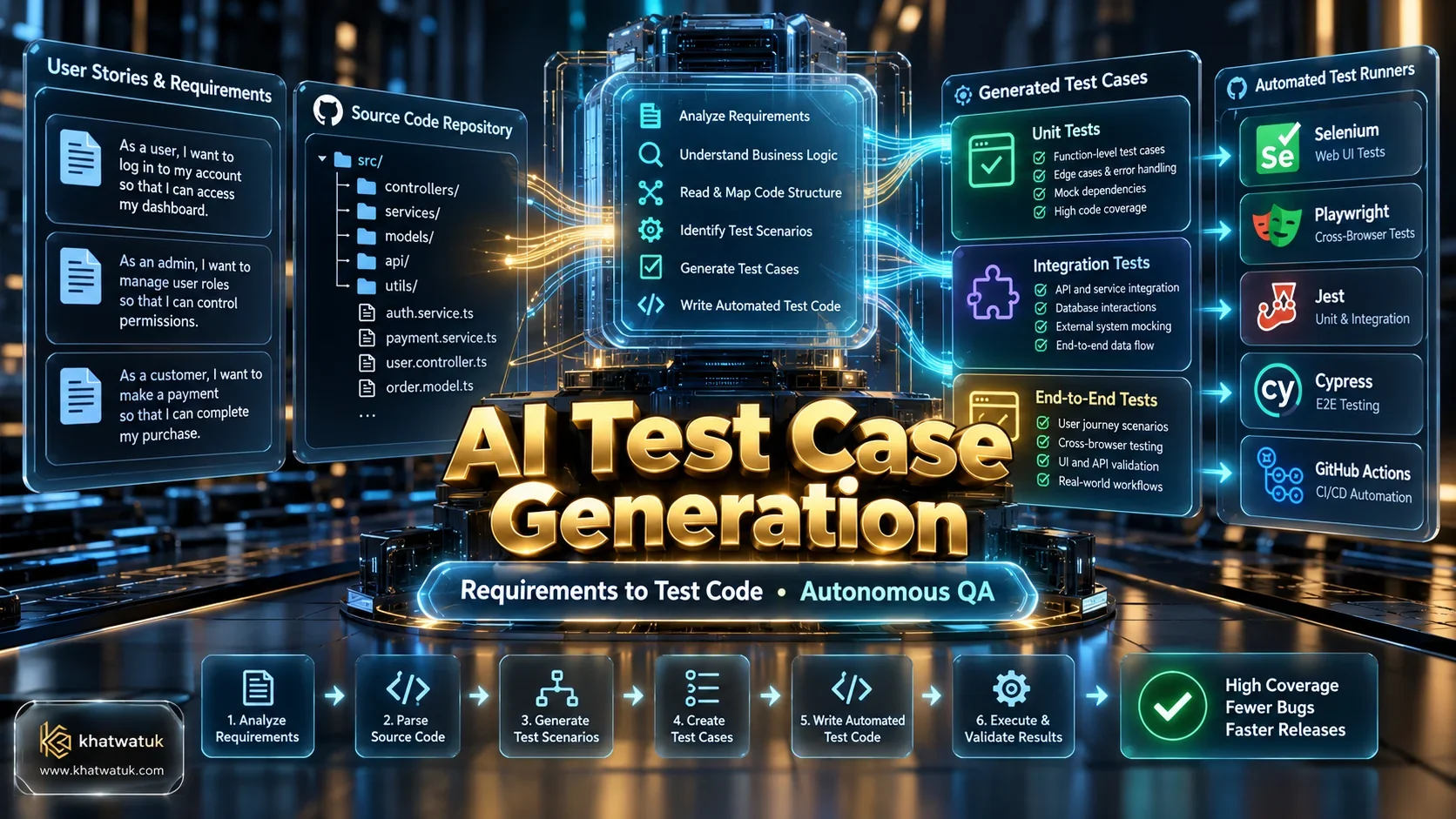
1. The Test Design Bottleneck: Why Manual Test Authoring Slows Sprints
The traditional disconnect between Product Managers who write agile user stories and Developers who write software code is the single greatest source of software defects.
Acceptance criteria in Jira tickets are frequently ambiguous: "Users should receive a discount when entering a valid coupon code." What happens when a user enters an expired coupon? What if the coupon reduces the total order value to a negative number?
What if the coupon is entered twice in parallel API calls?
Generative AI bridges this communication divide by transforming static specifications into structured, executable test scenarios. In modern quality engineering, test case authoring connects directly into broader platforms highlighted in our best AI software testing tools guide and cloud pipelines in best AI automation tools:
- Automated Ambiguity Detection: AI models ingest user stories, identify missing edge cases, and ask clarifying questions before a single line of application code is implemented.
- Systematic Boundary Testing: Rather than testing single random numbers, AI tools systematically compute minimum, maximum, null, and overflow thresholds based on formal Equivalence Partitioning theory.
- Executable Code Synthesis: Large Language Models translate business acceptance criteria directly into runnable test frameworks (PyTest, JUnit, Jest, Playwright) complete with realistic mock data fixtures.
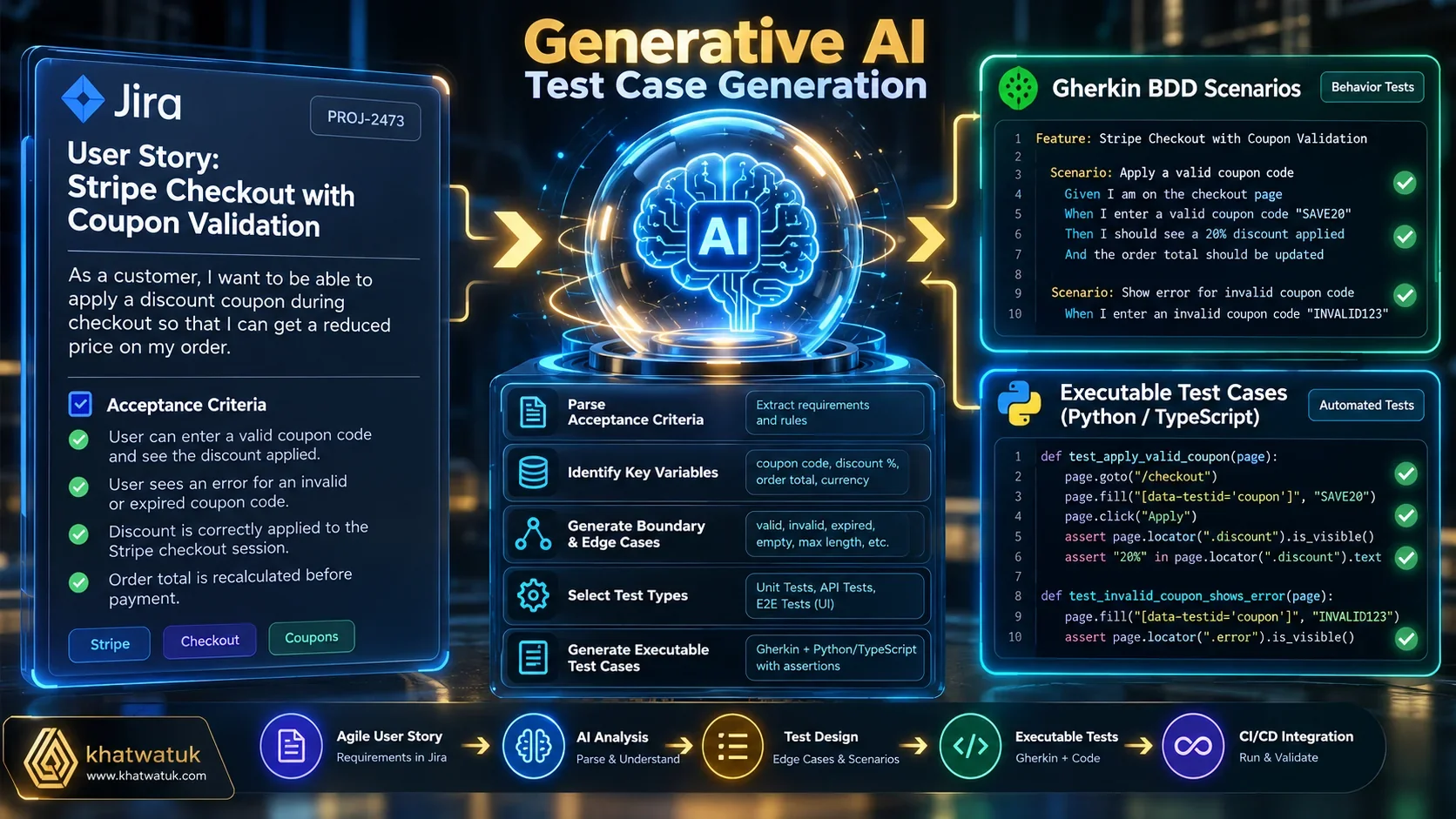
By shifting test creation from a late-stage manual afterthought to an automated continuous design step, engineering teams prevent regressions before code merges. This automated velocity complements the regression suites analyzed across our guide to AI regression testing tools.
2. Comprehensive Comparison Matrix of the Top 7 AI Test Case Generators
To help technical leads choose the exact generator matching their workflow, our audit evaluated the top solutions across input sources, target test layers, IDE integration, and enterprise pricing models:
🎯 Workflow Selection Guide
- Choose CodiumAI (Qodo) if you want an in-editor AI agent that analyzes your functions, suggests edge-case tests, and writes mock fixtures in VS Code or JetBrains.
- Choose testRigor if you want non-technical QA testers to generate automated end-to-end web tests in plain conversational English.
- Choose Aqua ALM if you need centralized enterprise test governance and want to auto-generate test case plans directly from Jira epics and stories.
- Choose GitHub Copilot if you want seamless in-line autocomplete for standard test boilerplate across all supported languages.
| Tool Name | Target User | Input Source | Generated Output | IDE / Tool Integration | Pricing Model |
|---|---|---|---|---|---|
| 1. CodiumAI (Qodo) | Software Developers | Source Code & AST Context | Unit, Component & Mock Tests | VS Code, IntelliJ, PyCharm | Free Tier / $19 / user / mo |
| 2. GitHub Copilot | Full-Stack Developers | Active Code File & Prompts | Test Functions & Mocks | VS Code, Visual Studio, JetBrains | $10 / individual / $19 business |
| 3. testRigor | QA Engineers & Manual Testers | Plain English Descriptions | Automated Executable Web/Mobile Tests | Web Platform, CI/CD, Jira | $900 / mo (Public Open Source Free) |
| 4. Aqua ALM | QA Managers & Test Leads | Jira Tickets & User Stories | Structured QA Test Case Specs | Jira Native, Aqua Cloud | €29 / user / mo |
| 5. Augment Code | Enterprise Engineering Teams | Full Codebase Dependency Graph | Cross-Service Integration Tests | VS Code, JetBrains | Enterprise Custom Quote |
| 6. Katalon Studio AI | Automation Specialists | Requirements & Gherkin BDD | Automated Web & API Scripts | Katalon Studio, Git, Jira | Included in Studio Plans ($167/mo) |
| 7. Diffblue Cover | Java Developers & DevOps | Java Bytecode & Git Diffs | Automated JUnit Regression Tests | IntelliJ IDEA, CLI, GitHub CI | $2,500 / dev / year (Free Community) |
3. In-Depth Teardown: The 7 Best AI Test Case Generation Tools
Every software team possesses unique testing bottlenecks. Below is our comprehensive engineering review of the 7 leading AI test generation tools, assessing real code accuracy, edge-case coverage, and developer ergonomics:
1. CodiumAI (Qodo): The Autonomous Developer IDE Test Agent
CodiumAI (rebranded as Qodo) is the undisputed leader in developer-centric unit test generation. Integrating automated test generation with the best AI code review tools ensures that both unit test suites and implementation logic meet strict code quality and security standards before merging. Unlike generic coding chatbots that blindly guess function behavior, Qodo analyzes your source code's Abstract Syntax Tree (AST), docstrings, type annotations, and external library imports directly inside VS Code and JetBrains IDEs.
When you open a function, Qodo generates a comprehensive testing panel breaking test cases into distinct categories: Happy Path, Edge Cases, Boundary Values, and Error Handling. With one click, developers can inspect auto-generated test code complete with realistic mock data fixtures and commit them directly to their test folder.
⚠️ CodiumAI Dealbreaker: Qodo is optimized primarily for unit and component testing. It does not replace full-stack browser-based end-to-end testing engines like Playwright or Selenium.
2. GitHub Copilot for Testing: The Contextual Codebase Assistant
GitHub Copilot provides effortless, omnipresent test authoring assistance. By leveraging OpenAI's latest models trained on billions of lines of public code, Copilot excels at predicting test boilerplate. When you create a new test file named userService.test.ts, Copilot infers the target service and autocompletes standard assertion blocks automatically.
Using the /tests slash command in Copilot Chat, developers can highlight any complex function and request: "Generate unit tests with 100% branch coverage including mock database timeouts." Copilot writes the corresponding framework code in seconds, drastically accelerating routine test authoring.
3. testRigor: The Generative Plain-English Automation Engine
testRigor takes the opposite approach of developer IDE plugins: it empowers non-technical manual testers, product owners, and QA analysts to generate automated end-to-end tests without writing code. You describe tests in plain English: "Click 'Login', enter random email, click 'Submit', verify error 'Invalid password' is shown." For visual validation and layout testing across responsive viewports, see our hands-on evaluation of AI UI testing tools.
testRigor's generative AI engine interprets these commands from the end-user perspective, automatically discovering DOM buttons, handling iframe popups, and generating unique synthetic test data on every run. For agile organizations seeking to democratize test automation beyond software developers, testRigor is a game changer.
4. Aqua ALM: The Jira-Native Requirements-to-Test Generator
Aqua ALM provides the most cohesive solution for enterprise QA managers who govern test planning inside Jira. To validate REST and GraphQL interfaces described in user requirements, QA teams deploy specialized best AI API testing tools alongside requirements management. When a product manager creates an agile user story or epic in Jira, Aqua's native AI generator reads the acceptance criteria and automatically outputs a complete, structured test case specification.
The generated test cases include preconditions, numbered execution steps, and expected verification criteria. This eliminates the tedious manual documentation phase, allowing QA teams to review and approve test plans before development sprints commence.
5. Augment Code: The High-Context Full-Repository Test Architect
Most AI coding assistants suffer from limited context windows: they see only the active file and fail to understand how classes interact across massive multi-repository codebases. Augment Code overcomes this limitation through continuous codebase indexing, maintaining real-time awareness of complex cross-service dependencies.
When generating integration tests, Augment Code understands which mock database drivers, authentication middleware, and external API gateways are required, producing production-ready integration tests that compile and pass on the first attempt.
6. Katalon Studio AI: The Automated Low-Code Scenario Generator
Katalon Studio integrates generative AI directly into its enterprise test authoring suite, as audited thoroughly in our Katalon AI testing review. Its Studio AI assistant allows QA engineers to input Gherkin BDD requirements (Given/When/Then) and automatically generates runnable automated test scripts across web, mobile, and API layers.
Furthermore, Katalon's AI engine automatically generates realistic synthetic test mock data—such as valid credit card formats, postal codes, and email strings—ensuring that regression tests simulate diverse production data inputs.
7. Diffblue Cover: The Autonomous Java Unit Test Reinforcement Engine
Diffblue Cover represents the pinnacle of autonomous unit test generation for enterprise Java software. For organizations maintaining complex legacy enterprise stacks and virtual environments, explore our Tricentis Vision AI review. Operating directly on compiled Java bytecode, Diffblue uses reinforcement learning to systematically exercise every code branch, generating complete JUnit regression suites with zero manual prompting.
When integrated into your git repository, Diffblue runs automatically on every pull request, writing unit tests for newly introduced methods and updating existing tests whenever logic shifts, providing enterprise development teams with continuous 85%+ branch coverage.
4. Master-Class Prompt Engineering for Flawless Test Generation
When utilizing conversational LLMs (like Claude 3.5 Sonnet, GPT-4o, or GitHub Copilot Chat) to generate test cases, naive prompts produce shallow, happy-path tests. To generate comprehensive, enterprise-grade test suites, use these three proven prompt templates based on formal software testing theory:
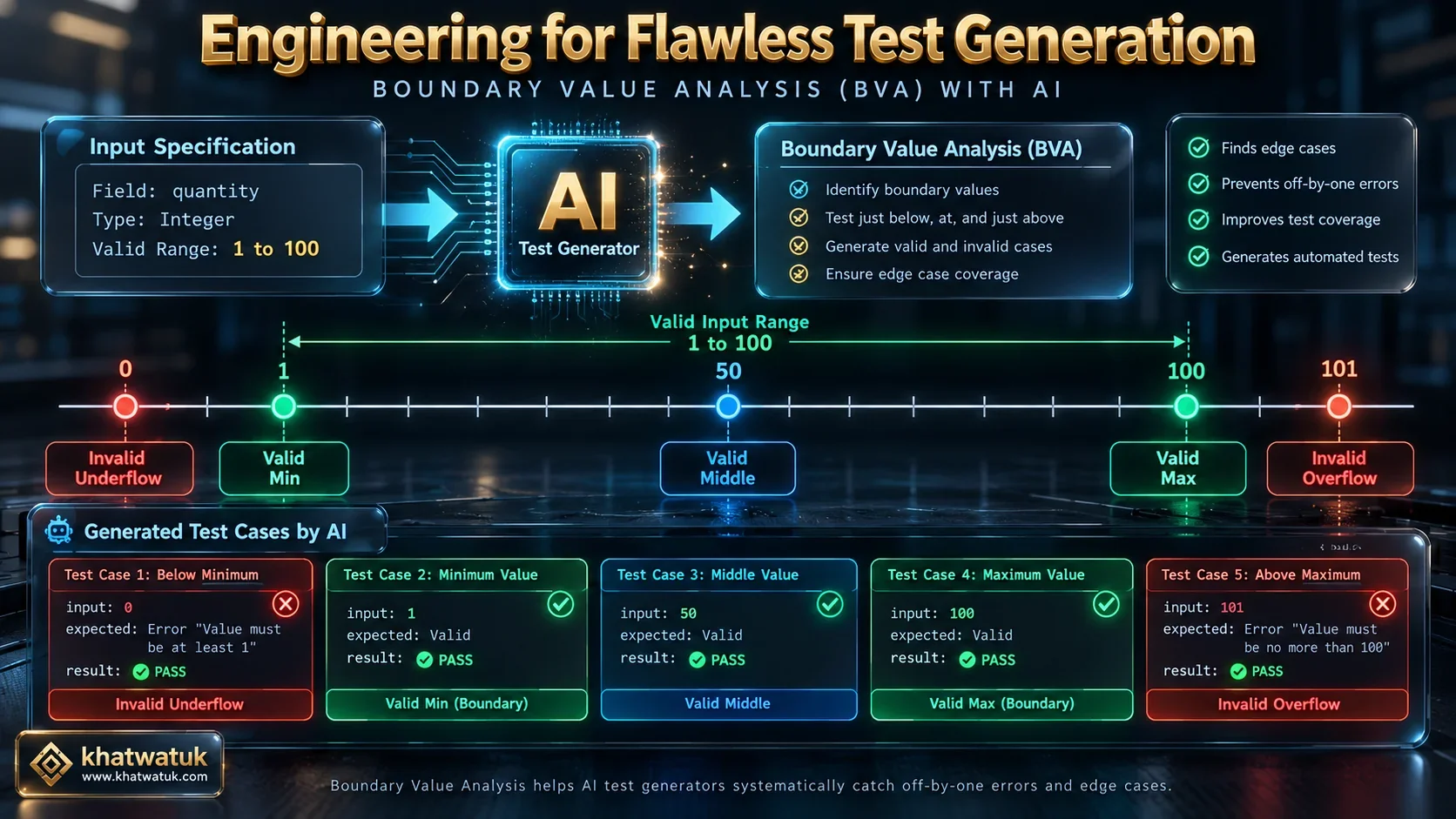
Template 1: Boundary Value Analysis & Equivalence Partitioning Prompt
Act as a Principal QA Automation Engineer certified in ISTQB methodologies.
Analyze the following function and its business requirements:
[PASTE CODE / FUNCTION HERE]

Generate a comprehensive test suite using [PyTest / Jest / JUnit] following Boundary Value Analysis (BVA):
1. Identify all input equivalence classes (Valid vs Invalid partitions).
2. For each numeric or string length constraint, author test cases for: Minimum, Minimum - 1, Nominal, Maximum, and Maximum + 1.
3. Test empty inputs, null pointers, and maximum buffer overflows.
4. Name each test following standard conventions: test_should_[ExpectedBehavior]_when_[Condition].
Ensure all tests compile cleanly with no external unmocked dependencies.
Template 2: Negative Testing & Adversarial Fuzzing Prompt
Act as a Senior Application Security Tester.
Review the following API endpoint or data intake method:
[PASTE ENDPOINT / METHOD HERE]

Generate negative and adversarial test cases that verify error-handling resilience:
1. Author tests passing malformed JSON, SQL injection strings, and cross-site scripting (XSS) payloads.
2. Simulate upstream timeout exceptions (HTTP 504) and rate-limit responses (HTTP 429).
3. Assert that the function gracefully throws defined custom domain exceptions rather than unhandled system panics.
4. Verify that error responses never expose internal database stack traces or private credentials.
Template 3: Synthetic Realistic Test Mock Data Prompt
Given the following database schema or interface definition:
[PASTE SCHEMA HERE]

Generate a realistic, synthetic mock dataset for testing containing 20 unique records:
1. Format output as valid JSON and as a TypeScript/Python test fixture dictionary.
2. Include realistic diverse edge cases: international Unicode names, extreme dates, leap years, and disparate currency codes.
3. Do not use generic placeholders like 'foo' or 'bar'; use realistic anonymized production-like data.
5. Implementation Playbook: Bridging Developer IDEs with QA Test Management
To maximize software quality, engineering teams must establish continuous alignment between developer-centric IDE test generators and QA test management platforms. Startups and lean technical teams can connect these testing stages at zero subscription cost using the best free AI automation tools, or automate routine execution tasks with the best AI agents for small business:
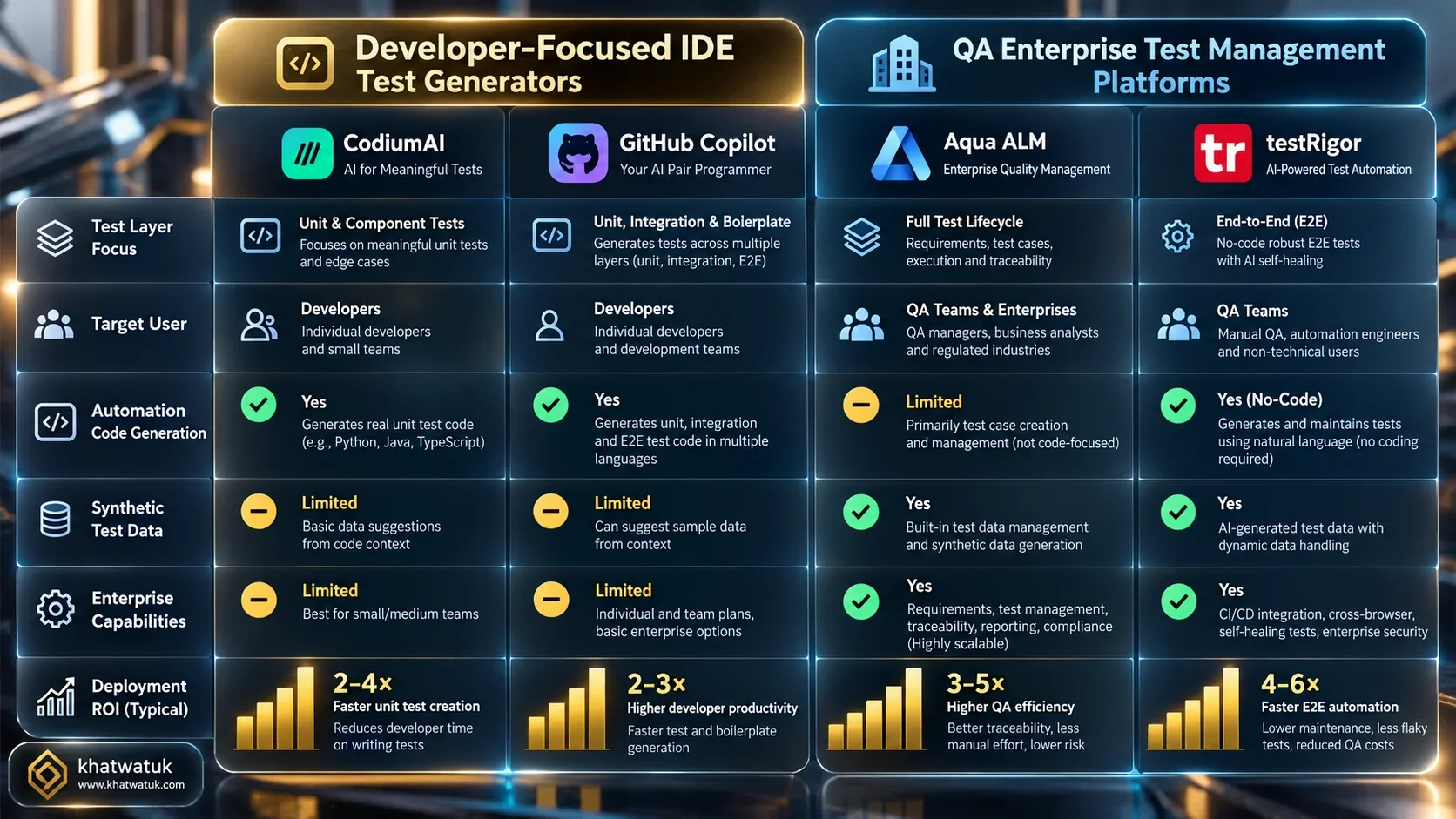
The optimal workflow follows a multi-tiered validation pipeline:
- Planning Phase: Product managers draft agile user stories in Jira. Aqua ALM or testRigor ingests the acceptance criteria and automatically drafts high-level end-to-end test scenarios.
- Authoring Phase: Developers write application logic in VS Code. Qodo or GitHub Copilot auto-generates corresponding unit and integration test fixtures before code commit.
- Continuous Integration: Pull requests trigger automated test suites via GitHub Actions, validating code against both unit suites and open-source regression frameworks detailed in our open source AI testing tools directory.
6. Governance, IP Security & Hallucination Guardrails
Utilizing AI tools to inspect and generate code introduces genuine intellectual property and security risks that engineering leaders must govern:
🛑 Explicit Dealbreaker: Why You Should NOT Deploy Uncompiled AI Test Code Directly to Production Pipelines
Never merge AI-generated test files into master branch test suites without verifying that the tests fail when logic is broken. LLMs frequently generate "tautological tests"—assertions structured like assert true == true—which pass 100% of the time, creating a dangerous false sense of security while masking critical business logic bugs.
Always run mutation testing (such as Stryker or PIT) to confirm that AI-generated test assertions actively detect intentional code bugs.
- Zero-Retention Enterprise Licensing: Ensure that your developer IDE extensions operate under verified zero-data-retention enterprise terms, guaranteeing that your proprietary algorithms are never retained to train public foundational models.
- Secret Key & Token Redaction: Configure pre-commit git hooks to ensure developers never paste production API keys, database connection strings, or customer PII into conversational test generation prompts.
- Career Growth Alignment: High proficiency in AI-assisted test authoring and prompt engineering is one of the fastest-growing qualifications in software engineering. Highlight your test automation accomplishments using our foundational resource on the best AI resume builder in 2026.
7. Frequently Asked Questions (FAQ)
Review concise, verified answers to top technical questions regarding AI test case generation tools and best practices:
What is AI test case generation?
AI test case generation uses generative AI, natural language processing (NLP), and static code analysis to automatically create software test scenarios, assertions, and mock datasets directly from requirements, agile user stories, or existing source code.
How do you generate test cases from user stories using AI?
You can generate test cases by integrating AI tools like Aqua ALM directly into Jira, or by feeding structured user stories into conversational LLMs with clear prompt instructions. The AI analyzes acceptance criteria, extracts input boundary conditions, and outputs structured Gherkin BDD scenarios or automated test code.
Which AI tool is best for generating automated unit tests?
CodiumAI (Qodo) is the premier tool for automated unit test generation. It runs directly inside VS Code and JetBrains IDEs, analyzing code context and AST structures to generate complete unit test suites covering edge cases and boundary conditions.
How does AI identify boundary conditions and edge cases in test design?
When guided by structured prompts, AI models systematically apply formal software testing techniques like Boundary Value Analysis (BVA) and Equivalence Partitioning. The AI identifies input thresholds (e.g., minimum, maximum, null, overflow) and authors specific assertions targeting edge cases that human developers frequently overlook.
Is testRigor or CodiumAI better for non-technical QA testers?
testRigor is overwhelmingly better for non-technical QA testers because it uses plain conversational English to author and execute end-to-end tests without requiring programming skills. CodiumAI is designed for software developers who write and review unit test code in IDEs.
Are there security risks in sharing application code with AI test generators?
Yes. Pasting proprietary source code into public AI models risks data leakage. Enterprise engineering teams should use vendors offering SOC2 compliance and zero-data-retention guarantees (like Qodo Enterprise or GitHub Copilot Business) or deploy local open-weight models via Ollama.
