

Learning how to automate your job search in 2026 requires deploying an integrated, four-stage Human-in-the-Loop stack rather than relying on risky bulk-application bots. By automating algorithmic role discovery, ATS-aligned resume tailoring, browser-based application autofill, and CRM pipeline tracking, candidates eliminate 15 to 20 hours of weekly administrative grunt work while dramatically increasing interview callback rates.
Quick Verdict: The 2026 Job Search Automation Blueprint
- Core Operating Standard: Deploy a four-tier modular stack (Discovery → ATS Tailoring → Copilot Autofill → CRM Tracking) while preserving human review before final submission.
- Best Discovery & Tracking Hub: Teal — Chrome extension bookmarking across 40+ job boards with unified Kanban management.
- Best ATS Keyword Tailoring: Jobscan — Industry-standard ATS gap diagnostics reverse-engineering employer parsing algorithms.
- Best Application Autofill: Simplify Copilot — Free browser assistant eliminating repetitive data entry on Greenhouse and Workday.
- Expected Performance Gain: Reduces weekly administrative application time from 20 hours to under 4 hours while tripling interview conversion velocity.
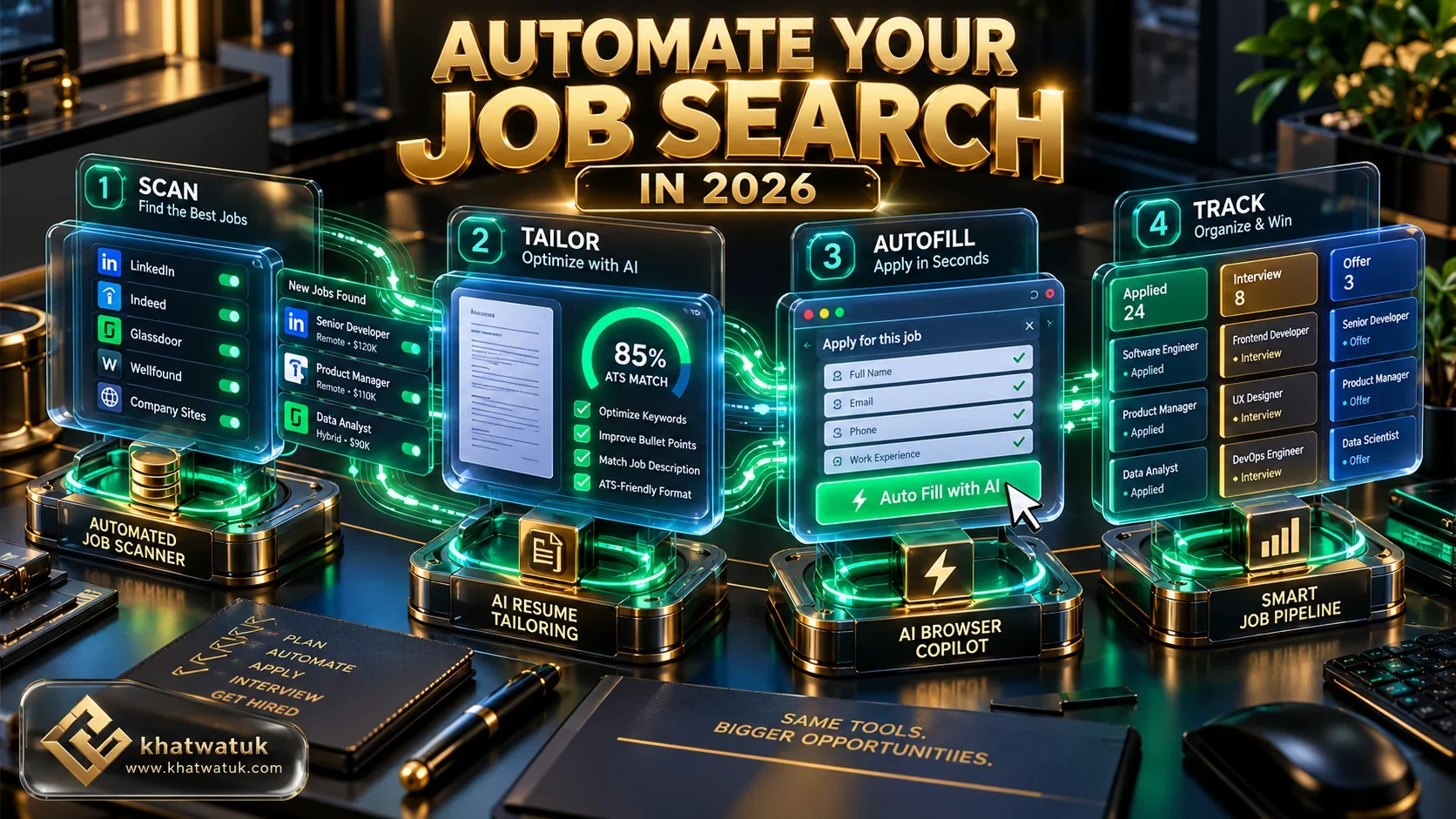
Table of Contents
- 1. The High-Volume Trap: Why Spray-and-Pray Job Bots Fail
- 2. The 4-Pillar Job Search Automation Architecture
- 3. Stage 1: Automating Job Discovery and Precision Alerts
- 4. Stage 2: Automating ATS Resume Tailoring and Keyword Match
- 5. Stage 3: Accelerating Applications with AI Browser Copilots
- 6. Stage 4: Automating Job Tracking and Recruiter Follow-Ups
- 7. Comparison Matrix: Best Job Search Automation Tools in 2026
- 8. Archetype Comparison: Which Automation Stack Fits Your Profile?
- 9. Alternative: Building a Free No-Code Automation Pipeline
- 10. Job Search Automation Safety Rules: How to Avoid Account Bans
- 11. Where to Draw the Line: What You Must Never Automate
- 12. The 7-Day Job Search Automation Action Plan
- 13. Frequently Asked Questions
The High-Volume Trap: Why Spray-and-Pray Job Bots Fail
Blasting hundreds of automated applications with unattended bots is the fastest route to getting disqualified from corporate hiring pipelines in 2026. Enterprise hiring systems have deployed sophisticated defensive algorithms specifically designed to intercept, flag, and silently drop high-velocity automated submissions. Candidates who rely on sheer volume without personalization face diminished response rates and risk permanent domain blacklisting.
Understanding the fundamental mechanics of recruitment technology clarifies why blind automation backfires. When you explore our detailed benchmark on the Best AI Resume Builder in 2026, targeted documents consistently generate higher interview conversion than generic templates. High-leverage automation does not replace candidate judgment; it eliminates administrative friction while keeping your credentials razor-sharp.
How Enterprise Recruiters Spot and Filter AI Bot Applications
Modern Applicant Tracking Systems such as Workday, Greenhouse, and Lever utilize behavioral heuristics and rate-limiting triggers to detect robotic submissions. When an IP address submits dozens of multi-page job forms within minutes, security protocols flag the activity as automated script behavior. Candidates submitting generic profiles without tailored keywords are routed directly into archival rejection queues before human recruiters ever review them.
Furthermore, corporate hiring teams look for obvious AI generation markers in open-ended answers and cover letters. Generic phrasing, hallucinated tool proficiencies, and repetitive syntactic structures signal low-effort applications. This operational bottleneck explains why mass application campaigns frequently achieve callback rates below 0.2%, wasting valuable career opportunities.
The Solution: The "Human-in-the-Loop" (HITL) Automation Standard
The Human-in-the-Loop methodology resolves the tension between rapid submission speed and high conversion quality. Under this framework, automated software handles the tedious 90% of job hunting: aggregating listings, extracting keywords, filling repetitive portal fields, and tracking pipeline stages. However, the candidate retains absolute control over the final 10% by reviewing customized responses and executing the ultimate submission click.
By dedicating 60 seconds to verifying each application before hitting submit, you ensure perfect demographic data accuracy and eliminate hallucinated text. This deliberate balance satisfies corporate compliance checks, bypasses anti-bot defenses, and preserves the authentic voice needed to impress hiring managers.
The 4-Pillar Job Search Automation Architecture
A high-converting job search functions exactly like an automated enterprise sales pipeline. Instead of treating job hunting as a chaotic manual scramble across disconnected browser tabs, top candidates structure their workflow into four specialized, sequential pillars. Each pillar addresses a specific operational bottleneck, converting raw labor into predictable interview invitations.
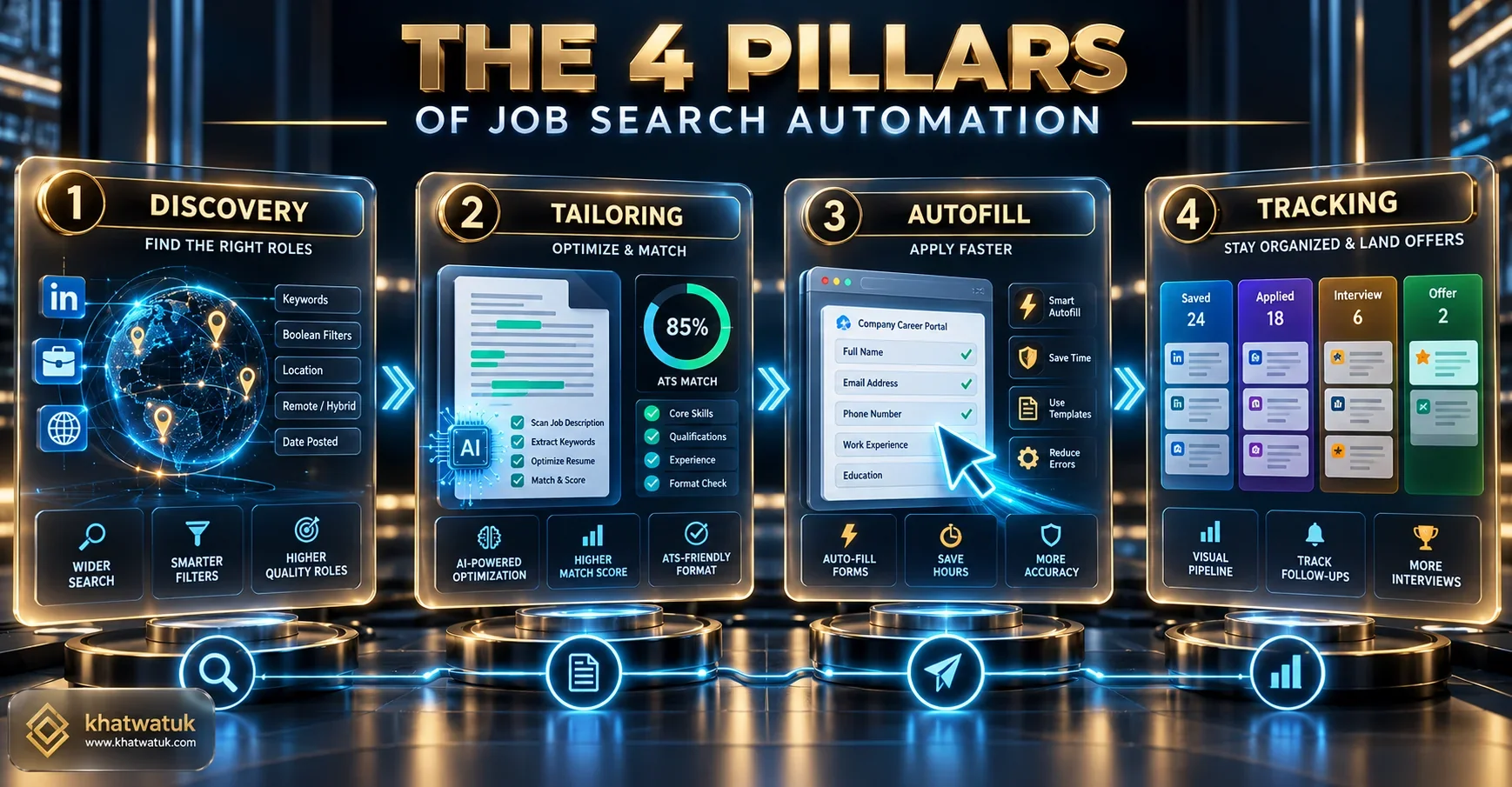
Pillar 1: Algorithmic Discovery & Precision Alerts. Filter out 95% of irrelevant postings automatically using Boolean logic and programmatic feeds so that only high-fit roles land in your review queue.
Pillar 2: ATS-Aligned Resume & Cover Letter Tailoring. Extract technical skills and contextual keywords instantly to align your existing achievements with employer scoring models.
Pillar 3: Browser Copilot Form Autofill. Populate 10-page enterprise portal questionnaires in seconds via smart field-mapping extensions while verifying answers manually.
Pillar 4: Centralized Application Tracking & Recruiter CRM. Capture job metadata automatically and manage multi-stage recruiter follow-ups on an interactive Kanban board.
Stage 1: Automating Job Discovery and Precision Alerts
Manual job board browsing wastes hours scrolling through outdated, poorly matched, or duplicate listings. Automating your discovery engine transforms job hunting from an active daily search into a passive inbound stream where qualified openings arrive directly in your workflow. By configuring precision filters, you eliminate low-paying and unqualified positions before they ever consume your attention.
Securing interviews requires applying within the first 48 hours of a job posting going live. Establishing real-time notification hooks guarantees that you are among the first applicants reviewed by talent acquisition leads, dramatically raising callback probabilities.
Advanced Boolean Filtering for Job Feeds
Standard keyword searches on platforms like LinkedIn and Indeed deliver excessive noise. Deploying structured Boolean operators silences irrelevant listings and pinpoints exact organizational seniority levels. Constructing strings that combine positive role requirements with strict negative exclusions saves dozens of hours of manual filtering.
Consider this battle-tested Boolean search formula for a senior remote position:
Save this query as a real-time instant alert on LinkedIn Jobs, Indeed, and Google Jobs. Instead of checking job boards repeatedly throughout the day, your email inbox receives only verified, qualified openings matching your exact compensation and career scope.
Automating Inbound Recruiter Visibility on LinkedIn
Outbound applications represent only half of a comprehensive job search strategy. Inbound recruiter interest generates higher offer rates because recruiters actively source candidates whose profiles match specific algorithm criteria. Automating your profile optimization ensures your background ranks prominently in LinkedIn Recruiter search queries.
Tools like Careerflow and Teal examine current market job descriptions to extract high-frequency skills. Integrating these terms naturally into your LinkedIn headline, summary, and experience sections signals relevance to corporate talent sourcers, generating inbound interview inquiries without manual outreach.
Stage 2: Automating ATS Resume Tailoring and Keyword Match
Submitting a static, one-size-fits-all resume guarantees low conversion rates in modern corporate hiring. Applicant Tracking Systems parse uploaded resumes into structured records, comparing candidate qualifications against employer requirements. When an application lacks the exact hard skills and contextual terms specified in the job posting, automated filters score the candidate poorly.
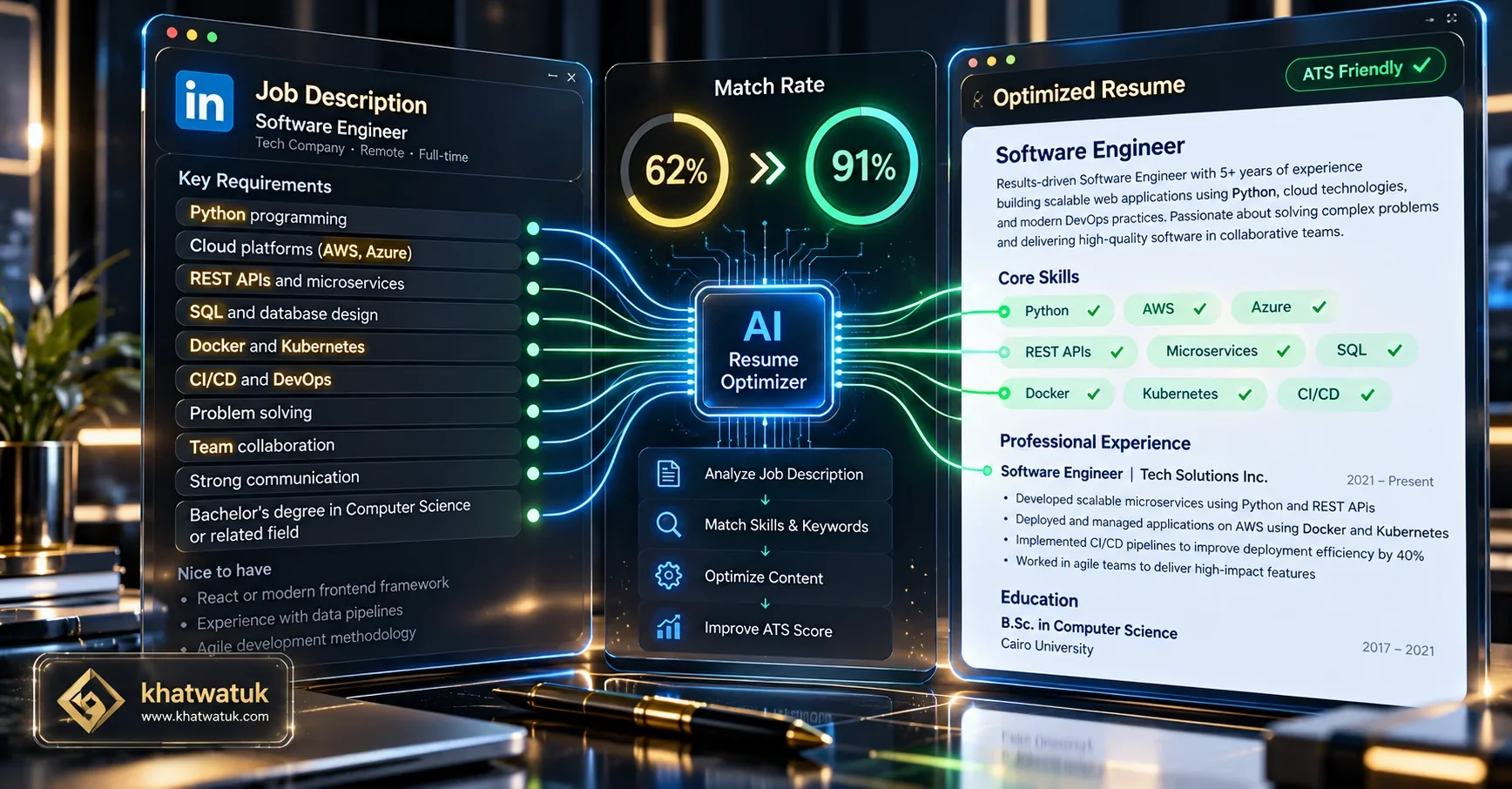
Manually tailoring a resume for each role typically takes 45 to 60 minutes. Modern AI diagnostic platforms compress this process into under 60 seconds, identifying semantic gaps and suggesting precise adjustments while maintaining strict factual honesty.
Algorithmic Keyword Extraction and Gap Scoring
ATS scanners evaluate two primary categories of terms: hard technical skills and contextual competency keywords. Platforms like Jobscan analyze job descriptions against candidate resumes to produce an objective match percentage. This score reveals missing technical tools, certifications, and responsibilities that human reviewers will look for.
As analyzed in our comprehensive Jobscan vs Teal comparison, running an automated scan prior to submitting an application increases interview callback rates by up to 300%. The system highlights exactly which sections of your career history require clearer alignment.
AI Bullet Point Customization Without Hallucinations
A significant danger when using generalist AI chatbots is "hallucination"—the model inventing metrics, tools, or achievements you never accomplished. When an interviewer questions an unearned qualification during technical rounds, candidate credibility collapses immediately.
To customize bullet points safely, feed the AI your verified master career achievements and instruct it strictly to rewrite descriptions using the target job's terminology. As detailed in our breakdown of Teal vs Rezi, using structured prompt boundaries keeps every statement truthful while maximizing ATS alignment.
Stage 3: Accelerating Applications with AI Browser Copilots
The single most exhausting phase of job hunting is re-typing personal history into enterprise career portals. Large corporations using Workday, Taleo, or iCIMS frequently require candidates to complete 8 to 12 separate form pages, re-entering job titles, employer addresses, dates of employment, and degree information already present on their resume.
This repetitive administrative bottleneck causes immense application fatigue. Modern browser copilots solve this friction point by programmatically mapping your master career data into web form fields with a single click.
Browser Copilots vs. Unattended Bots: The Safety Comparison
It is critical to distinguish between browser copilots and background auto-apply scripts. Background bots execute headless scripts that bypass visible browsers, often triggering Cloudflare barriers, CAPTCHA blocks, and portal account suspensions. Because bots cannot read subtle question nuances, they frequently submit incorrect answers to mandatory screening criteria.
In contrast, browser copilots like Simplify and Teal operate directly inside your active browser session. They auto-populate visible input fields while allowing you to inspect every answer. This preserves 100% submission security and prevents automated portal rejections.
Handling Open-Ended Portal Questions with AI Context
Modern application portals frequently include custom subjective prompts, such as "Why do you want to join our organization?" or "Describe a challenging technical problem you solved." Typing custom answers for 20 applications every week creates severe mental exhaustion.
AI browser assistants allow candidates to store pre-approved response modules. When encountering a company-specific prompt, the copilot synthesizes the organization's mission statement with your personal career highlights to produce a contextual first draft in seconds, which you can quickly polish.
The 60-Second Human Verification Pass
Never allow any automation tool to click the final "Submit Application" button autonomously. Incorporating a mandatory 60-second human verification pass protects your professional brand and prevents avoidable mistakes.
During this quick review, confirm four essential data points: salary expectation ranges, legal work authorization status, attached resume versions, and contact information. Once verified, click submit manually with total confidence.
Stage 4: Automating Job Tracking and Recruiter Follow-Ups
Submitting applications without an automated tracking system leads to missed recruiter communications, forgotten interview details, and lost job offers. Managing active searches across manual spreadsheets quickly becomes unmanageable once you surpass 20 applications, creating confusion and administrative disarray.
Modern career CRMs automate status updates and schedule follow-ups, ensuring every active opportunity progresses through your pipeline smoothly.
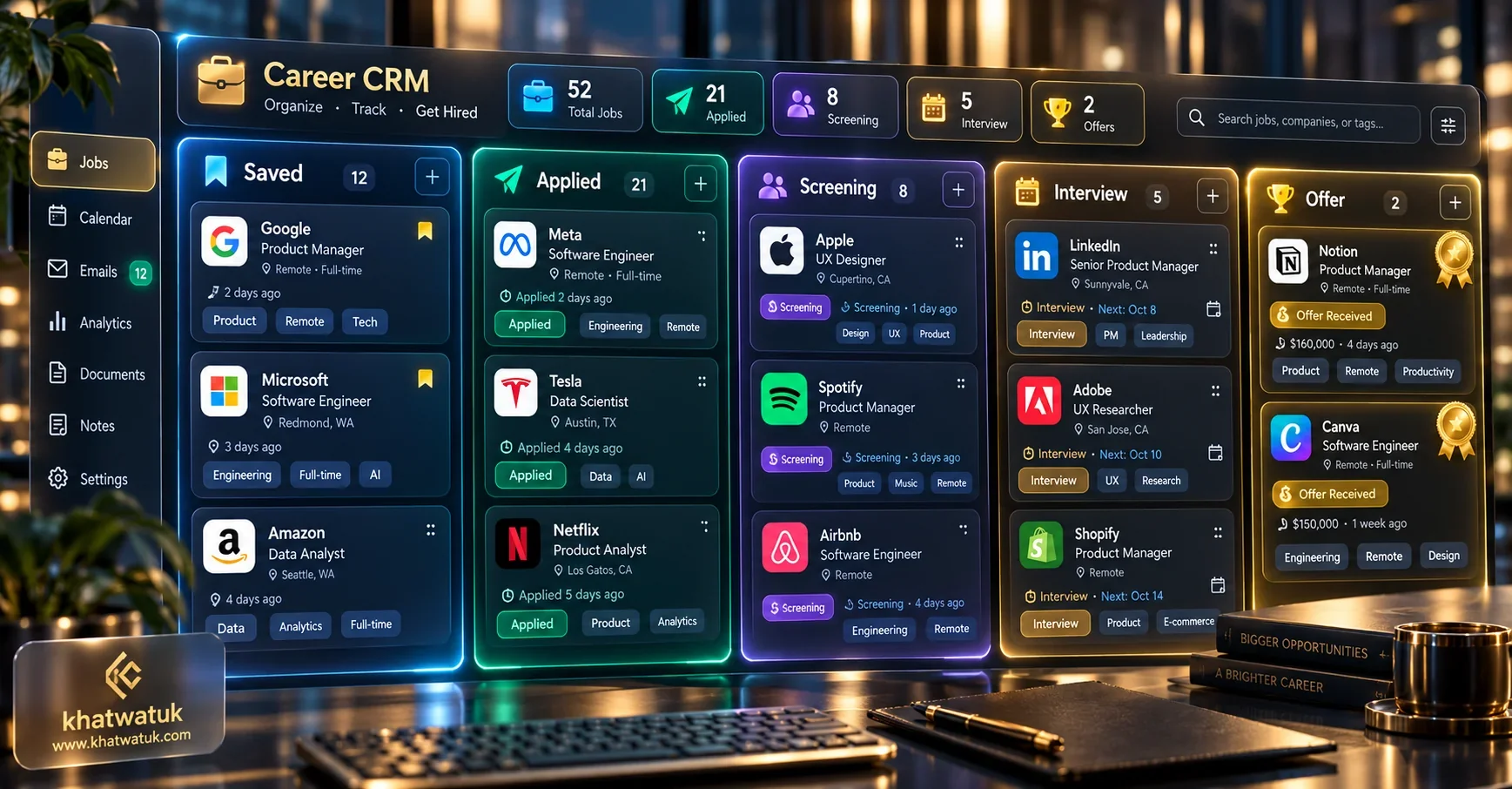
Unified Kanban Boards vs. Broken Spreadsheets
Career CRMs like Teal and Huntr utilize visual Kanban pipelines organized into clear stages: Bookmarked, Applied, Interviewing, and Offered. Browser extensions capture role compensation, company URLs, job descriptions, and recruiter names with a single click, saving them directly to your board.
As discussed in our evaluation of Huntr vs Teal, dedicated pipeline software eliminates manual copy-pasting into spreadsheets and provides clarity on your active application metrics.
Automated Recruiter Follow-Up Cadence & Templates
Over 70% of candidate rejections stem from failing to follow up after submitting an application. Automated CRM systems allow you to establish automated calendar reminders and follow-up templates for hiring managers.
A disciplined two-touch follow-up cadence consistently yields results:
- Day 5 Follow-Up: A brief, courteous message sent via LinkedIn or email confirming receipt of your submission and reiterating excitement about the role.
- Day 10 Follow-Up: A value-focused check-in sharing a relevant industry insight or work portfolio sample demonstrating domain expertise.
Comparison Matrix: Best Job Search Automation Tools in 2026
Choosing the right software stack requires evaluating feature depth, platform safety, and pricing transparency across the market. The comparison matrix below benchmarks six top job search automation tools across six core operational parameters.
| Platform | Primary Function | Automation Type | ATS Pass Rate | Risk Level | Pricing Model |
|---|---|---|---|---|---|
| Teal | Career CRM & Resume Builder | Browser Copilot (Assisted) | High (85%+) | Zero Risk | Freemium ($29/mo Pro) |
| Simplify Copilot | Job Portal Form Autofill | Chrome Extension (Assisted) | High (88%+) | Zero Risk | 100% Free |
| Jobscan | ATS Keyword Gap Scanner | Diagnostic Analysis | Very High (92%+) | Zero Risk | Freemium ($49.95/mo) |
| Huntr | Application Pipeline CRM | Email Parsing & Kanban | Neutral | Zero Risk | Freemium ($40/mo) |
| LoopCV | Bulk Auto-Apply Engine | Unattended Auto-Apply | Low (45%) | Moderate / High | Paid ($49/mo) |
| Zapier | Custom No-Code Workflows | Modular API Automation | Custom Dependent | Zero Risk | Freemium ($19.99/mo) |
Streamline Your Job Search with Teal
Eliminate messy spreadsheets and track your applications seamlessly with Teal's all-in-one career management hub and browser extension.
Start Automating Your Job Search for Free with Teal →Archetype Comparison: Which Automation Stack Fits Your Profile?
No two job searches are identical. The ideal tooling configuration depends directly on your target industry, technical background, and current career priorities. Review the archetypes below to select the setup that best matches your search parameters.
Choose The Career Accelerator Stack (Teal + Jobscan + Simplify) if: You are targeting competitive professional, corporate, or technology roles where high ATS match rates and polished applications are essential.
Choose The High-Speed Autofill Stack (Simplify + Huntr) if: Your resume is already finalized, and your primary daily headache is typing your work history into repetitive Workday and Greenhouse portals.
Choose The DIY No-Code Stack (Zapier + Google Sheets + Claude) if: You prefer complete data privacy, enjoy building customized workflows, and want to avoid paying recurring software subscriptions.
Choose The Outbound Volume Stack (LoopCV / Sonara) if: You are pursuing high-turnover entry-level or contract positions where broad submission volume is more important than in-depth customization.
When comparing application tracking systems, understanding each tool's architectural strengths prevents wasted time. For a deeper breakdown of feature differences, review our analysis of Huntr vs Jobscan to determine which fits your search stage.
Alternative: Building a Free No-Code Automation Pipeline
You do not need to spend money on premium subscriptions to build an effective automated job hunt. Technical and budget-conscious candidates can assemble a completely free, highly capable automation pipeline using tools they already own.
By combining free RSS feeds, Google Sheets, and free-tier AI assistants, you can construct a powerful personal job search engine:
- Automated Discovery: Generate free RSS feed URLs for your targeted LinkedIn and Indeed searches, routing them to a free feed reader or Google Sheet.
- Free AI Tailoring: Use free versions of Claude or ChatGPT with a structured prompt comparing the job description against your master resume to generate tailored bullet points.
- Free Autofill: Install the 100% free Simplify Copilot extension to eliminate repetitive portal data entry without paying for software licenses.
- Free Pipeline CRM: Use a free Google Sheets Kanban template or Notion career board to track application dates and follow-up deadlines.
Job Search Automation Safety Rules: How to Avoid Account Bans
Automating job applications carries real operational risks if basic technical guardrails are ignored. Job boards and enterprise career portals implement aggressive anti-bot algorithms that monitor user cadence. Following strict safety rules keeps your accounts in good standing and ensures your applications reach actual recruiters.
Mandatory Automation Safety Guidelines:
- Strict Daily Volume Limits: Never submit more than 20 to 25 applications in a single 24-hour window. Submitting 100+ applications overnight is an immediate bot red flag.
- Randomized Execution Delays: If using any browser assistant, ensure delays between form clicks mirror realistic human timing (5 to 15 seconds).
- Zero Factual Inaccuracies: Never allow an AI tool to invent technical credentials or employer tenures. Unearned claims cause immediate disqualification during interviews.
- Protect Credentials: Never enter sensitive portal passwords or financial details into unverified third-party bots.
Where to Draw the Line: What You Must Never Automate
Automation excels at administrative and logistical tasks, but attempting to automate interpersonal relationships destroys hiring outcomes. Recruiters and executive hiring managers prioritize genuine human connection, emotional intelligence, and cultural resonance above all else.
Keep these three core touchpoints strictly manual throughout your career transition:
- High-Stakes Networking Messages: Direct messages to hiring managers and executive references must be written personally. Automated messages feel generic and get ignored.
- Live Interview Conversations: AI tools are great for practicing mock interview questions beforehand, but using real-time automated voice copilots during interviews introduces latency and damages authenticity.
- Compensation Negotiations: Negotiating equity, salary floors, and benefits requires nuanced human dialogue and emotional awareness that algorithms cannot replicate.
The 7-Day Job Search Automation Action Plan
Transitioning from chaotic manual job hunting to an automated pipeline is straightforward when approached systematically. Follow this step-by-step 7-day action plan to establish your personal career automation engine in one week:
Day 1: Master Profile & Boolean Alerts. Build your master career document and configure Boolean alert strings on LinkedIn and Indeed.
Day 2: ATS Resume Parser Calibration. Run your base resume through an ATS diagnostic scanner to identify missing core skills.
Day 3: Browser Copilot Installation. Install Simplify Copilot and Teal, mapping your work history and education fields.
Day 4: Centralized CRM Board Setup. Organize your Kanban tracking columns (Bookmarked, Applied, Interviewing) and test email parsing.
Day 5: Pilot Run with 5 Applications. Execute five semi-automated submissions using the 60-second verification review.
Day 6: Automated Follow-Up Setup. Schedule Day 5 and Day 10 recruiter follow-up reminders in your calendar.
Day 7: Pipeline Review & Optimization. Review application metrics, refine Boolean search filters, and enjoy your reclaimed free time.
📚 Deep Dive Comparison: Need help choosing the best individual software platforms to build your automation stack? Read our in-depth evaluation of the best AI job search tools in 2026 tested across 7 major software platforms.
Frequently Asked Questions About Job Search Automation
Below are direct answers to the most common questions candidates ask regarding job search automation tools, account safety, and ATS optimization.
Can you automate your job search without getting banned?
Yes. Account bans occur when users deploy unthrottled background bots that submit hundreds of generic applications. Utilizing assisted browser copilots (like Simplify or Teal) that respect platform rate limits and preserve human verification eliminates account suspension risks.
What are the best tools to automate job applications in 2026?
The top tools form a complementary stack: Teal for pipeline tracking and resume management, Simplify Copilot for portal form autofill, and Jobscan for ATS keyword optimization. Combining these tools covers the entire application workflow safely.
How do you set up automated job alerts on LinkedIn and Indeed?
Construct structured Boolean queries combining exact titles and mandatory skills while excluding irrelevant levels (e.g., using NOT Intern). Save the search and set notification frequency to real-time instant alerts so you apply within the initial 48 hours.
Is it safe to use auto-apply bots on Workday and Greenhouse?
Autonomous auto-apply bots are risky on enterprise portals because platforms deploy bot-detection heuristics that drop suspicious submissions. Browser extension copilots that auto-populate forms while keeping you in control of the final submit button are completely safe.
How can I use AI and Zapier to track job applications automatically?
You can create a Zapier workflow that parses incoming confirmation emails from Greenhouse and Lever, extracting company name, role title, and submission date, and automatically appends a new row to your Google Sheets tracking document.
Does automated resume tailoring actually help beat ATS filters?
Yes. Applicant Tracking Systems rank incoming applications by semantic keyword density and hard skills. Using automated tools to identify and weave missing requirements into your resume before submitting significantly improves callback odds.
What is the difference between job search automation and auto-apply bots?
Job search automation is a comprehensive system that streamlines discovery, tailoring, autofill, and tracking while maintaining candidate review. Auto-apply bots are scripts that blast generic resumes blindly without human oversight, leading to poor conversion rates.
How do I automate follow-up emails after submitting a job application?
Utilize career CRMs like Teal or Huntr that trigger follow-up tasks on a preset schedule (Day 5 and Day 10). Combine them with pre-drafted message templates to reach out to recruiters quickly on LinkedIn.
