

How to Prepare for a Case Interview in 2026: The MBB & First-Principles Playbook
To learn how to prepare case interview performance at top strategy consultancies like McKinsey, BCG, and Bain in 2026, you must abandon memorized framework templates and master bespoke first-principles issue trees, mental math agility, and structured hypothesis-driven business communication under real-world executive pressure.
Modern strategy consulting firms have completely re-engineered their case interview evaluations over the past two years. If you enter a first-round interview at McKinsey, BCG, Bain, Strategy&, or Oliver Wyman reciting Victor Cheng's rigid 12-case frameworks or robotic profitability formulas, your interviewer will spot it within sixty seconds. Partners do not hire candidates who repeat rehearsed scripts; they hire prospective junior colleagues who think through complex, ambiguous commercial problems from first principles.
To win an offer in today's fiercely competitive hiring market, your preparation must shift from memorizing static templates to athletic, deliberate skill development. Case interview mastery is not an academic knowledge test—it is an athletic performance that combines rapid quantitative agility, commercial intuition, executive presence, and answer-first synthesis.
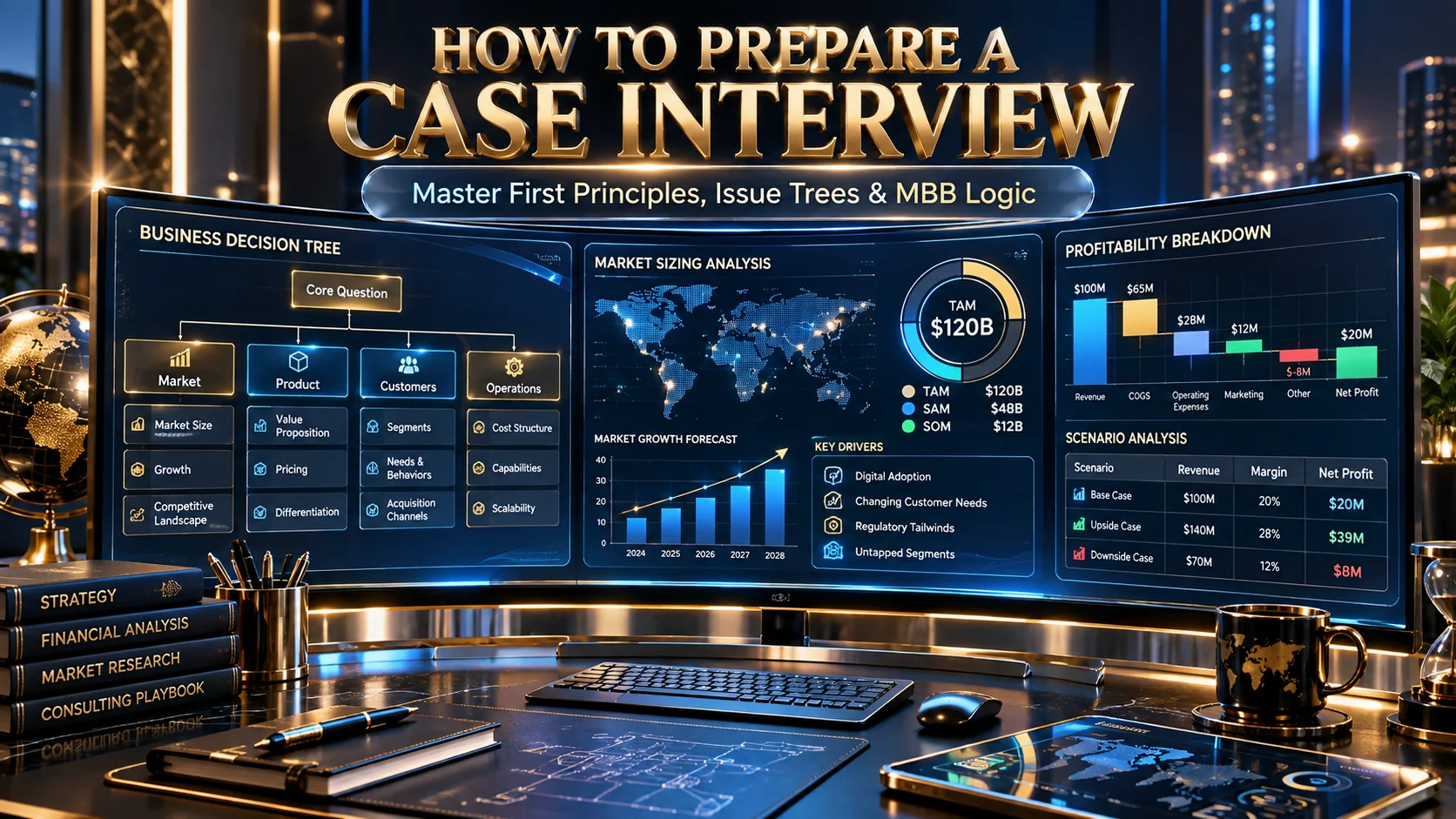 The Modern MBB Case Interview Arena: First-principles issue trees replace static memorized frameworks.
Quick Verdict: How to Prepare for a Case Interview at a Glance
Executive Preparation Formula (The 6-Week Benchmark)
Preparing for a consulting case interview requires 60 to 80 hours of deliberate practice spread across 6 to 8 weeks. Rather than grinding 70 random cases passively, top 1% candidates divide their prep into distinct micro-drills: 20 hours of fast mental math and chart interpretation, 25 hours of first-principles issue tree structuring drills, and 30 live interactive mock cases with calibrated peers or former consultants.
- Phase 1 (Weeks 1-2): Build core business acumen, master the Rule of 72, fast percentage splits, and consulting math drills.
- Phase 2 (Weeks 3-4): Execute 90-second prompt-to-structure drills across the 4 major case archetypes using the TRIM test.
- Phase 3 (Weeks 5-6): Conduct 30-40 full-length live mock interviews simulating candidate-led (BCG/Bain) and interviewer-led (McKinsey) formats.
Table of Contents
- The Anatomy of Modern Case Interviews: What MBB Really Evaluates
- The Skills-First Methodology: Deliberate Practice vs Brute Force Grinding
- The 90-Second Structuring Engine: Building Bespoke First-Principles Issue Trees
- Master the 4 Core Business Case Archetypes (Without Memorized Templates)
- 7 Best Rehearsal Tools & Practice Platforms for Case Interview Mastery
- Comprehensive Comparison Matrix: 7 Case Interview Practice & Career Tools
- The 6-Week Phased Case Preparation Roadmap & Target Milestones
- Frequently Asked Questions (Case Interview FAQ)
1. The Anatomy of Modern Case Interviews: What MBB Really Evaluates in 2026
A case interview is a 30 to 45-minute interactive business simulation where an interviewer presents an authentic client challenge and evaluates your problem-solving architecture in real time. The case may involve helping an international airline survive post-pandemic fuel volatility, evaluating whether a European private equity fund should acquire a med-tech manufacturer, or reversing a retail bank's collapsing profit margins.
Many candidates mistakenly believe that case interviews test whether you guess the "correct" financial answer. In reality, strategy firms use case interviews to test how you structure chaotic information under extreme uncertainty. When partner-level interviewers evaluate your performance, they assess four specific dimensions:
1. Problem Structuring (35%)
Can you break down an ambiguous prompt into mutually exclusive, collectively exhaustive (MECE) branches that isolate root causes?
2. Quantitative Agility (25%)
Can you execute fast mental math without a calculator, calculate break-even volumes, and sanity-check order-of-magnitude estimates?
3. Commercial Acumen (20%)
Do you understand real-world unit economics, industry profit pools, customer buying journeys, and regulatory constraints?
4. Synthesis & Presence (20%)
Can you deliver an answer-first, executive recommendation using the Pyramid Principle while maintaining calm composure?
Candidate-Led vs Interviewer-Led Case Formats
One of the most dangerous mistakes is preparing for only one case format. Top management consulting firms divide into two operational testing structures:
- Candidate-Led Cases (BCG, Bain, L.E.K., Kearney): In this format, you drive the case from start to finish. Once the interviewer gives you the initial prompt, you must set the agenda, decide which branch of the issue tree to explore first, ask for specific data, interpret charts without prompting, and proactively steer toward the business solution. If you sit passively waiting for instructions, you will fail.
- Interviewer-Led Cases (McKinsey & Company): McKinsey uses a command-and-control interview structure divided into distinct, structured phases. The interviewer controls the progression: they will ask you to structure the problem, then pivot immediately to a quantitative calculation, then present an unexpected exhibit, then ask an open-ended brainstorming question. Each question is scored independently on a standardized rubric.
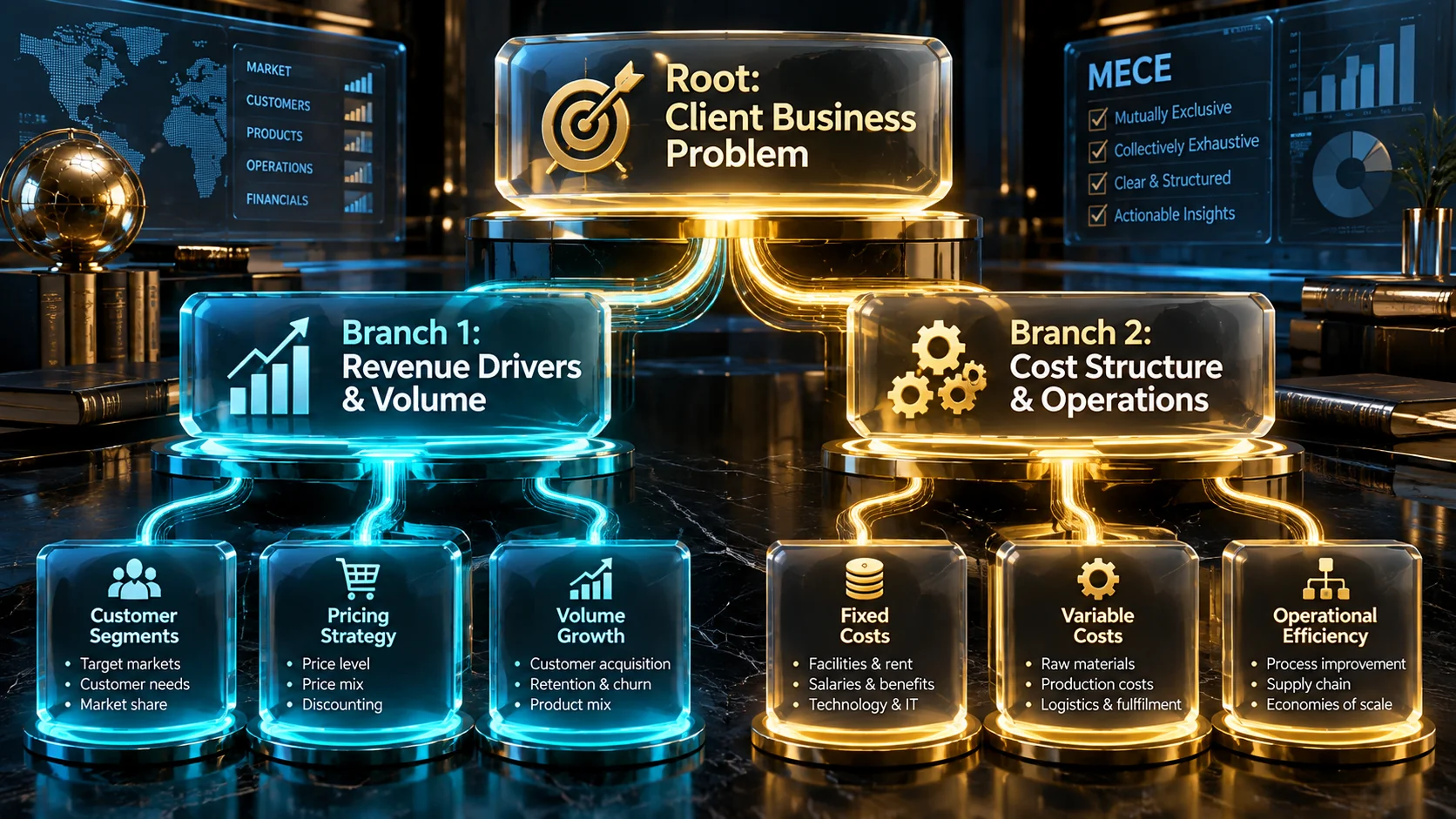 First-Principles Issue Trees: Tailoring root-cause branches directly to client unit economics.
2. The Skills-First Preparation Methodology: Deliberate Practice vs Brute Force
The biggest trap in consulting recruiting is what insiders call "brute force case grinding." Candidates download casebooks from Harvard, Wharton, and INSEAD, find a study partner, and attempt 60 complete 45-minute cases back-to-back. When they struggle, they simply do another case.
This approach is deeply flawed. Running an entire 45-minute case when your mental math is slow or your chart-reading skills are weak is like playing full 90-minute soccer games to improve your penalty kicks. Top performers use athletic skill isolation: they break down the case interview into distinct micro-disciplines and drill each skill independently until it becomes second nature.
Consulting Mental Math Shortcuts: Speed and Sanity Checks
In an MBB interview, you are not allowed to use a calculator. You must perform multi-million-dollar revenue projections, profit margin breakdowns, and market sizing calculations on blank paper while speaking out loud. Master these non-negotiable mental math techniques:
The 4 Essential Consulting Math Shortcuts
- The Rule of 72 (CAGR Approximation): Divide 72 by the annual growth rate to find how many years it takes for an investment or market size to double. A market growing at 8% annually doubles every 9 years (72 / 8 = 9).
- Scientific Notation (Zero Management): When multiplying large figures, convert them into powers of 10 to eliminate calculation errors. For example: 300 million people ($3 imes 10^8$) spending $40 ($4 imes 10^1$) yields $12 imes 10^9$ = $12 billion.
- Fraction-to-Percentage Equivalencies: Instantly memorize common consulting fractions: 1/6 = 16.7%, 1/7 = 14.3%, 1/8 = 12.5%, 1/9 = 11.1%, 1/12 = 8.33%.
- The Sanity-Check Habit: Always state your directional sanity check before handing back the number: "A $1.2B addressable market represents roughly 3% of the total regional beverage market, which is commercially realistic for a premium entrant."
Beyond mental math, your application materials must reflect quantitative rigor before you even reach the interview room. Top consultancies screen out over 80% of resumes that lack clear business impact metrics. Candidates who build metric-driven executive resumes streamline this entire process effortlessly.
3. The 90-Second Structuring Engine: Building Bespoke First-Principles Issue Trees
The moment your interviewer finishes reading the case prompt, the clock starts. You typically have 90 to 120 seconds of silence to organize your thoughts and draw your problem-solving issue tree. Weak candidates panic and write down generic headings like "Company, Competitors, Customers, Product." Elite candidates execute the 90-Second Structuring Engine:
The 5-Step Case Kickoff Protocol:
- Step 1: Clarify & Paraphrase (30s): Rephrase the core business objective in your own words. Confirm the client's quantifiable goal (e.g., "Achieve $50M in operating profit within 24 months").
- Step 2: Ask 2 Clarifying Questions (30s): Ask focused questions about scope, geography, or business model constraints. Never ask open-ended questions just to fill time.
- Step 3: State Your Working Hypothesis (15s): "Based on the prompt, my initial hypothesis is that profitability is suffering from supply-chain cost inflation rather than volume collapse. I will structure my analysis to validate this."
- Step 4: Request 90 Seconds of Silence (5s): "If you don't mind, I'd like to take about 90 seconds to organize my thoughts and structure our issue tree."
- Step 5: Present Using the Pyramid Principle: Turn your notebook toward the interviewer (or share screen virtually) and walk them through your MECE branches from macro to micro.
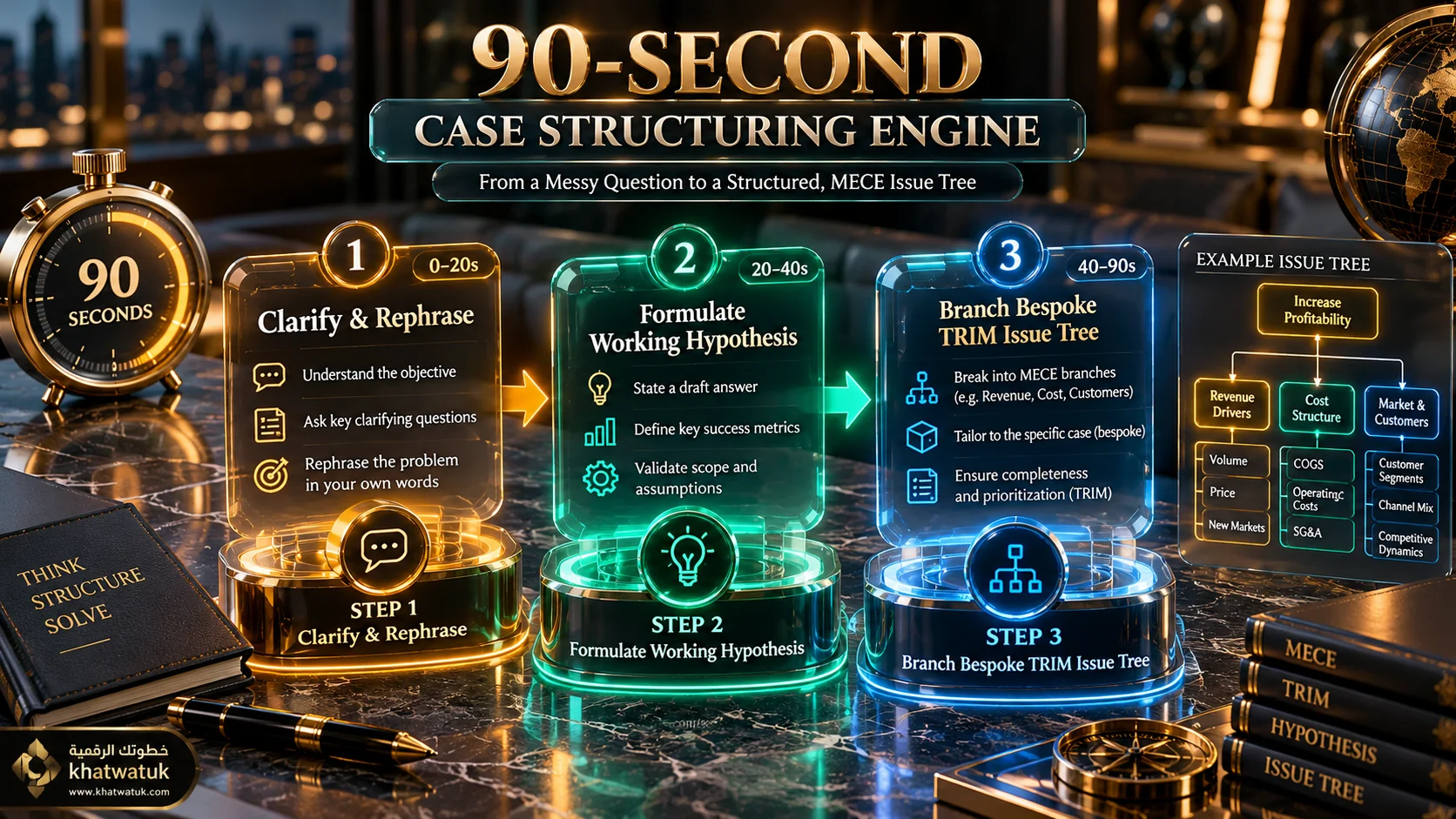 The 90-Second Structuring Engine: Rapid hypothesis formulation and issue tree disaggregation.
The TRIM Test for Flawless Frameworks
To ensure your structure never sounds like a memorized textbook, run your issue tree through the TRIM Test before walking the interviewer through it:
- T - Tailored: Does the structure reflect the client's specific industry economics? (e.g., if analyzing an airline, your cost branch should explicitly separate jet fuel, aircraft leasing, and gate landing fees).
- R - Relevant: Does every single branch directly influence the client's decision, or are you including decorative filler?
- I - Insightful: Does your tree indicate where high-impact profit leverage exists rather than merely listing generic business categories?
- M - MECE: Are your top-level branches Mutually Exclusive (no conceptual overlap) and Collectively Exhaustive (no critical blind spots)?
4. Master the 4 Core Business Case Archetypes (Without Memorized Templates)
While you must never force a memorized template onto a case, over 90% of business problems in management consulting fall into four core economic archetypes. Understanding the underlying commercial levers of each archetype gives you an intuitive mental foundation:
Archetype 1: Profitability Optimization
Profit = Total Revenue (Price $ imes$ Volume) minus Total Costs (Fixed + Variable). Disaggregate revenue by customer segment, product line, and sales channel. Disaggregate costs into operational unit drivers.
Key Lever: Price elasticity vs volume cannibalization.
Archetype 2: Market Entry & Growth
Evaluate market attractiveness (Total Addressable Market, CAGR, margin profile), competitive landscape (fragmentation vs moats), client capabilities, and execution mode (Greenfield vs M&A vs Joint Venture).
Key Lever: Regulatory barriers & distribution economics.
Archetype 3: Mergers & Acquisitions (M&A)
Strategic rationale (cost synergies, revenue cross-selling), valuation multiple sanity check (DCF / comparable multiples), operational feasibility, cultural integration risk, and exit multiples.
Key Lever: Realizable cost synergies vs integration overhead.
Archetype 4: Operations & Capacity
Analyzing bottleneck constraints, asset utilization, capital expenditure payback periods, supply chain resilience, and inventory holding costs across manufacturing or tech infrastructure.
Key Lever: Incremental contribution margin per machine hour.
Preparing these case archetypes alongside modern AI career workflows creates an unfair advantage. Review our comprehensive foundational guide to best AI resume builder in 2026 to ensure your initial screening scores put you directly in front of partner interviewers.
5. 7 Best Rehearsal Tools & Practice Platforms for Case Interview Mastery
To master case interview mechanics efficiently, relying on textbook reading alone is insufficient. Top candidates deploy specialized software tools to track applications, isolate mental math drills, and simulate live partner interactions:
1. Teal (Application & Pipeline Management)
Before you can perform in a case interview, you must secure invitations across MBB, Tier-2, and boutique firms. Teal provides an intelligent job pipeline management dashboard with Chrome extension tracking and resume keyword optimization designed to align your profile with strategy consulting job descriptions.
Best For: Managing multi-firm consulting recruiting pipelines and tracking application statuses.
2. PrepLounge (Peer Mock Case Network)
PrepLounge is the undisputed global hub for peer-to-peer case mock interviews. It allows you to schedule live video case sessions with candidates and current consultants worldwide, access an extensive case library, and benchmark your quantitative scoring against global applicants.
Best For: Finding calibrated live peer mock interview partners across international time zones.
3. RocketBlocks (Targeted Atomic Skill Drills)
Built by former McKinsey, BCG, and Google executives, RocketBlocks offers bite-sized, interactive drills covering structuring, mental math, chart interpretation, and commercial synthesis. It enables deliberate practice without needing a partner.
Best For: Daily solo micro-drills in mental math and 90-second prompt structuring.
4. CaseCoach (McKinsey Video Courses & Fast Math)
Founded by a former McKinsey Engagement Manager, CaseCoach provides institutional-grade case interview courses, realistic video demonstrations of top-decile candidates, and a specialized mental math trainer calibrated to consulting standards.
Best For: High-definition video analysis of top-performing candidate interviews.
5. Crafting Cases (First-Principles Structuring Masterclasses)
Crafting Cases focuses explicitly on breaking candidate reliance on memorized frameworks. Their curriculum teaches you how to construct tailored, bespoke issue trees from pure business principles and operational drivers.
Best For: Candidates who struggle with rigid templates and need deep first-principles coaching.
6. ChatGPT Voice Mode (Interactive Conversational Simulation)
Modern generative AI voice systems can act as relentless, realistic mock interviewers. By prompting the model to act as a senior BCG Partner, candidates can practice verbal synthesis, answer pushback questions, and explore our master guides on how to practice interview with ChatGPT and how to practice interview with AI.
Best For: Zero-cost conversational case roleplay and rapid hypothesis stress-testing.
7. Rezi (ATS Resume & Metric Optimization)
Rezi ensures your consulting resume passes the most stringent automated applicant tracking systems. It guides you to structure bullet points with quantified commercial metrics and executive action verbs that consulting recruiters look for.
Best For: Crafting an ATS-compliant consulting resume that highlights revenue and cost impact.
 Mental Math Telemetry: Achieving sub-15-second calculation agility with zero arithmetic errors.
6. Comprehensive Comparison Matrix: 7 Case Interview Practice & Career Tools
Compare the top 7 case interview preparation platforms and career tools across core analytical dimensions, simulation formats, and training pricing:
| Tool Name | Category | Case Simulation | Mental Math Drills | Pricing Model | Best For |
|---|---|---|---|---|---|
| Teal | Pipeline & Tracker | Application Tracking | N/A (Career Tools) | Freemium / $9/wk | Pipeline Management |
| PrepLounge | Peer Network | Live Video Mocks | Interactive Tool | Freemium / Premium | Live Peer Practice |
| RocketBlocks | Skill Drilling | Bite-Sized Concepts | Comprehensive | $35 / month | Solo Skill Isolation |
| CaseCoach | Courseware & Video | Recorded MBB Mocks | Advanced Drills | Course Packages | Video Mock Benchmarks |
| Crafting Cases | First-Principles | Hypothesis Training | Math Modules | Tiered Masterclass | Bespoke Structuring |
| ChatGPT Voice | AI Roleplay | Conversational AI | On-Demand Prompts | Free / $20 Plus | Spontaneous Practice |
| Rezi | ATS Resume Builder | Resume Targeting | N/A (Resume Metrics) | Freemium / Pro | Consulting Resume ATS |
To accelerate your practice with scenario simulations, explore our comprehensive analysis of best AI tool for interviews to determine which software fits your preparation workflow.
7. The 6-Week Phased Case Preparation Roadmap & Target Milestones
To guarantee peak performance on interview day, follow this structured 6-week preparation funnel. It ensures you build foundational habits before exposing yourself to high-stress live mock simulations:
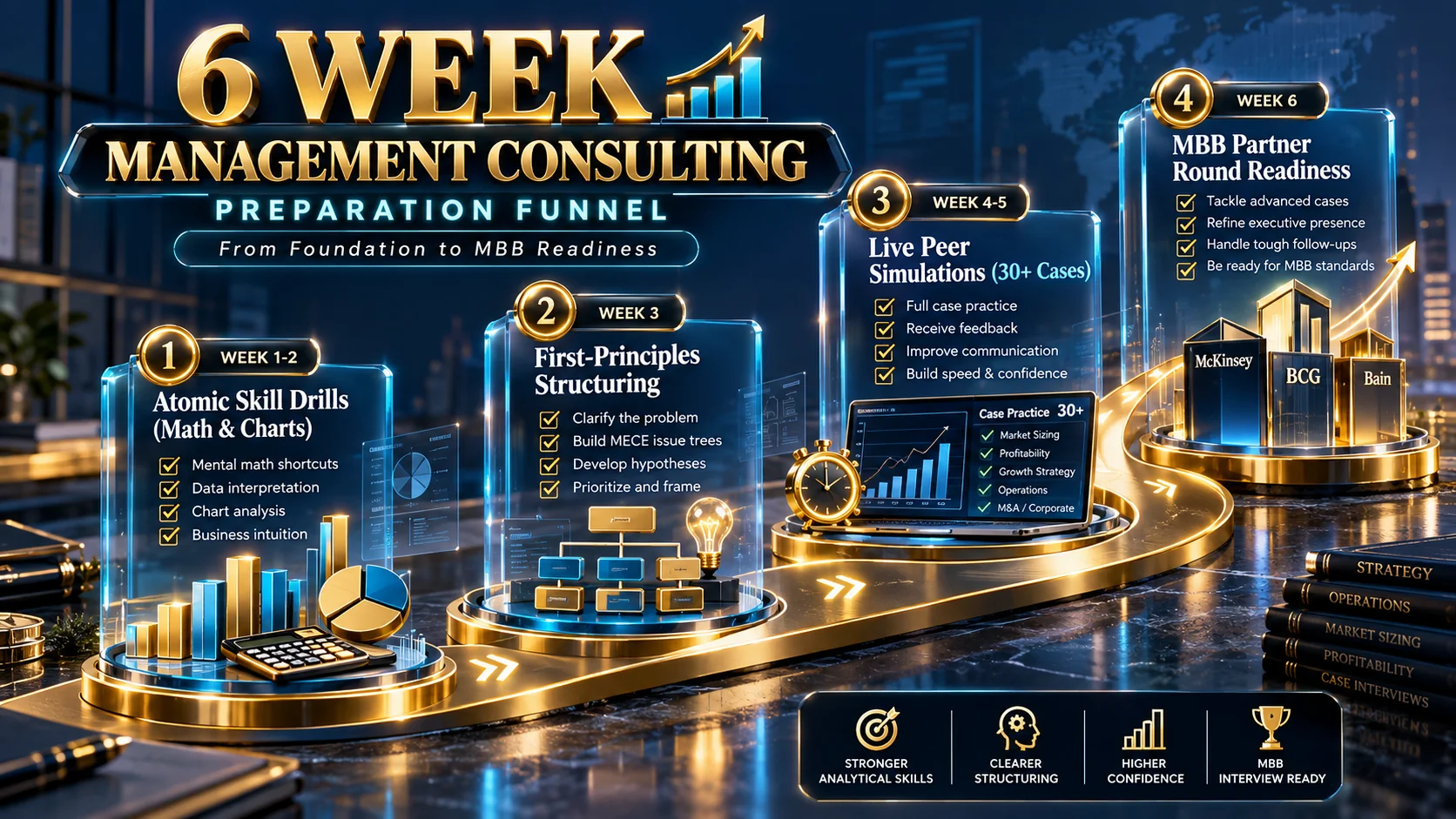 The 6-Week Funnel: Progressing from atomic drills to full partner-level live simulations.
Weeks 1 & 2: Foundations & Quantitative Agility
Focus on business fundamentals: income statements, balance sheets, unit contribution margins, and market sizing mechanics. Dedicate 30 minutes daily to speed math (division, percentages, CAGR approximations). Complete 15 solo market sizing estimations.
Weeks 3 & 4: Atomic Structuring & 90-Second Drills
Practice rapid issue tree generation. Take 20 different case prompts and give yourself exactly 90 seconds to sketch bespoke branches using the TRIM test. Review your structures against real McKinsey and BCG case studies. Ensure you master our tactical guidance on how to pass HireVue interview screens if targeting firms with automated video rounds.
Weeks 5 & 6: Live Peer Simulations & Executive Polish
Conduct 3 to 4 live cases per week using PrepLounge or MBA case partners. Spend equal time giving cases as you do receiving them; playing the interviewer role dramatically accelerates your ability to diagnose structuring weaknesses. Polish your Personal Experience Interview (PEI) stories using our proven AI behavioral interview practice techniques and explore leading tools reviewed in our best AI interview assistant guide.
The Day-Before Checklist
- Stop Casing 24 Hours Prior: Do not run full mock cases the night before your interview. Your brain needs rest to maintain high cognitive processing speed.
- Prepare Grid Paper & Clean Pens: Ensure your note-taking setup is immaculate. Divide your pages into Structure, Math, and Exhibit zones.
- Review Your 5 PEI Stories: Ensure you have crisp, metric-backed behavioral stories for leadership, conflict resolution, and personal impact.
8. Frequently Asked Questions (Case Interview FAQ)
How do you prepare for a consulting case interview?
To prepare effectively, follow a three-stage athletic training model: First, master foundational business economics and mental math shortcuts. Second, execute isolated 90-second structuring drills across profitability, market entry, M&A, and operations archetypes using bespoke MECE issue trees. Third, complete 30 to 40 live interactive mock cases with calibrated peers or former consultants.
How many cases should you do before your first live interview?
Most successful candidates who receive offers at McKinsey, BCG, and Bain complete between 30 and 45 high-quality live mock cases. Grinding more than 60 cases often leads to mental burnout and robotic behavior. Quality and deep post-case reflection are significantly more important than raw volume.
What is the difference between McKinsey and BCG case interviews?
McKinsey uses an interviewer-led format where the interviewer strictly steers the conversation across sequential phases (structuring, quantitative calculation, chart interpretation, brainstorming, and synthesis). BCG and Bain use candidate-led formats where the interviewee is expected to proactively drive the entire case, choose which hypothesis branch to explore, and request data independently.
How do you structure a case interview without memorized frameworks?
To structure from first principles, start by defining the client's quantifiable business goal, form a clear working hypothesis, and disaggregate the problem into 2 to 4 branches directly tied to the client's industry unit economics. Apply the TRIM test (Tailored, Relevant, Insightful, MECE) to ensure your branches address specific commercial drivers rather than abstract textbook categories.
How do you improve mental math for case interviews?
Improve mental math by spending 15 to 20 minutes daily on atomic calculation drills: master zero-management with scientific notation, memorize common fraction-to-percentage conversions (e.g., 1/6 = 16.7%, 1/7 = 14.3%), leverage the Rule of 72 for compounding growth, and always vocalize your calculations and sanity checks out loud.
