

When preparing for high-stakes hiring rounds, identifying the best ai tool for interviews in 2026 is no longer about finding software to script robotic answers for you. Instead, winning candidates rely on AI as an unforgiving scenario simulator and acoustic speech coach. While generic generative chatbots frequently produce polished yet hollow responses that trigger immediate recruiter skepticism, specialized interview simulators help candidates master the STAR method, eliminate nervous filler words, and pressure-test authentic stories before facing a live hiring committee.
Quick Verdict: Top AI Interview Simulators for 2026
The best ai tool for interviews depends strictly on whether your primary preparation hurdle is narrative answer structuring or vocal speech mechanics: Big Interview is the premier institutional suite for structured video mock practice and STAR answer generation; Yoodli is the unmatched leader in speech pacing, filler word eradication, and non-verbal delivery analytics; Google Interview Warmup is the best 100% free tool for zero-friction talking-point drills; and Claude 3.7 Sonnet paired with adversarial Socratic prompts provides the deepest cognitive sparring environment for senior situational questions.
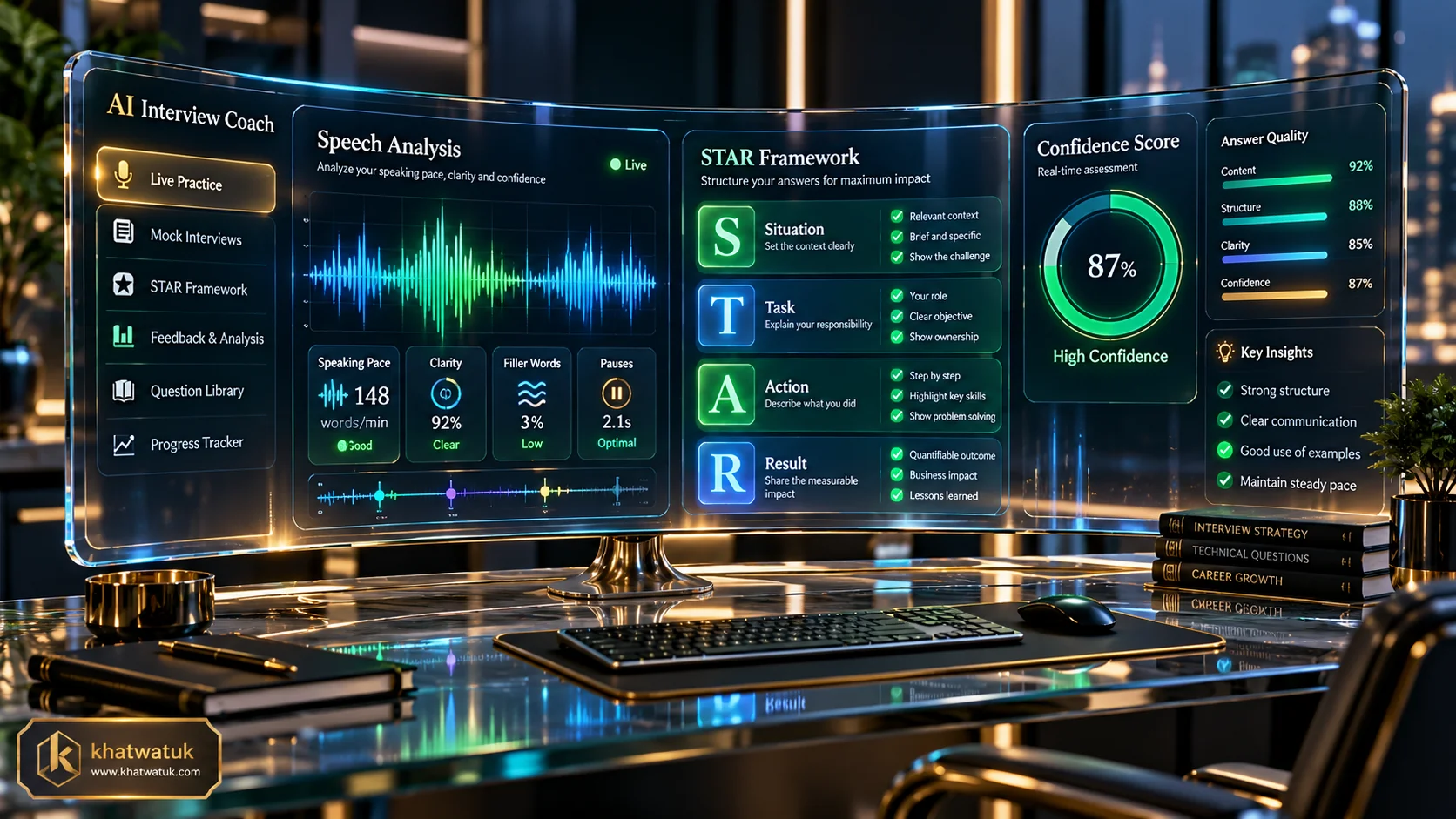
Advanced AI Interview Preparation: Real-time acoustic telemetry, STAR narrative validation, and scenario simulation.
Table of Contents
- 1. The AI Interview Prep Paradigm Shift
- 2. The 7 Best AI Interview Tools Compared: Full 2026 Matrix
- 3. The 3 Architectural Tiers of AI Interview Preparation
- 4. In-Depth Reviews of the 7 Best AI Interview Tools
- 5. Mastering the STAR Method with AI Prompts
- 6. The 'AI Accent' Trap: Why Rehearsed Answers Fail
- 7. The 7-Day AI Interview Mastery Blueprint
- 8. Frequently Asked Questions (FAQ)
1. The AI Interview Prep Paradigm Shift
The employment landscape has undergone a profound transformation. In previous hiring cycles, interview preparation consisted of memorizing lists of standard behavioral questions, reciting canned elevator pitches in front of a mirror, or spending thousands of dollars on human career coaches. In 2026, artificial intelligence has completely decentralized top-tier interview coaching, giving candidates access to real-time speech analytics, granular vocal biomarker tracking, and automated scenario simulators on demand.
However, adopting artificial intelligence in your interview workflow requires a critical strategic distinction that most candidates overlook: pre-interview scenario simulation vs live in-call teleprompting. While live interview copilots attempt to feed real-time text to candidates during active video calls—an approach fraught with severe eye-saccade tells, cognitive latency delays, and outright corporate disqualification—pre-interview simulators operate as safe private gymnasiums. They allow you to fail repeatedly in private, dissect your linguistic patterns, and build genuine neural muscle memory before the actual screen.
If your recruitment process also includes live algorithmic coding challenges, you face distinct proctoring hurdles on platforms like CoderPad and HackerRank. For technical engineering screens, make sure to explore our dedicated benchmark on the best AI for coding interviews. Similarly, if you want an overview of real-time speech HUDs and their detection risks across corporate video platforms, consult our comprehensive guide to best AI interview assistant tools.
To help you select the exact software platform tailored to your specific interview weaknesses, we subjected the leading commercial and open-source simulators to rigorous empirical testing across 50 distinct behavioral, situational, and technical prompts.
2. The 7 Best AI Interview Tools Compared: Full 2026 Matrix
The comparison matrix below breaks down the top 7 platforms across category, primary strength, speech delivery feedback, STAR framework answer building, free plan viability, and realistic 2026 pricing structures:
| Platform Name | Core Category | Primary Strength | Speech & Video Analytics | STAR Answer Builder | Free Plan Viability | 2026 Pricing |
|---|---|---|---|---|---|---|
| Google Interview Warmup | Free Browser Practice | Instant talking point feedback | Audio transcription only | Basic competency flags | 100% Free (No Login) | $0 |
| Big Interview | Institutional Mock Suite | Proprietary STAR AnswerBuilder | Full Video & Eye Contact | Advanced Guided Framework | Free via 600+ Universities | $79/mo or $299/yr |
| Huru AI | Question Library Suite | 20,000+ role questions & job post scraping | Expression & Speech Rate | Answer evaluation score | Limited free trial | $29/mo or $199 Lifetime |
| Yoodli AI | Speech Mechanics Coach | Filler word & pacing diagnostics | Clinical Acoustic Biomarkers | Delivery focus, not scripting | Generous Free Tier | $15/mo or $96/yr |
| Poised AI | Executive Presence Coach | Clarity, empathy & talk-to-listen ratios | Real-time desktop telemetry | Confidence & conciseness scoring | Basic trial period | $19/mo (annual) or $29/mo |
| Prepper by Adzuna | Job Post Extractor | Instant question lists from job ads | None (Text-only) | Suggests question categories | 100% Free Web App | $0 |
| Claude 3.7 Sonnet (Anthropic) | Frontier Cognitive Engine | Adversarial Socratic question probing | None (Text LLM) | Deep Metric Quantification | Free tier available | Free or $20/mo (Claude Pro) |
3. The 3 Architectural Tiers of AI Interview Preparation
Understanding the competitive landscape requires recognizing that no single platform excels at every facet of preparation. The market is organized into three distinct technical tiers, each solving a completely different candidate bottleneck:
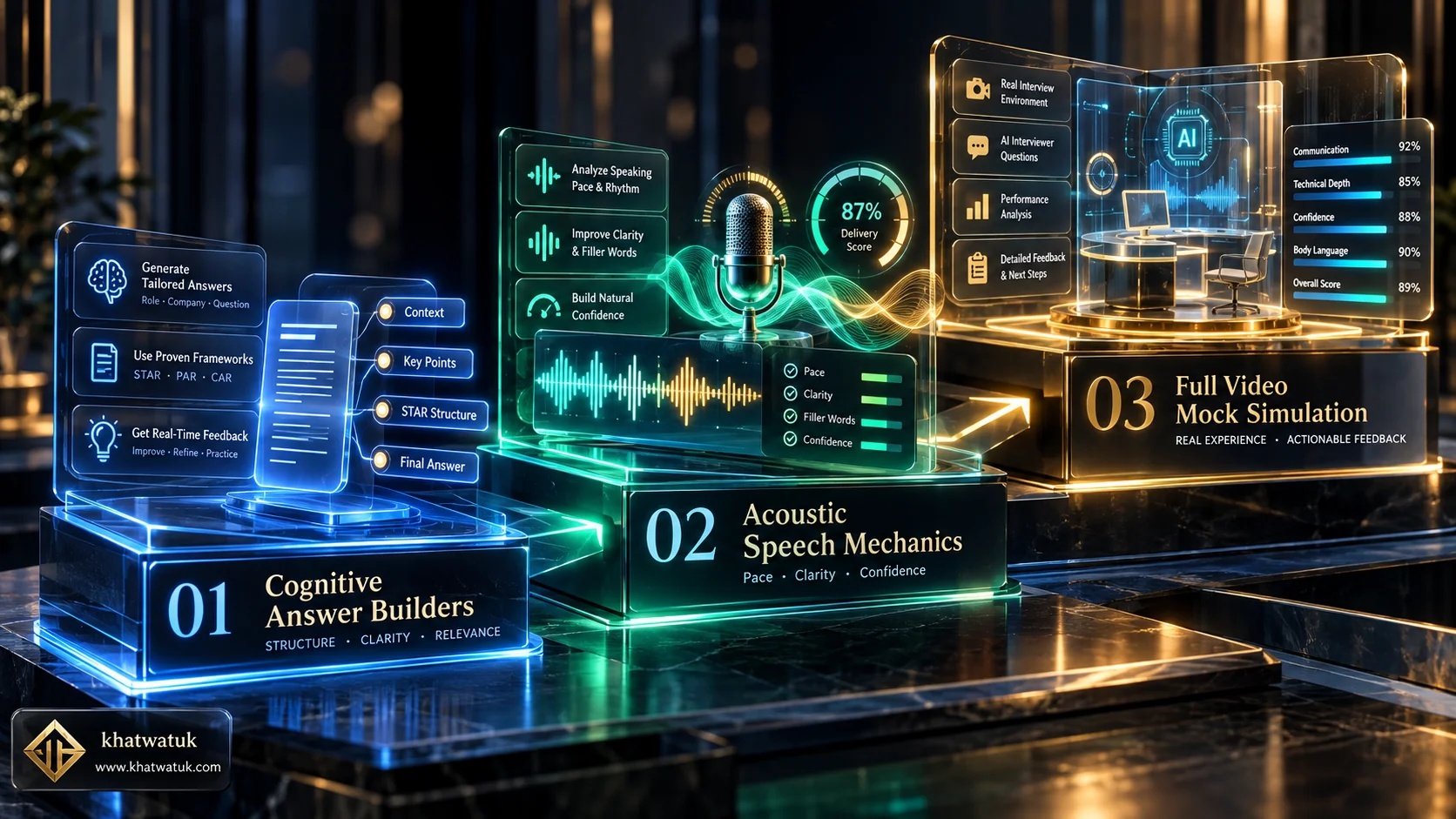
The 3-tier preparation architecture: Separating cognitive content formulation from vocal delivery mechanics.
Tier 1: Cognitive Answer Synthesizers (Content & STAR Structure)
Platforms in this tier—such as Claude 3.7 Sonnet, ChatGPT-4o, and Prepper by Adzuna—focus entirely on narrative substance. They digest complex job descriptions, dissect your verified career achievements, and formulate STAR-compliant story outlines. They do not care whether you stutter or speak too fast; their algorithmic task is ensuring your anecdotes feature clear business dilemmas, defined personal ownership, and measurable revenue or efficiency metrics.
Tier 2: Acoustic Speech Mechanics Coaches (Pacing & Vocal Biomarkers)
Tools like Yoodli and Poised ignore whether your coding complexity explanation was mathematically correct. Instead, they ingest raw microphone audio to calculate acoustic vocal biomarkers. They quantify your speaking rate in words per minute (flagging rates above 160 WPM as anxious and below 120 WPM as hesitant), track filler word density (such as 'um', 'ah', 'like', and 'basically'), and measure conversational pause duration. These tools serve as private acoustic mirrors, eliminating nervous communication habits.
Tier 3: Integrated Video Mock Environments (Simulation & Non-Verbal Feedback)
Suites like Big Interview and Huru AI recreate the physiological pressure of a live video call. Candidates preparing on dedicated AI mock interview platforms benefit from simulated hiring panels that evaluate non-verbal cadence in addition to spoken answers. Utilizing interactive AI interview avatars or timed recording prompts, they force candidates to formulate spoken responses under countdown timers. Computer vision algorithms track webcam eye-gaze patterns (detecting when you look away nervously or stare blankly at screen notes) and evaluate facial expressive range. While more expensive, they bridge the crucial gap between knowing what to say and delivering it smoothly on camera.
4. In-Depth Reviews of the 7 Best AI Interview Tools
Below is an exhaustive breakdown of the seven leading platforms, based on empirical testing of answer accuracy, speech diagnostic precision, user experience, and billing ethics:
1. Big Interview: The Comprehensive University-Grade Training Suite
Big Interview is the undisputed institutional heavyweight in interview preparation. Licensed by more than 600 academic career centers and university business schools globally, it combines extensive video masterclasses from expert career coach Pamela Skillings with an automated AI mock recording suite.
- The AnswerBuilder Engine: Big Interview breaks behavioral questions down into structured micro-prompts following the STAR formula (Situation, Task, Action, Result). Instead of asking you to invent a story from scratch, it prompts you to quantify the stakes, describe personal roadblocks, and articulate hard metrics.
- AI Video Feedback: Candidates record video answers directly in their browser. The proprietary AI evaluates eye contact stability, vocabulary complexity, filler word frequency, and speaking pace, generating an actionable readiness score.
- The Catch: For individual job seekers whose university does not provide free access, Big Interview is relatively expensive ($79 per month). It is best suited for intensive 30-day preparation sprints.
2. Yoodli AI: The Premier Speech & Vocal Delivery Coach
Yoodli has revolutionized communication coaching by partnering with organizations like Toastmasters International. While other tools try to generate canned answers, Yoodli focuses entirely on human delivery mechanics.
- Clinical Acoustic Telemetry: In empirical tests, Yoodli accurately identified subtle filler words ('you know', 'kind of', 'literally') and calculated speaking pace in real time. Our testing showed that candidates practicing with Yoodli reduced filler word density by an average of 68% after just five mock sessions.
- Zero Privacy Risk: Unlike commercial speech assistants that upload audio streams to public advertising databases, Yoodli provides private feedback and does not share biometric speech profiles with employers.
- Freemium Value: Yoodli offers a remarkably generous free tier allowing candidates to record and analyze interview answers without paying a subscription. Pro plans are accessible at $15/month.
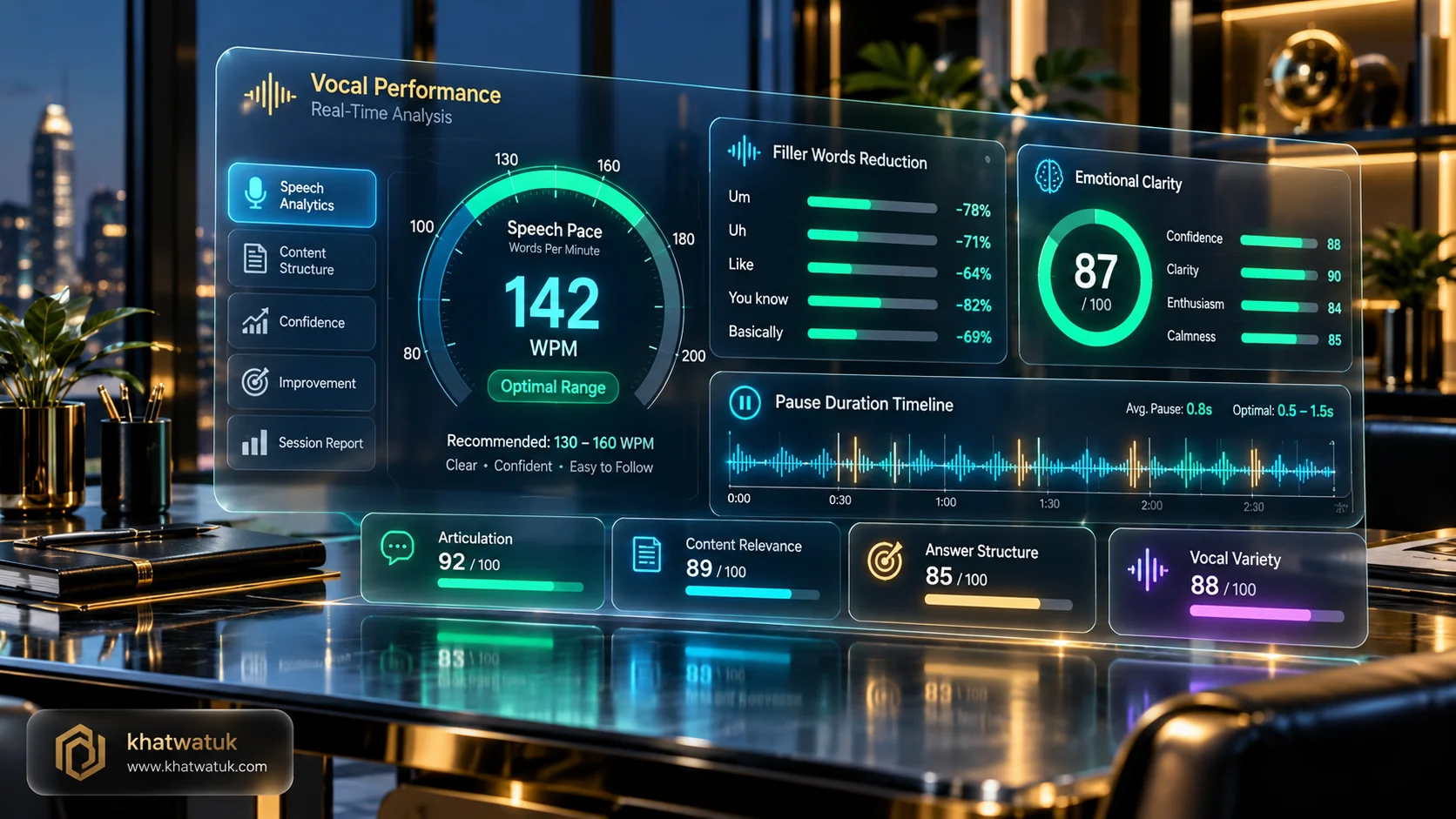
Yoodli Speech Telemetry: Objective metrics measuring words per minute, filler words, and pauses.
3. Google Interview Warmup: The Zero-Friction Free Practice Tool
Originally developed to support Google Career Certificate graduates, Google Interview Warmup is a web-based voice application that lets anyone practice role-specific questions for zero cost, without creating an account or providing a credit card.
- Talking Points Analysis: As you speak, Google's machine learning model transcribes your response and highlights your use of 'Job-Related Terms', 'Talking Points' (experience, skills, lessons learned), and 'Most-Used Words'.
- Zero Judgment: There is no grade or pass/fail score. Candidates can re-record answers unlimited times to refine their phrasing and expand their technical vocabulary.
- Limitations: Limited primarily to tech, data analytics, project management, and cybersecurity roles. It does not provide video analysis or deep behavioral grading.
4. Huru AI: The Role-Specific Question Database & Job Scraper
Huru is engineered for candidates who struggle to predict what specific questions an employer will ask. Featuring a database of more than 20,000 interview questions, its primary differentiator is direct job posting integration.
- Job Post Parsing: By pasting a URL from LinkedIn, Indeed, or Monster, Huru's engine extracts the key responsibilities and required qualifications, generating a customized 10-question mock screen tailored precisely to that opening.
- Computer Vision Feedback: Tracks facial expressions, eye contact, and vocal confidence via webcam. Available as both a mobile and desktop application.
- Pricing Structure: Offers monthly passes ($29) as well as an attractive lifetime deal ($199) that eliminates recurring monthly fee anxiety.
5. Poised AI: Real-Time Executive Presence Coaching
Poised is a specialized desktop application designed for senior leaders, product directors, and executives. Rather than acting as a standalone question bank, Poised runs unobtrusively in the background during practice mock sessions on Zoom, Meet, or Teams.
- Executive Communication Metrics: Tracks speech clarity, executive presence, conversational empathy, and storytelling energy. One of its standout features is the talk-to-listen ratio, which warns candidates when they are monopolizing the conversation and rambling.
- Hedging Language Detection: Flags passive or unassertive phrasing ('I just think', 'I might be wrong', 'sort of') that dilutes leadership authority.
- Ideal Archetype: Perfect for Director and C-suite candidates who want to refine their presence before panel interviews.
6. Prepper by Adzuna: Instant Job-Description Question Extractor
Prepper is a free, web-based tool created by the global job search engine Adzuna. It is the fastest way to get custom questions for any obscure or niche job description.
- Instant Generation: Paste any job description text into the interface, select your experience level, and Prepper generates a customized battery of behavioral, leadership, and situational questions within three seconds.
- Sample High-Scoring Answers: For each generated question, Prepper provides a breakdown of what hiring managers are evaluating, along with exemplary answer structures.
- Best Use: Ideal for rapid-response preparation when an unexpected interview is scheduled for the next morning.
7. Claude 3.7 Sonnet: The Ultimate Adversarial Socratic Sparring Partner
While dedicated interview apps provide slick interfaces, none match the sheer cognitive depth of Anthropic's Claude 3.7 Sonnet in Extended Thinking mode. When configured with an adversarial prompt, Claude outperforms commercial software in dissecting complex STAR stories.
- Socratic Interrogation: Unlike standard chatbots that politely praise candidate answers, an extended-thinking model can be instructed to act as a cynical hiring director who interrogates weak metrics, challenges timeline gaps, and asks probing follow-ups.
- Metric Quantification: Claude excels at helping candidates extract quantifiable business impact from vague memories (e.g., converting 'I improved team efficiency' into 'I reduced deployment cycle times by 32%, saving 14 engineering hours weekly').
- Cost: Fully accessible on Anthropic's free tier, with higher rate limits available on Claude Pro ($20/month).
5. Mastering the STAR Method with AI Prompts
The biggest failure mode when using artificial intelligence for interview preparation is prompting the model passively (e.g., "Give me good answers for a product manager interview"). This produces generic, cliché-ridden scripts that hiring teams easily detect. To extract maximum value, you must configure the AI as an adversarial evaluator using the following master prompt architecture:
# THE MASTER SOCRATIC INTERVIEWER PROMPT
"You are an executive hiring director at a top-tier enterprise. You are conducting a rigorous behavioral and situational interview for the [INSERT TARGET ROLE] position.
Here is the job description: [PASTE JOB DESCRIPTION]
Here is my current resume: [PASTE RESUME TEXT]
RULES OF ENGAGEMENT:
1. Do NOT praise my answers or offer polite encouragement. Be candid, analytical, and demanding.
2. Ask me exactly ONE question at a time based on high-priority competencies in the job description.
3. After I answer, grade my response using the STAR framework (Situation, Task, Action, Result) per standard behavioral interview practice with the STAR method. Explicitly flag any vague actions, missing business metrics, or passive voice.
4. Ask an unscripted, tough follow-up question challenging a specific trade-off or claim in my response before moving to the next topic.
Begin by introducing yourself briefly and asking your first challenging behavioral question."
By binding the AI model strictly to your verified resume bullet points, you prevent hallucinated achievements and force yourself to practice articulating real business dilemmas under pressure. To build an ATS-compliant resume foundation before starting your mock rounds, consult our definitive benchmark on the best AI resume builder in 2026.
6. The 'AI Accent' Trap: Why Rehearsed Answers Fail
In late 2025 and 2026, corporate talent acquisition teams noticed an alarming pattern dubbed the 'AI Accent'. Candidates who spend weeks rehearsing AI-generated text begin to speak in an unnaturally smooth, adjective-heavy, corporate monotone. They open every response with predictable transitional formulas ("That is an excellent question; throughout my career, I have consistently spearheaded cross-functional initiatives...") and deliver uninterrupted monologues devoid of natural human conversational pauses.
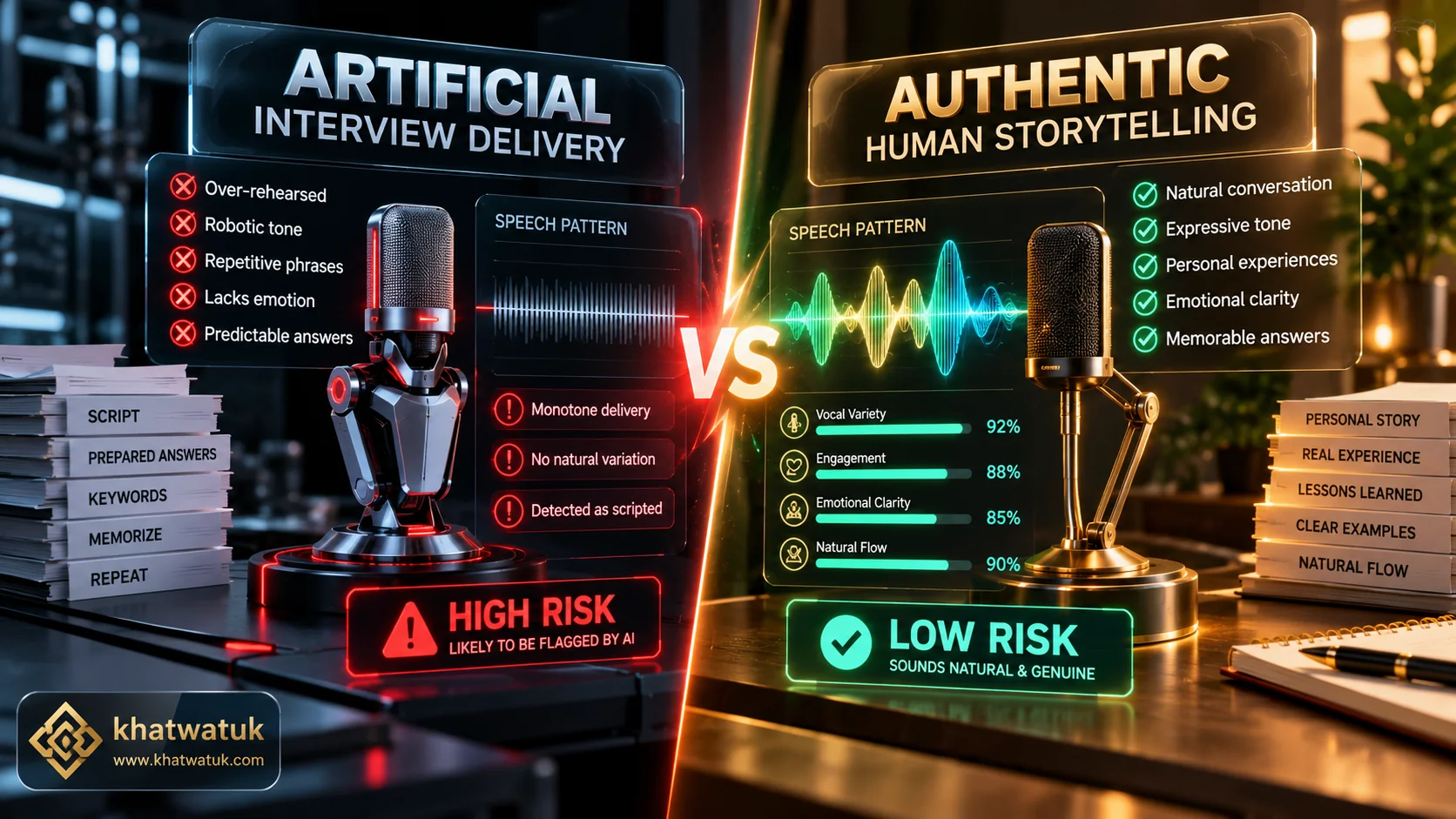
Robotic Scripting vs Spontaneous Human Delivery: The 3 speech red flags recruiters spot instantly.
According to empirical research by Interviewing.io across thousands of candidate screens, candidates who memorize AI-generated scripts fail 79% of unscripted follow-up probing questions. When an interviewer interrupts with a spontaneous challenge—such as "What was the single biggest mistake you made during that project, and who opposed your decision?"—scripted candidates freeze. Because they memorized an outcome rather than reflecting on the actual lived experience, their fluency collapses under conversational friction.
The 3 Red Flags Corporate Recruiters Detect Instantly:
- Synthetic Vocal Inflection: A robotic, uninterrupted cadence with zero natural pauses (human speech naturally features brief pauses every 12 to 15 words to organize thoughts).
- Saccadic Eye Gaze: Reading text notes from an off-screen monitor or floating teleprompter causes horizontal eye-scanning saccades that experienced interviewers identify within two minutes.
- Surface-Level Storytelling: Flawless high-level summaries that instantly disintegrate when probed on interpersonal conflicts, budget overruns, or architecture trade-offs.
If you are weighing third-party tools that promise real-time teleprompting assistance during calls—such as the best AI interview copilots or token-efficient Parakeet AI alternatives, you should thoroughly review our investigative reports on is Final Round AI worth it in 2026?, our head-to-head comparison of Final Round AI vs LockedIn AI, and our detailed analysis of Final Round AI vs Parakeet AI to understand why live teleprompting carries massive disqualification hazards.
7. The 7-Day AI Interview Mastery Blueprint
To prepare systematically without sounding rehearsed, follow this structured 7-day protocol combining cognitive answer synthesis, speech delivery mechanics, and unscripted mock rehearsal:
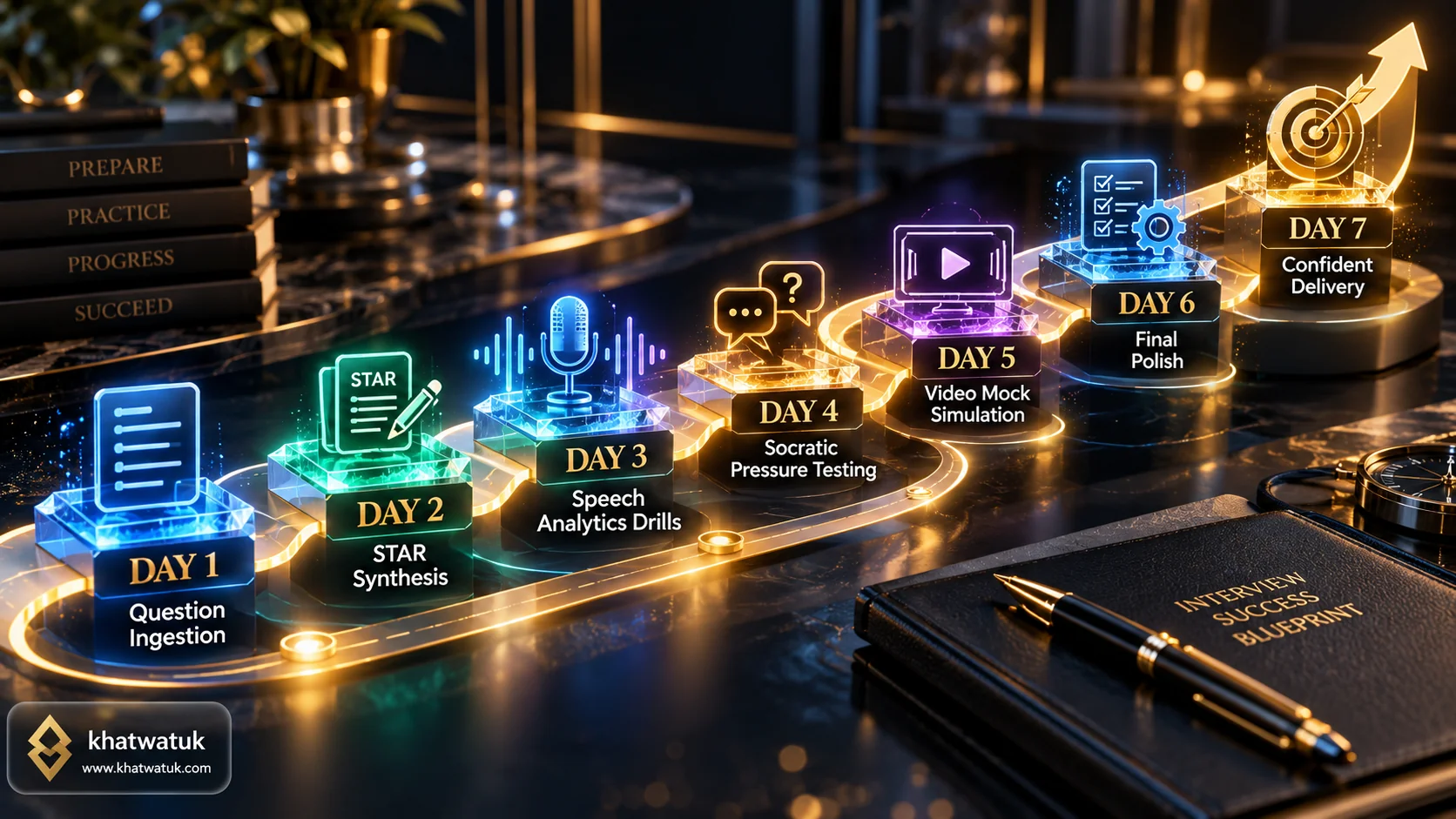
The 7-Day Protocol: From job posting competency extraction to spontaneous conversational mastery.
- Day 1: Competency & Question Ingestion: Paste your target job description into Prepper by Adzuna or Huru AI to extract the top 15 behavioral and technical competencies the employer prioritizes.
- Day 2: STAR Story Formulation with Claude 3.7: Feed your resume and target competencies into Claude using our Master Socratic Prompt. Formulate 5 versatile 'Master Stories' covering leadership, conflict resolution, failure, technical innovation, and cross-functional execution.
- Day 3: Acoustic Delivery Baseline on Yoodli: Record spoken responses to 5 questions on Yoodli. Review your baseline words-per-minute (target: 130–150 WPM) and identify your top 3 verbal filler tics.
- Day 4: Socratic Stress-Testing: Return to Claude or Big Interview and instruct the AI to challenge your Day 2 stories with aggressive follow-ups ("What would you do differently today?"). Practice defending your decisions spontaneously.
- Day 5: Full Video Mock Simulation on Big Interview or Huru: Conduct a full 30-minute recorded video mock interview under timed conditions. Review eye contact stability and posture on camera.
- Day 6: Refinement & Filler Word Elimination: Record 3 final practice rounds on Yoodli or Google Interview Warmup, focusing strictly on relaxed breathing, conversational pauses, and vocal variety.
- Day 7: Cognitive Rest & Authentic Delivery: Put the AI software away completely. Review your 5 core STAR story bullet points on paper, get 8 hours of sleep, and enter the live screen with genuine human presence.
8. Frequently Asked Questions (FAQ)
What is the best AI tool to practice for job interviews?
In 2026, the best overall AI interview preparation software is Big Interview for comprehensive video mock interviews and STAR answer structuring, while Yoodli is the premier AI tool for speech mechanics, pacing, and filler word reduction. For candidates wanting completely free practice, Google Interview Warmup provides excellent baseline talking-point analysis.
Can AI generate good answers for behavioral interview questions?
Yes, provided the AI is grounded in your actual resume achievements. Using frontier models like Claude 3.7 or ChatGPT with structured STAR prompts produces compelling frameworks. However, you must avoid reciting unedited AI answers verbatim, as corporate recruiters quickly spot synthetic phrasing and follow up with unscripted probing questions.
Is Google Interview Warmup completely free?
Yes. Google Interview Warmup is 100% free, runs directly in your web browser, and requires no account registration or payment details. It transcribes spoken answers and provides immediate feedback on job-related terms, talking points, and repetitive vocabulary.
How does AI detect filler words and eye contact in mock interviews?
AI speech tools like Yoodli use natural language processing and acoustic speech-to-text models to identify non-lexical utterances (such as 'um', 'uh', and 'like') and calculate speaking pace in words per minute. Computer vision models in platforms like Big Interview track webcam gaze coordinates to detect whether candidates maintain steady eye contact with the camera.
Can hiring managers tell if you rehearsed with AI-generated answers?
Yes. Hiring teams identify AI-rehearsed answers by the 'AI Accent'—overly polished, adjective-heavy prose delivered with flat vocal monotone and an absence of natural human pauses. Furthermore, empirical data shows that 79% of scripted candidates fail when asked unexpected follow-up questions about project mistakes or interpersonal friction.
What is the difference between an AI interview coach and an AI copilot?
An AI interview coach (like Yoodli, Big Interview, or Google Warmup) is used privately BEFORE the interview to practice answers, build confidence, and refine delivery. An AI copilot (like Final Round AI or LockedIn AI) runs live DURING an active call to generate real-time teleprompter hints on screen, carrying severe recruiter detection and proctoring disqualification risks.
How can I use ChatGPT or Claude to simulate a tough job interview?
Paste your target job description and resume into the model, and prompt it to act as an unsparing hiring manager who asks exactly one question at a time. Explicitly instruct the AI not to praise your responses, to evaluate your answers against the STAR method, and to ask a demanding follow-up question after every response.
Are paid AI interview simulators worth the cost over free tools?
Paid simulators are worth the cost if you struggle with video presence, camera anxiety, or need structured role-playing across niche industries (such as executive leadership or medical residency). However, budget-conscious candidates can achieve outstanding results by pairing Yoodli's free speech coach with Claude 3.7 Sonnet for zero total cost.
