

In the head-to-head matchup of final round ai vs parakeet ai, Parakeet AI is the superior choice for candidates seeking fast, pay-per-interview credit packs without recurring subscription traps, while Final Round AI is built for job seekers wanting an all-in-one platform with automated resume grounding and pre-call AI mock drills. Parakeet delivers faster sub-second audio transcription (~420ms vs ~780ms), whereas Final Round provides deeper career workflow integration at a noticeably higher monthly cost.
⚡ Executive Summary: Fast Head-to-Head Verdict
- Choose Parakeet AI if: You have sporadic interviews, want zero auto-renewal billing surprises, prefer purchasing non-expiring credit packs ($30 for 3 credits), and need rapid, lightweight audio streaming with minimal latency.
- Choose Final Round AI if: You are actively running a high-intensity, multi-week interview blitz, need pre-interview AI mock practice, and require live teleprompter answers explicitly grounded in your uploaded resume history.
- Real-Time Response Speed: Parakeet AI wins with approximately 420ms first-token generation versus Final Round AI's 780ms cloud pipeline overhead.
- Pricing & Billing Ethics: Parakeet AI wins decisively. Its pay-as-you-go credit model eliminates the aggressive weekly auto-rebilling complaints frequently reported with Final Round AI ($39/week recurring).
- Candidate Safety & Detection: Tie. Both tools run real-time cloud LLMs and require disciplined candidate execution (eye gaze control and vocal inflection) to prevent recruiter suspicion.
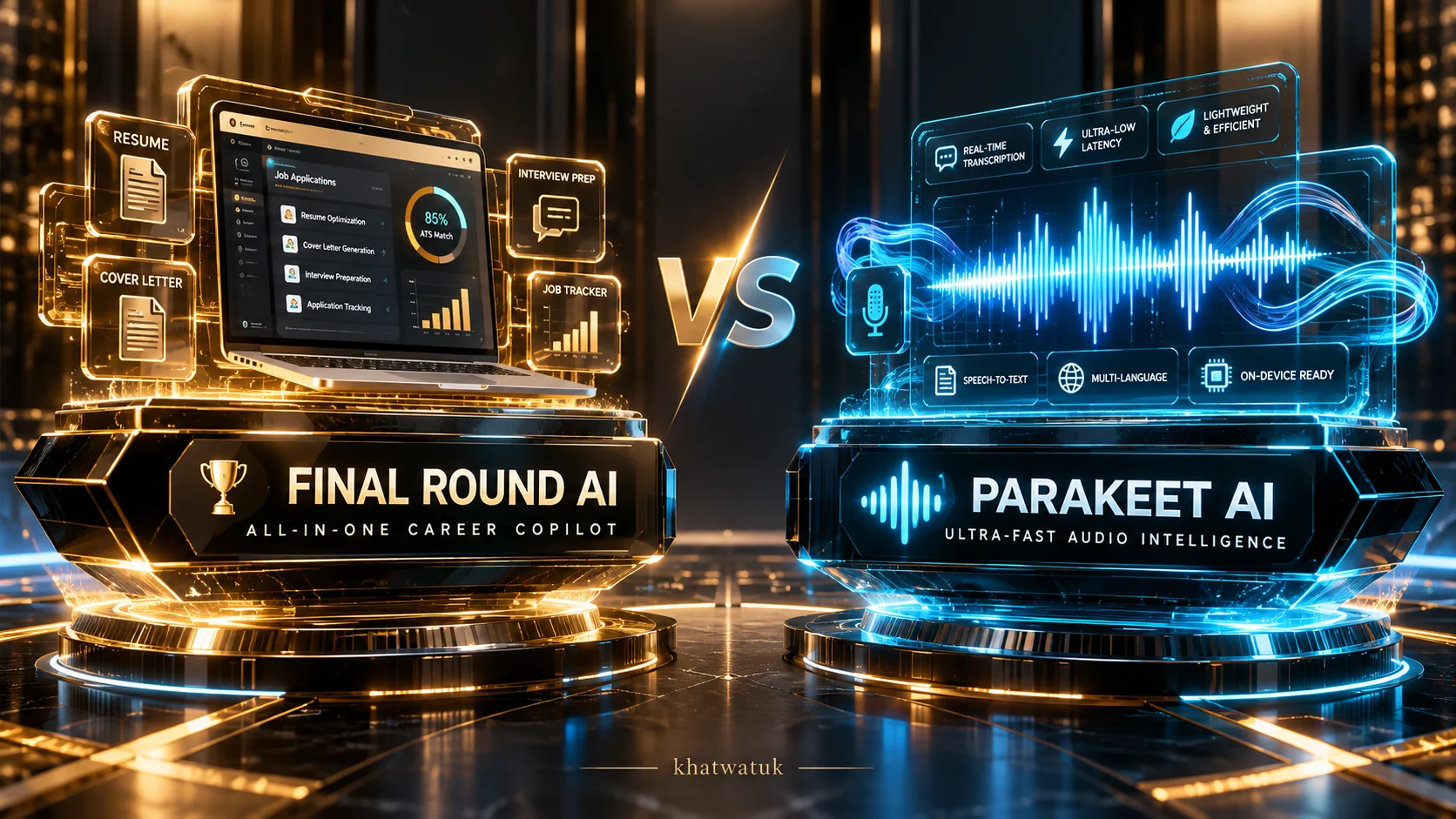
Final Round AI vs Parakeet AI: Head-to-Head Copilot Comparison
2. Head-to-Head Comparison Matrix: Final Round AI vs Parakeet AI
When deciding between these two prominent tools, comparing specifications side by side reveals distinct engineering priorities. While one platform focuses on end-to-end preparation, the other concentrates on execution agility during live calls. Before committing to either software, ensuring that your application materials are properly tracked across job boards is critical; job seekers managing multiple interview rounds should review our comprehensive guide on the Best AI Job Application Tool to streamline inbound interview pipelines.
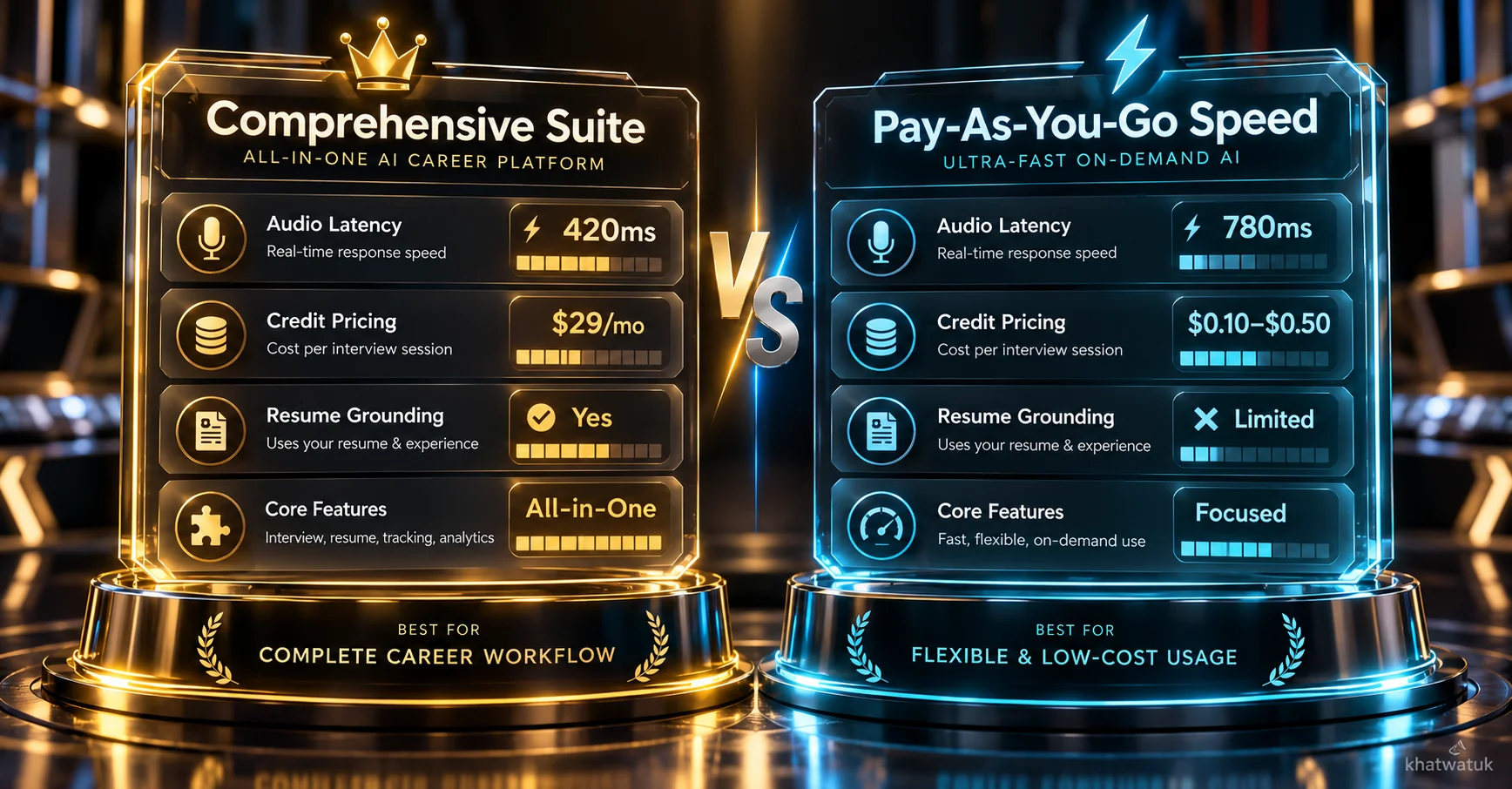
Final Round AI vs Parakeet AI: Core Specifications and Feature Matrix
| Evaluation Feature | Final Round AI | Parakeet AI |
|---|---|---|
| Core Architecture | All-in-one web dashboard + virtual desktop teleprompter | Lightweight native desktop HUD overlay (macOS / Windows) |
| First-Token Audio Latency | ~750ms – 1,100ms (multi-stage LLM reasoning) | ~400ms – 550ms (streamlined speech-to-text pipeline) |
Beyond software mechanics, interview success depends on systematic tracking. If you are fielding interview requests across multiple companies and need a centralized hub to track application deadlines, interview dates, and recruiter contact notes, consider using an integrated career platform:
3. Real-Time Copilot Performance: Audio Latency and Response Accuracy
If low-latency live teleprompting is your primary criteria, compare this with our dedicated evaluation of Final Round AI vs LockedIn AI. In a high-stakes video interview on Zoom, Google Meet, or Microsoft Teams, first-token latency represents the single most crucial technical metric. When an interviewer asks a complex situational question, candidates have roughly 1.5 to 2.5 seconds of natural pause before silence feels awkward or suspicious. If an AI copilot requires 1.8 seconds simply to transcribe audio and initiate generation, the candidate is forced to stall or deliver disjointed filler sentences.
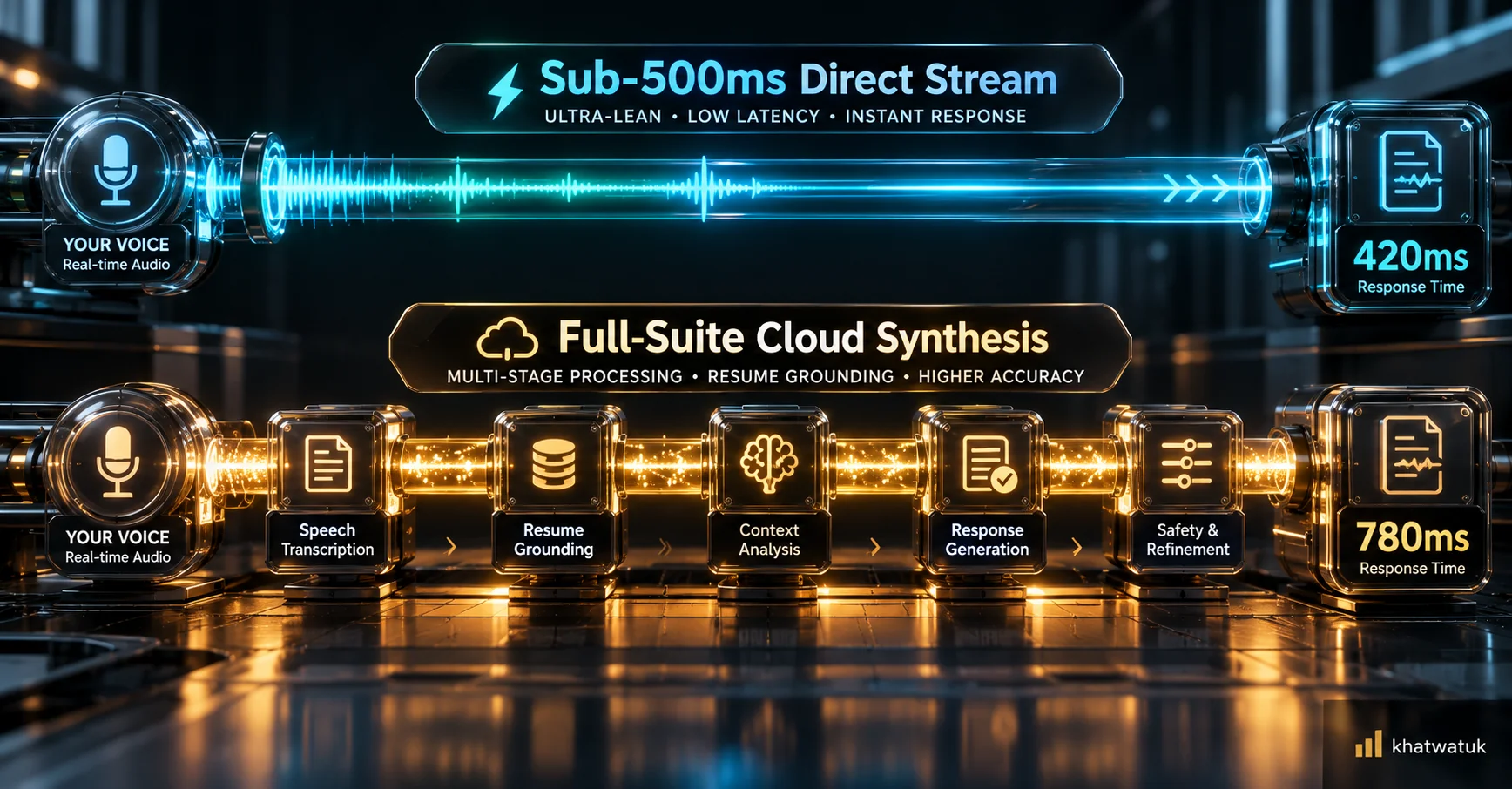
Real-Time Audio Latency and Response Speed Benchmarks
Here is where the technical philosophies of both systems diverge sharply:
- Parakeet AI's Lean Streaming Pipeline: Parakeet utilizes an ultra-lean audio pipeline that streams incoming system sound directly to optimized transcription servers via WebSockets. First tokens routinely render on screen within 400ms to 550ms. The answers appear as rapid bullet points, giving candidates instant conceptual cues rather than dense paragraphs.
- Final Round AI's Multi-Agent Cloud Synthesis: Final Round AI routes the prompt through multiple LLM reasoning layers to incorporate candidate resume context and company research. While this produces richer, highly tailored responses, it introduces significant processing latency (~750ms to 1,200ms). In fast-paced technical screens, this delay can cause noticeable hesitation.
However, Final Round AI counters with superior resume grounding. When a recruiter asks, "Tell me about a time you resolved a major production outage," Final Round AI references your exact past employer, technology stack, and metrics directly from your uploaded CV. Parakeet AI, by comparison, relies on custom user prompt instructions, meaning candidates must manually prime the client with background notes to achieve comparable contextual accuracy.
For broader context on how real-time copilots compare against standalone mock prep tools, explore our definitive analysis of Best AI Interview Assistant Tools across the modern hiring ecosystem.
4. Pricing and Credit Economics: Subscription Traps vs Pay-Per-Interview
Pricing model transparency is perhaps the most defining separator between Final Round AI and Parakeet AI. Job searching is inherently episodic: a candidate might have three interviews during one intensive week, followed by two weeks of total silence while waiting for committee feedback. A pricing model should reflect this unpredictable reality. For candidates investigating the true cost of subscription billing traps and Reddit user feedback, consult our detailed analysis on is Final Round AI worth it in 2026?.
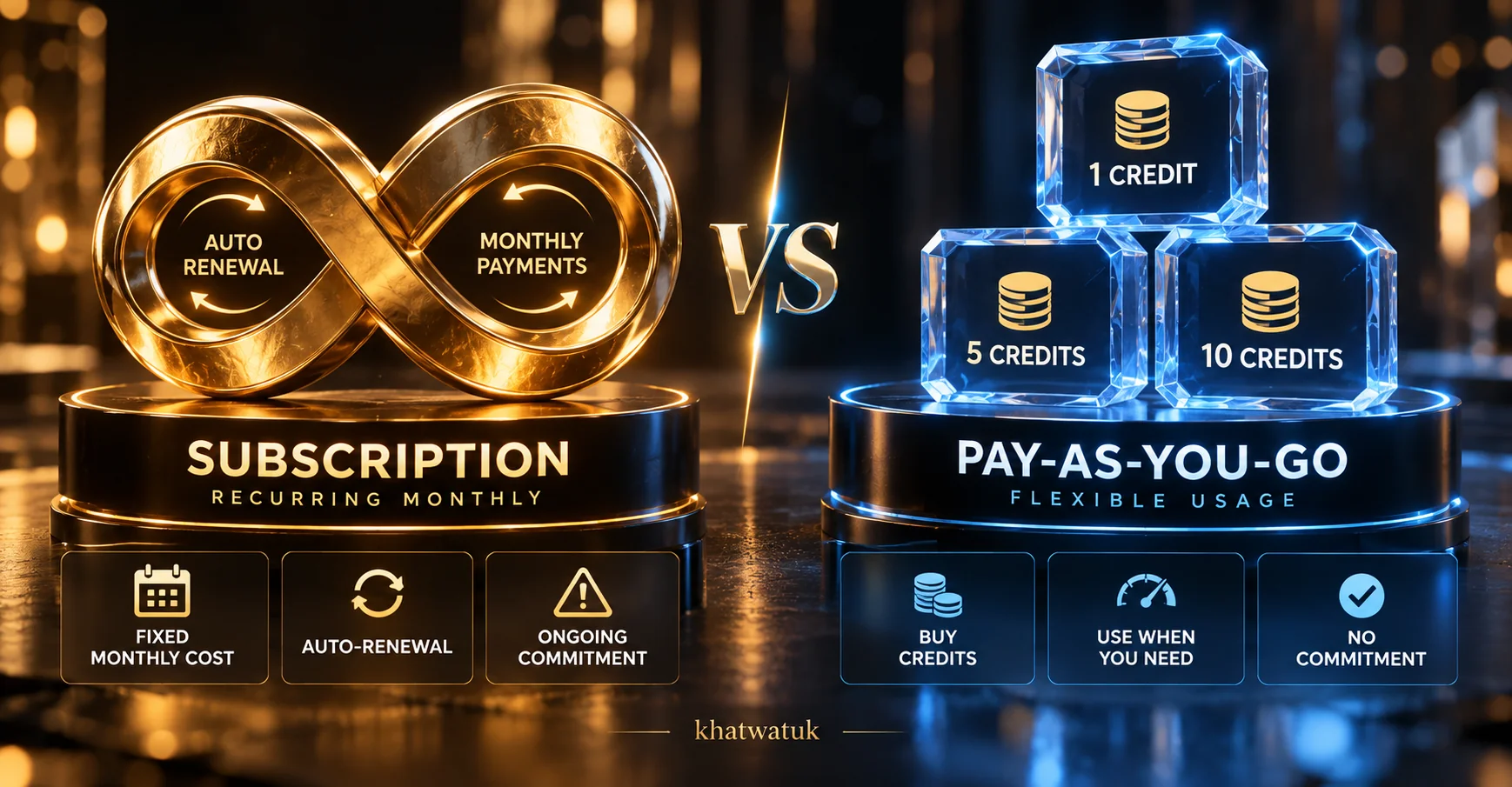
Subscription Traps vs Pay-Per-Interview Credit Economics
A detailed financial breakdown highlights how candidate costs scale:
- Parakeet AI's Pay-Per-Interview Model: Parakeet operates almost entirely on credit packages. Candidates can purchase a 3-interview starter pack for approximately $30 (~$10 per interview) or a 15-interview bundle for around $88 (~$5.86 per interview). These credits do not expire weekly. If your next round is scheduled three weeks out, your balance remains untouched with zero auto-renewal billing.
- Final Round AI's Subscription Model: Final Round AI charges between $39 and $49 per week for short passes, or upwards of $99 to $149 per month for full access. Unless actively canceled in account settings, the subscription automatically renews. Multiple candidate reports across Reddit's career communities cite unexpected charges when users forgot to cancel after their final round concluded.
From an economic standpoint, if you have fewer than six interviews scheduled over a 60-day period, Parakeet AI saves between 60% and 80% compared to maintaining an ongoing Final Round AI subscription. Final Round AI only achieves cost parity if you are conducting 4 to 5 mock drills and live screens every single week.
5. Stealth, Screen Sharing, and Privacy Architecture
The single biggest technical nightmare for any candidate using an interview assistant is the unexpected screen share. An engineering manager suddenly says, "Could you share your screen and walk me through this architecture diagram?" If your copilot teleprompter is sitting in a browser window on the same desktop, panic ensues.
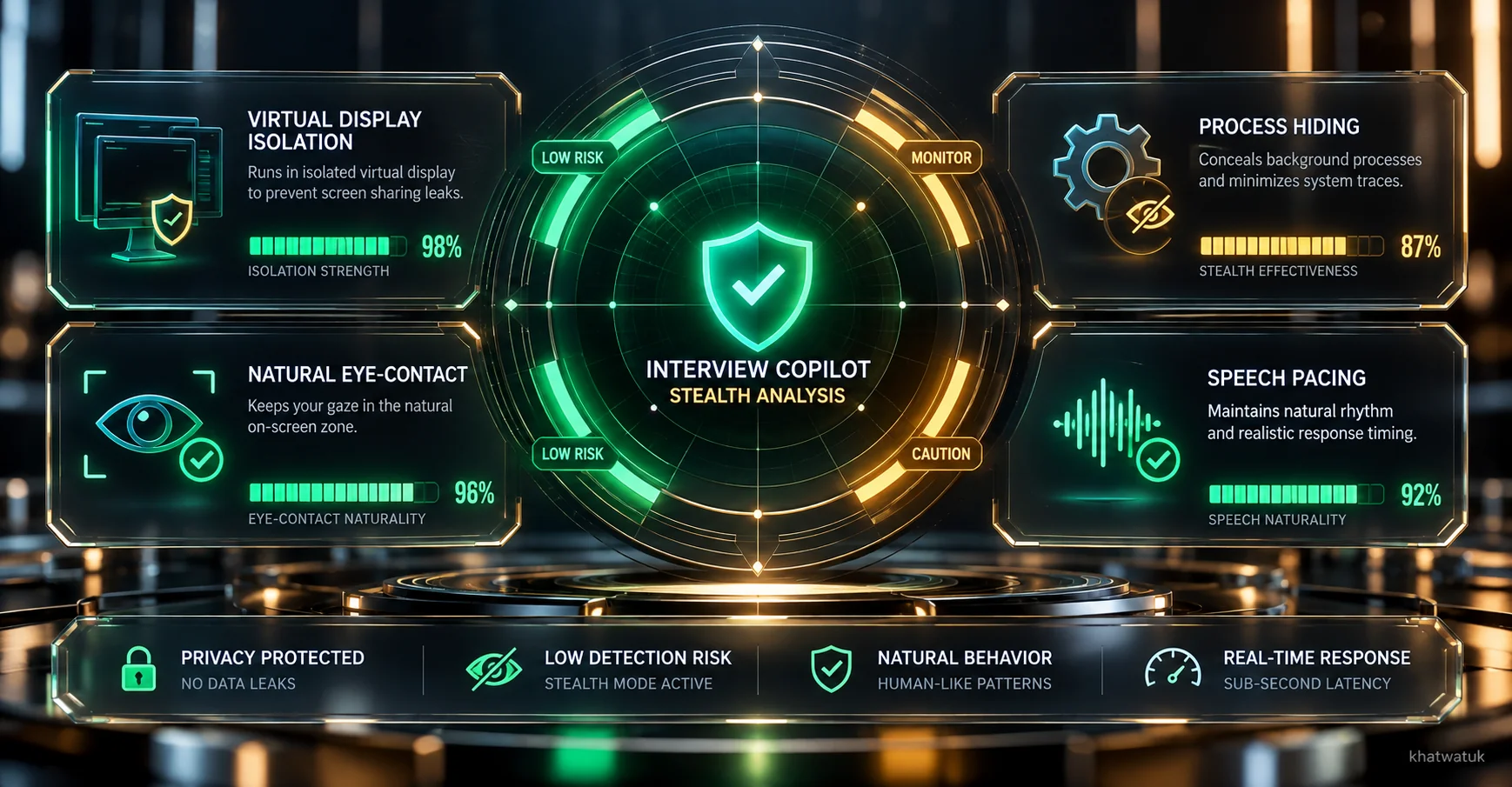
Stealth Copilot Safety Radar: Screen-Share Isolation & Recruiter Telltales
Both tools approach process obfuscation through distinct technical setups:
- Parakeet AI's Desktop Overlay: Parakeet provides a native desktop client that utilizes transparent window hooks. While it floats conveniently on top of Zoom or Meet, candidates must ensure they share a specific application window (such as Chrome or VS Code) rather than their entire desktop. Sharing the entire desktop can inadvertently reveal the floating overlay on certain operating system configurations.
- Final Round AI's Web & App Ecosystem: Final Round AI allows users to run the teleprompter on a secondary device (such as an iPad or secondary monitor positioned immediately behind the webcam). This physical separation provides absolute hardware-level screen-share safety, as the interview computer never hosts the teleprompter window.
Regarding enterprise data privacy, both platforms transmit audio snippets to third-party cloud infrastructure (such as OpenAI Whisper or custom fine-tuned speech models). Candidates interviewing under strict non-disclosure agreements (NDAs) at enterprise organizations should exercise caution when transmitting proprietary whiteboard discussions over third-party cloud APIs.
6. Archetype Decision Framework: When to Choose Final Round AI vs Parakeet AI
Choosing between Final Round AI and Parakeet AI is straightforward when aligned with your career stage, interview timeline, and budget elasticity:
🎯 The Archetype Selection Framework
- Choose Parakeet AI if:
- You have 1 to 3 critical interviews scheduled and want zero commitment to recurring monthly subscriptions.
- You prioritize rapid audio prompts and bullet-point inspiration over lengthy pre-written scripts.
- You want complete financial control through transparent, one-time credit packs.
- Choose Final Round AI if:
- You are executing a full-time, multi-week job search blitz with multiple interviews per week.
- You need an automated mock interview simulator to practice answering questions before live calls.
- You want live answers heavily anchored in your specific historical resume achievements and metrics.
The #1 Mistake Candidates Make: The most catastrophic error with both platforms is attempting to read generated answers verbatim. Recruiters immediately recognize the flat vocal cadence and horizontal eye tracking of someone reading text off a screen. Use the copilot as an outline trigger: glance at the key bullet points, absorb the concept, and deliver the answer in your natural voice.
Remember that an AI copilot cannot compensate for a weak or poorly structured resume. For candidates targeting competitive executive roles, aligning leadership achievements on paper is paramount; learn more in our detailed guide on the Best Resume Builder for Executives. Furthermore, before any interview copilot can generate compelling talking points, your core resume bullet points must be optimized for ATS systems and executive recruiters:
7. The Recruiter Detection Reality: Can Hiring Teams Tell You're Using AI?
A critical question candidates ask when evaluating Final Round AI vs Parakeet AI is whether interviewers can tell they are using assistive software (especially during algorithmic or technical rounds where platforms like CoderPad and HackerRank monitor paste events and focus switches; see our guide to the best AI for coding interviews). In 2026, corporate hiring teams, talent acquisition partners, and hiring managers are actively trained to identify real-time AI assistance.
Hiring teams rely on four behavioral telltales rather than invasive software detection:
- The Teleprompter Gaze Scan: When a human speaks spontaneously, their eyes wander naturally—looking up to reflect, pausing, and re-engaging webcam contact. When reading an AI-generated paragraph from Final Round or Parakeet, the candidate's eyes execute rigid, repetitive left-to-right micro-saccades across the display.
- The Artificial Latency Hesitation: Even with Parakeet's 420ms response, candidates often freeze completely for 3 seconds while waiting for text to render, then suddenly launch into an unnaturally articulate, paragraph-long monologue without the normal false starts of authentic human conversation.
- The Monotone Vocal Delivery: Spontaneous speech contains natural variations in pitch, pace, and emphasis. Reading generated text invariably induces a flatter, slightly robotic inflection that seasoned interviewers detect within seconds.
- The Fragile Surface Trap: AI models generate polished surface-level answers. Experienced hiring managers frequently counter with immediate, unexpected follow-up probes: "Why did you choose PostgreSQL over DynamoDB in that specific project?" If the candidate was merely reciting the copilot's prompt, they stumble when forced to defend the underlying engineering trade-offs.
To master your foundational career materials and build authentic confidence before stepping into live screening calls, review our overarching analysis of the Best AI Resume Builder in 2026 to ensure your accomplishments speak for themselves.
8. Frequently Asked Questions (FAQ)
In the matchup of Final Round AI vs Parakeet AI, which is better overall?
Parakeet AI is better for most job seekers because of its lower latency (~420ms), lightweight client, and transparent pay-per-interview credit pricing ($30 for 3 credits) with zero recurring auto-billing traps. Final Round AI is better only for candidates who specifically need automated resume grounding and extensive pre-interview AI mock drills during an intense job search.
What is the main difference between Final Round AI and Parakeet AI?
The primary difference lies in product scope and billing architecture. Final Round AI is an all-in-one prep suite with mock interviews and resume integration sold via recurring weekly or monthly subscriptions ($39/wk to $149/mo). Parakeet AI is a specialized real-time copilot focused strictly on live call audio prompts sold via non-expiring pay-as-you-go credit packs.
How much does Parakeet AI cost compared to Final Round AI?
Parakeet AI costs approximately $30 for a 3-credit pack (~$10 per interview) or $88 for 15 credits (~$5.86 per interview) with no recurring charges. Final Round AI charges $39 to $49 per week or $99 to $149 per month on an auto-renewing subscription model.
Does Parakeet AI have recurring monthly subscriptions?
No. Parakeet AI operates primarily on one-time, pay-as-you-go credit packs. Once purchased, your credits do not expire weekly, eliminating the auto-renewal rebilling issues associated with recurring SaaS plans.
Which AI interview copilot has faster response latency?
Parakeet AI is noticeably faster, generating first tokens in approximately 400ms to 550ms. Final Round AI averages between 750ms and 1,100ms because it processes queries through multi-stage reasoning models and resume-grounding context.
Can interviewers tell if you are using Final Round AI or Parakeet AI?
Yes, if you read the generated text verbatim. While video meeting software cannot detect the application directly, recruiters easily identify telltale behavioral cues: horizontal eye scanning, artificial pauses before answering, and flat vocal inflection.
Does Final Round AI support resume grounding for live interviews?
Yes. Final Round AI allows candidates to upload their resume and target job description, ensuring that live teleprompter suggestions cite actual past projects and quantifiable achievements.
Can Parakeet AI or Final Round AI be detected during screen sharing?
If you share your entire desktop screen, floating overlays can be captured. To remain safe, always select 'Share Window' instead of 'Share Entire Screen', or display the copilot on a separate physical secondary screen.
