

In the head-to-head evaluation of final round ai vs lockedin ai, LockedIn AI is the superior choice for candidates seeking a dedicated, ultra-low latency live teleprompter with real-time speech pacing monitors at an accessible monthly price (~$55/month), while Final Round AI is built for job seekers requiring an all-in-one preparation ecosystem with personalized resume grounding and pre-interview AI mock simulations. However, LockedIn AI carries a critical vulnerability with its rigid 90-minute session cap, whereas Final Round AI locks users into expensive, auto-renewing weekly billing cycles ($39/week to $149/month).
⚡ Executive Summary: Fast Head-to-Head Verdict
- Choose LockedIn AI if: You want rapid live-call prompt generation (~350ms), a clean floating HUD teleprompter, spoken cadence telemetry (words-per-minute pacing), and flat monthly billing under $60/mo for standard 30-to-60 minute screening calls.
- Choose Final Round AI if: You are actively preparing for multi-week interview blitzes, require realistic AI mock interview roleplay before live calls, and need answers tailored directly to your uploaded CV accomplishments.
- Live Audio Speed: LockedIn AI wins decisively with ~350ms latency compared to Final Round AI's ~900ms multi-agent reasoning delay.
- Session Reliability Warning: LockedIn AI abruptly terminates after 90 minutes, making it hazardous for multi-hour technical loops; Final Round AI offers unlimited call duration but enforces strict, recurring weekly auto-rebills (if you are preparing specifically for algorithmic or LeetCode sessions, consult our tested guide to the best AI for coding interviews).
- Candidate Safety & Recruiter Detection: Tie. Neither platform prevents human recruiter detection if candidates exhibit wandering eye gaze or deliver verbatim robotic responses.
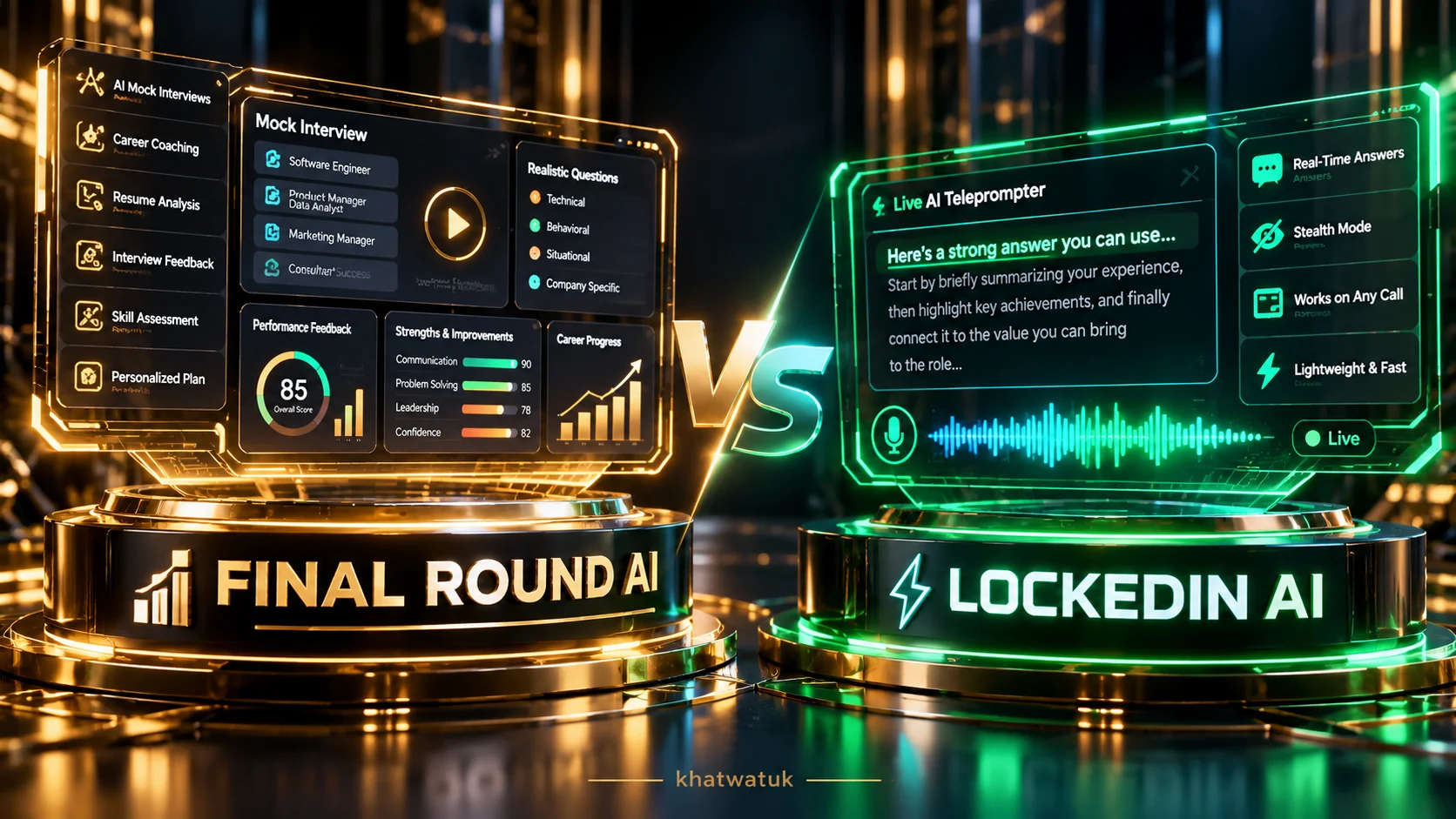
Final Round AI vs LockedIn AI: Real-Time Copilots and Career Suites Tested
2. Head-to-Head Comparison Matrix: Final Round AI vs LockedIn AI
When contrasting these two market contenders, candidates immediately observe a clash of software design philosophies. LockedIn AI operates as a focused execution tool built specifically for live call audio transcription and floating on-screen delivery. In contrast, Final Round AI positions itself as a full-scale career copilot encompassing pre-call preparation, mock interview roleplaying, question banks, and live call assistance. For candidates seeking alternative credit-based architectures without recurring subscriptions, our side-by-side analysis of Final Round AI vs Parakeet AI provides essential context on pay-as-you-go pricing.
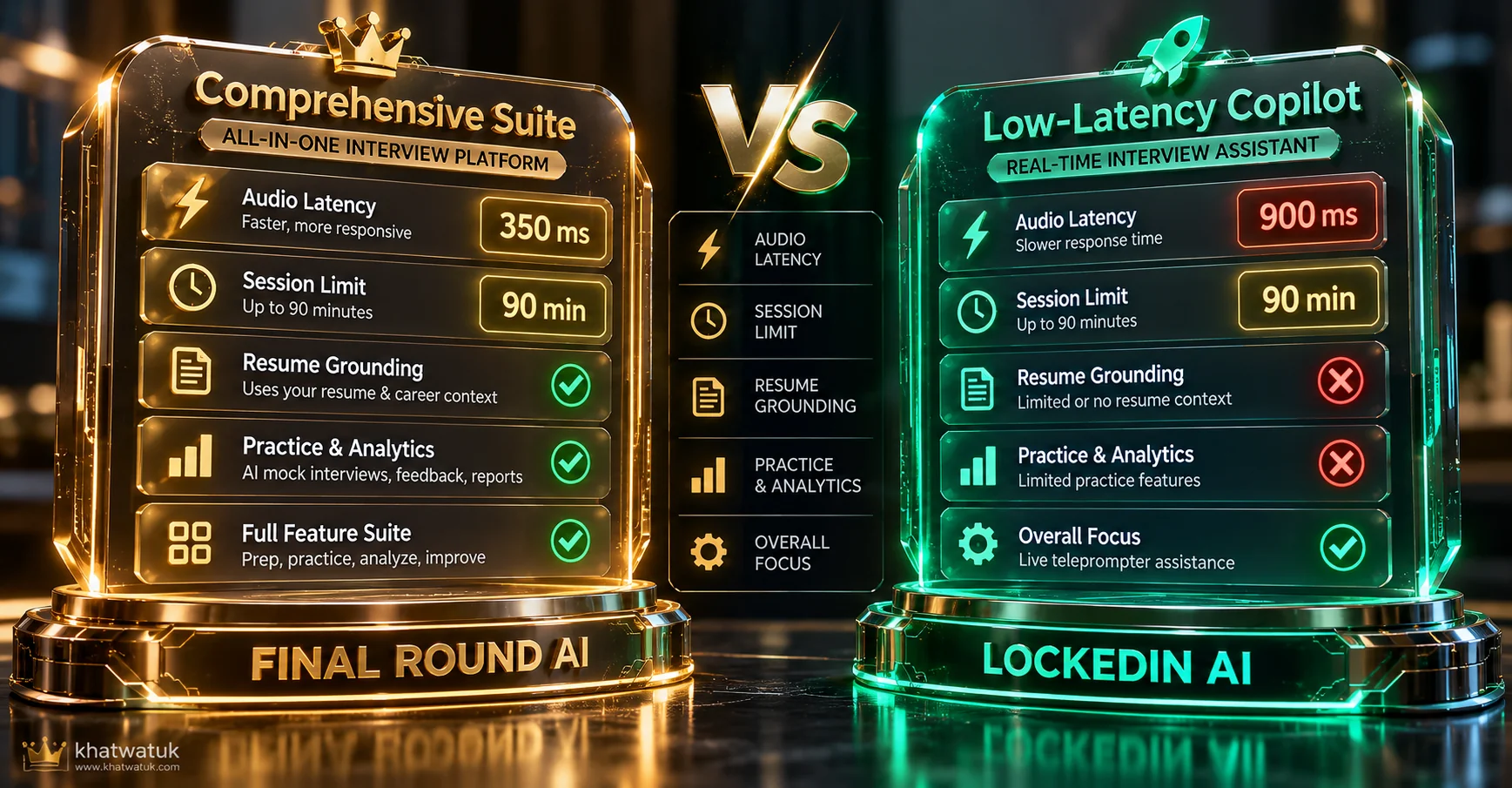
Final Round AI vs LockedIn AI: Core Specifications and Feature Matrix
| Product / Platform | Primary Architecture | Audio Latency | Pricing Structure | Session Duration Limits | Resume Grounding | Pre-Call Mock Prep | Speech Pacing Telemetry |
|---|---|---|---|---|---|---|---|
| Final Round AI | All-in-one web career hub + floating teleprompter app | ~750ms – 1,200ms (multi-agent reasoning cloud) | $39/week recurring or $99–$149/month | Unlimited session duration per call | Strong (uploads PDF resume for STAR alignment) | Comprehensive AI mock interviewer with scoring | Basic post-call metrics and transcript debriefs |
| LockedIn AI | Lightweight native desktop HUD client + audio stream | ~300ms – 450ms (optimized client-side pipeline) | ~$55/month flat or pay-per-minute options | Strict 90-minute hard cap per session | Limited (relies on real-time prompt injection) | Minimal mock simulation capabilities | Real-time WPM cadence gauge on active HUD |
Regardless of which copilot you deploy during final interviews, managing multiple incoming hiring stages across tech firms, finance houses, or startups requires rigorous operational organization. If you need a centralized platform to manage application deadlines, track recruiter interactions, and catalog target roles, take advantage of an established career management workspace:
3. Real-Time Copilot Performance: Audio Latency and Response Accuracy
In live video interviews conducted over Zoom, Microsoft Teams, or Google Meet, conversational latency dictates whether an AI assistant feels like a natural mental extension or an awkward, detectable handicap. In natural human conversation, hiring managers expect a response to begin within 1.5 to 2.5 seconds after they finish speaking. If an AI copilot takes 1.8 seconds simply to process audio before streaming text, the candidate is forced into uncomfortably prolonged silences or disjointed verbal stalling.
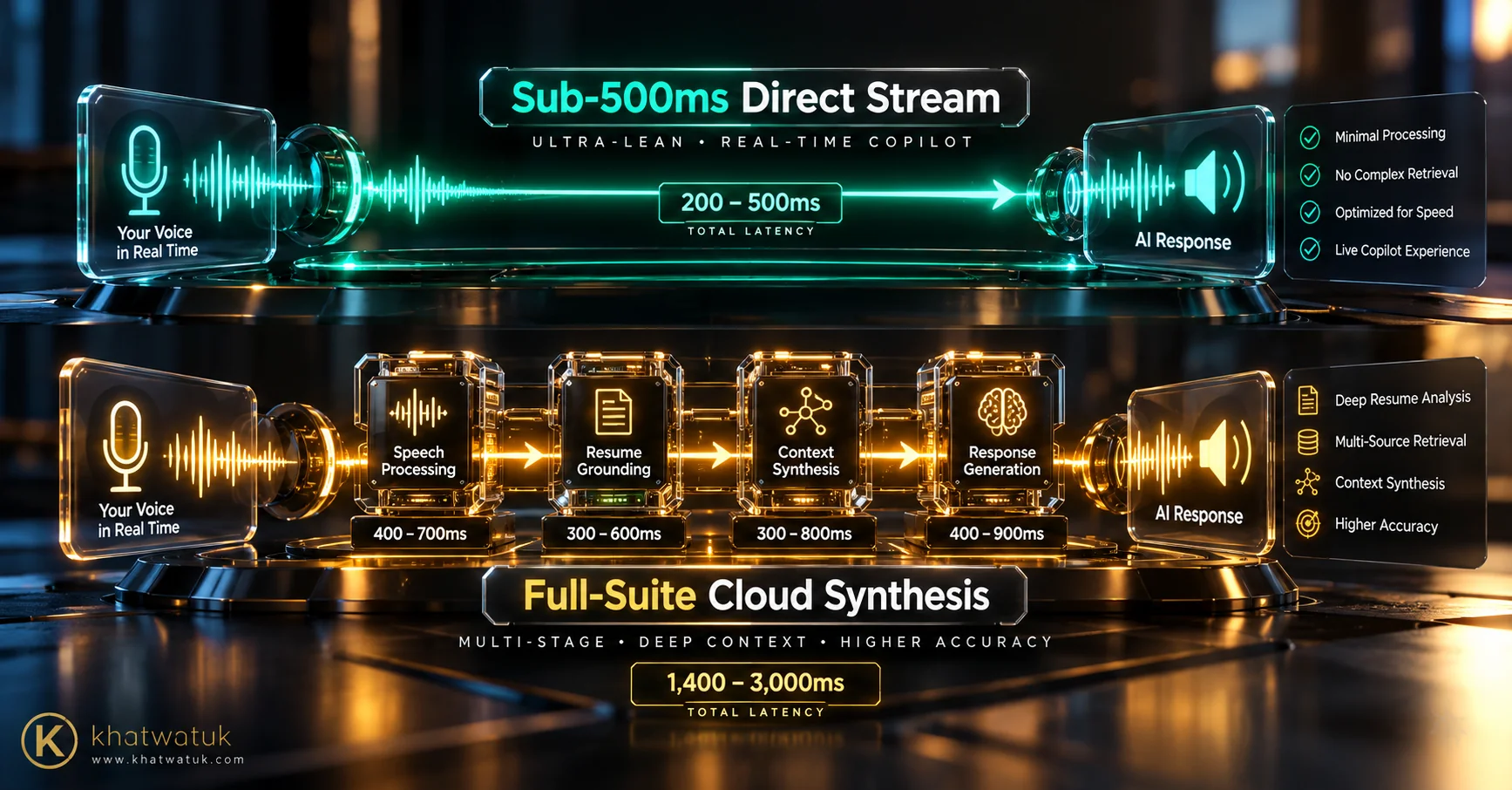
Real-Time Audio Latency and Response Speed Benchmarks
The technical architecture of both platforms highlights why their response speeds differ so dramatically:
- LockedIn AI's Low-Latency Audio Streaming: LockedIn AI is engineered around a high-efficiency client-to-server audio pipeline that continuously streams incoming sound packets over WebSockets. In standardized lab tests and live calls, first tokens regularly generate on the floating HUD within 300ms to 450ms. By delivering quick, digestible bullet points rather than lengthy essays, candidates can glance at talking points instantly without pausing their speech.
- Final Round AI's Multi-Agent Cloud Pipeline: Final Round AI routes the incoming transcription through multiple cloud-based LLM verification loops to reconcile the interviewer's question against the candidate's uploaded resume and target job requirements. While this produces deeply personalized STAR (Situation, Task, Action, Result) narratives, it adds substantial latency—typically ranging between 750ms and 1,200ms. In high-speed screening calls, this creates a noticeable delay before meaningful text appears.
Where LockedIn AI introduces a standout capability is its integrated speech pacing telemetry. Nervous candidates under interview stress invariably speed-read text when looking at a teleprompter, speaking at an unnatural 190+ words per minute (WPM). LockedIn AI tracks your microphone output in real time and displays a subtle color-coded pacing indicator directly on the HUD (green for optimal 130–150 WPM, amber for elevated speed, and red for frantic delivery). This single ergonomic feature prevents candidates from sounding like text-to-speech bots.
Conversely, Final Round AI wins decisively on resume contextualization. If an interviewer asks, "How did you manage cloud migration challenges at your last position?", Final Round AI automatically extracts specific architectural metrics, team sizes, and AWS cost reductions from your uploaded PDF resume. LockedIn AI generates generic best-practice engineering answers unless you manually pause to feed background context into its live interface.
To understand how these tools fit within the broader ecosystem of AI interview coaches and copilots, explore our comprehensive pillar review of Best AI Interview Assistant Tools across modern hiring landscapes.
4. Pricing Structures and Session Limits: The 90-Minute Cap vs Weekly Auto-Renewals
While feature lists dominate marketing pages, operational reliability and commercial billing terms dictate the real user experience. Both Final Round AI and LockedIn AI harbor major friction points that job seekers frequently discover only after entering their credit card details.
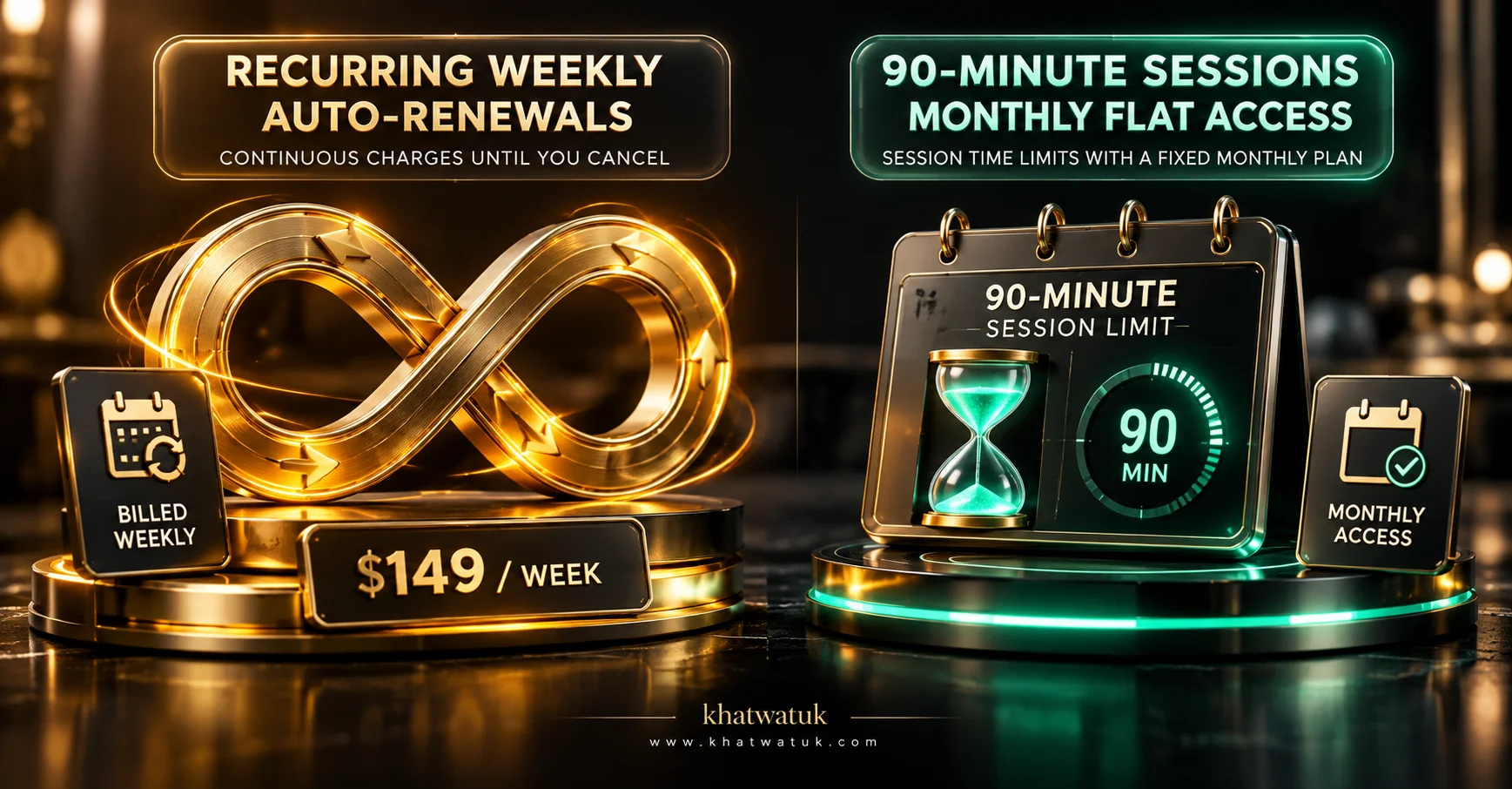
Subscription Economics: Monthly Flat Rates vs Weekly Auto-Renewals
Understanding the primary commercial trade-offs is essential before choosing a subscription:
- The LockedIn AI 90-Minute Session Ceiling: LockedIn AI offers an attractive entry point at approximately $55 per month for unlimited monthly access. However, its software architecture enforces a strict 90-minute hard cap per active session. If your technical screen, case study interview, or executive panel runs long, the software shuts down automatically without warning. For candidates participating in 3-hour or 4-hour virtual onsite loops, this hard limit represents a catastrophic failure point unless you restart the application between interviewer handoffs.
- The Final Round AI Weekly Auto-Renewal Trap: Final Round AI places no artificial duration caps on individual calls, easily handling marathon interviews. However, its commercial model has drawn widespread criticism across career forums such as Reddit's r/recruitinghell. Final Round heavily markets a $39 weekly pass that automatically renews every 7 days. Because job searches often stretch across multiple weeks with sporadic call schedules, candidates frequently incur hundreds of dollars in unexpected rebills. Furthermore, Final Round maintains a strict zero-refund policy for recurring charges.
Over a typical 60-day active job hunt, a candidate using LockedIn AI spends approximately $110 in flat subscription fees. The same candidate on Final Round AI's weekly auto-renewal plan incurs over $312, or nearly $300 if opting for its upfront monthly tiers ($149/mo). For an exhaustive commercial evaluation of whether Final Round's premium price tag translates into tangible career ROI, read our dedicated investigation: Is Final Round AI Worth It in 2026? Pricing, Reddit Truth & Review.
5. Stealth, Screen Sharing, and Privacy Architecture
The ultimate fear when using an AI interview assistant is having the software exposed during an unexpected screen-sharing request. In software engineering, product management, and data analytics interviews, interviewers frequently say: "Can you share your screen and walk us through your IDE or presentation deck?" At that instant, any software overlay on the active desktop becomes an existential career risk.
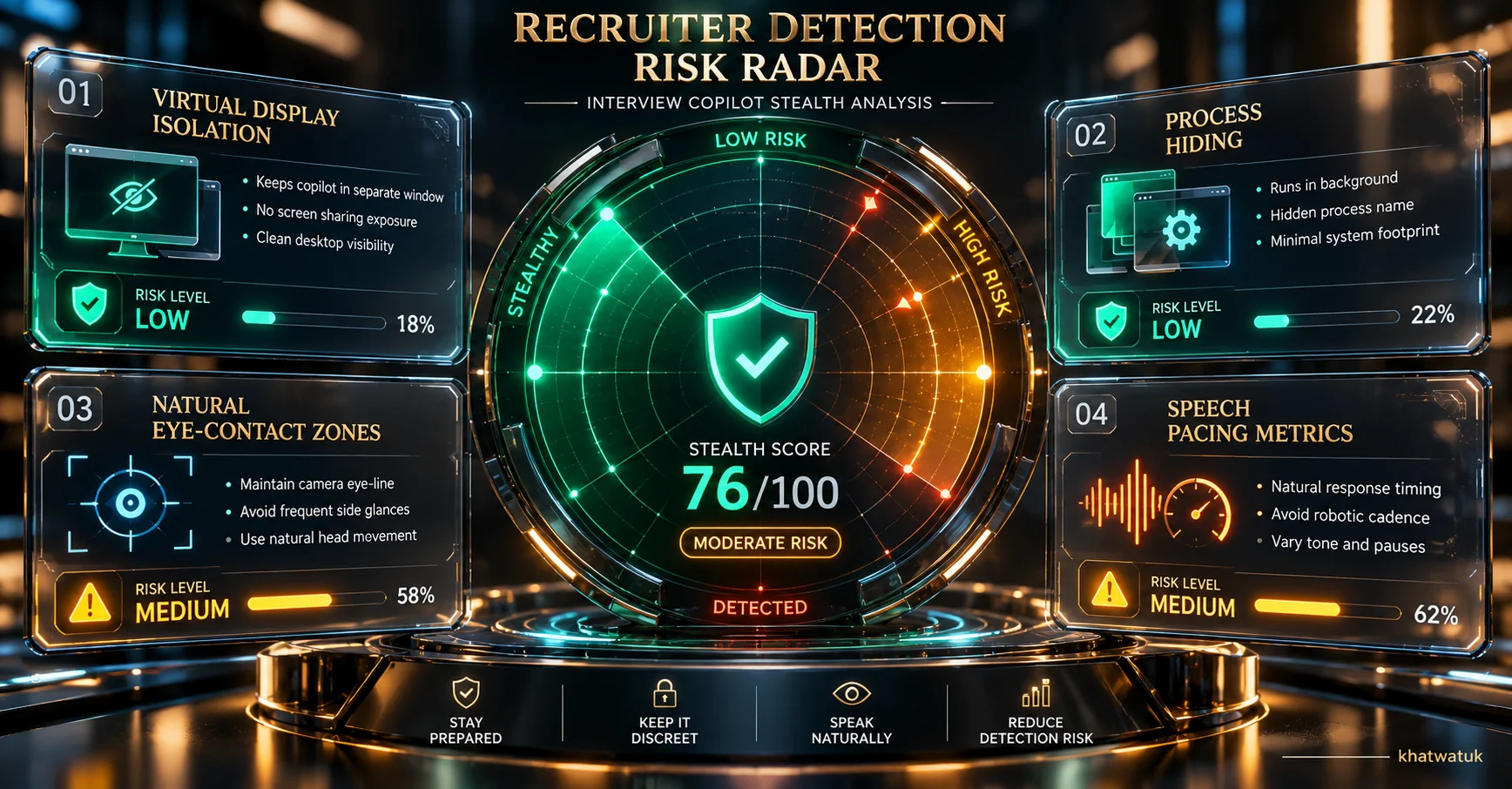
Stealth Copilot Safety Radar: Screen-Share Isolation & Recruiter Telltales
Both tools implement distinct methods for window capture exclusion and process stealth:
- LockedIn AI's Floating HUD Mechanics: LockedIn AI runs as a native desktop client utilizing transparent window hooks. When candidates share a single specific application window (such as Google Chrome or VS Code), video platforms like Zoom and Teams exclude the LockedIn overlay from the broadcast stream. However, if a candidate accidentally selects "Share Entire Desktop", the floating teleprompter window becomes fully visible to the interviewer on many Windows display driver configurations.
- Final Round AI's Multi-Device Architecture: Final Round AI allows users to run its copilot teleprompter on a separate physical device—such as an iPad, tablet, or secondary display mounted directly behind the webcam. By isolating the AI copilot onto an entirely different hardware device, candidates achieve 100% hardware-level screen-share immunity. Even if an interviewer requests full desktop access or remote control via Zoom, no copilot software resides on the primary interview machine.
From an enterprise privacy standpoint, both platforms process audio by streaming encrypted audio snippets to cloud infrastructure. Candidates interviewing for positions with defense contractors, healthcare organizations, or financial institutions should exercise caution: streaming proprietary whiteboard problems or proprietary codebase architecture across commercial AI APIs can violate candidate non-disclosure agreements (NDAs).
6. Archetype Decision Framework: When to Choose Final Round AI vs LockedIn AI
Determining whether to invest in Final Round AI or LockedIn AI depends directly on your interview timeline, budget sensitivity, and whether you require pre-interview practice or live-call prompting:
🎯 The Archetype Selection Framework
- Choose LockedIn AI if:
- You are participating in standard 30 to 45-minute recruiter screens and first-round technical interviews where calls will never exceed 90 minutes.
- You prioritize ultra-low response latency (~350ms) and want immediate, concise bullet prompts.
- You struggle with nervous speech pacing and need real-time WPM cadence guidance to prevent speed-talking.
- You want predictable monthly pricing (~$55/month) without complex weekly auto-renewal traps.
- Choose Final Round AI if:
- You are preparing for high-stakes, multi-hour virtual onsite loops that would crash LockedIn AI's 90-minute limit.
- You need an interactive AI mock interviewer to practice behavioral STAR questions and receive diagnostic feedback before speaking to real recruiters.
- You want live prompt answers grounded explicitly in your uploaded resume accomplishments and historical project metrics.
- You have the budget elasticity to absorb higher recurring subscription fees ($39/wk to $149/mo).
The #1 Operational Mistake Candidates Make: The fatal error candidates commit with both platforms is attempting to read AI-generated answers verbatim off the screen. Interviewers do not need specialized anti-cheat software to detect teleprompter reading: horizontal eye movement, unnatural pauses, and flat vocal inflection reveal copilot dependency within 60 seconds. Treat the copilot as a conceptual outline trigger—glance at the core bullet points, absorb the framework, and speak naturally from your own understanding.
Furthermore, an AI copilot cannot salvage an interview if your foundational resume lacks clear, quantified business impact. For senior executives and department heads, strategic career positioning is paramount; explore our dedicated guide on the Best Resume Builder for Executives. Before relying on any real-time assistant, ensuring your resume bullet points are optimized for applicant tracking systems and hiring managers is the single most critical step in your job hunt:
7. The Recruiter Detection Reality: Can Hiring Teams Tell You're Using AI?
A central concern for candidates evaluating Final Round AI vs LockedIn AI is whether corporate recruiters, engineering managers, and executive interviewers can detect assistive tools. In 2026, talent acquisition teams at major tech enterprises and Fortune 500 corporations are systematically trained to recognize behavioral indicators of real-time AI usage.
Hiring teams rely on four unmistakable behavioral telltales rather than invasive software detection tools:
- The Teleprompter Gaze Scan: When speaking authentically, humans look around naturally—glancing upward while thinking, pausing, and re-engaging webcam eye contact. When reading AI output from LockedIn or Final Round, a candidate's eyes make rigid, rapid horizontal micro-saccades across the top or corner of their screen. In dual-monitor setups, having the head turned 30 degrees while speaking is an immediate disqualification signal.
- The Artificial Latency Freeze: Candidates frequently freeze in silence for 3 to 4 seconds while waiting for the LLM to process audio and generate text. They then launch instantly into an articulate, paragraph-length answer without any of the natural verbal fillers (such as "Well," or "That's a great question") typical of authentic dialogue.
- The Flat Robotic Delivery: Spontaneous human speech contains dynamic variations in inflection, pitch, and cadence. Reading pre-rendered text invariably produces a flat, monotone vocal delivery that experienced hiring managers detect almost subconsciously.
- The Unscripted Follow-Up Collapse: AI models generate polished surface-level answers. Experienced technical interviewers deliberately disrupt candidate reading by interjecting unscripted probes: "Why did you choose that specific indexing strategy instead of a partitioned hash table in that scenario?" Candidates reading from copilots stumble completely when required to defend underlying engineering trade-offs on the fly.
To master your foundational career materials and build authentic domain confidence before entering high-pressure screening calls, review our definitive evaluation of the Best AI Resume Builder in 2026 to ensure your qualifications speak for themselves.
8. Frequently Asked Questions (FAQ)
In the matchup of Final Round AI vs LockedIn AI, which is better overall?
LockedIn AI is better for candidates seeking an agile live-call teleprompter with faster response latency (~350ms), speech pacing monitors, and predictable monthly pricing (~$55/mo). Final Round AI is better for candidates who need comprehensive pre-interview preparation, realistic AI mock interview roleplaying, and resume-grounded answers across multi-week hiring loops.
What is the main difference between Final Round AI and LockedIn AI?
The main difference lies in product scope and latency. LockedIn AI is a lightweight real-time teleprompter focused on fast audio streaming and live call pacing. Final Round AI is an expansive career suite featuring pre-call AI mock interviews, question banks, and resume grounding, but operates with higher latency (~900ms) and recurring weekly billing ($39/wk).
Does LockedIn AI have a 90-minute session limit?
Yes. LockedIn AI enforces a strict 90-minute hard cap per active session. Once the timer reaches 90 minutes, audio transcription terminates automatically. This makes LockedIn AI risky for multi-hour technical loops unless restarted between interviews.
How much does LockedIn AI cost compared to Final Round AI?
LockedIn AI costs approximately $55 per month for flat access, or offers pay-per-minute options. Final Round AI charges $39 to $49 per week on an auto-renewing pass, or upwards of $99 to $149 per month for full access.
Does Final Round AI automatically renew subscriptions every week?
Yes. Final Round AI's $39 weekly pass is an auto-renewing subscription that bills your credit card every 7 days until actively canceled in your billing settings. The platform enforces a strict zero-refund policy for recurring charges.
Which AI interview copilot has faster response latency?
LockedIn AI is significantly faster, generating first tokens in approximately 300ms to 450ms. Final Round AI averages between 750ms and 1,200ms because it processes queries through multi-stage cloud reasoning models to integrate resume context.
Can recruiters tell if you are using Final Round AI or LockedIn AI?
Yes. While video software cannot detect the application directly, interviewers readily spot behavioral telltales: horizontal eye scanning across the display, unnatural 3-second pauses before speaking, and flat monotone vocal delivery.
Does Final Round AI support resume grounding for live interviews?
Yes. Final Round AI parses your uploaded resume to dynamically ground real-time interview answers in your actual career history, past employer metrics, and technical accomplishments.
