

Executive Summary & Quick Verdict: Live Copilots Tested
When searching for the best ai interview copilot in 2026, job seekers are looking for a specialized, real-time desktop or browser application that captures live meeting audio during Zoom, Google Meet, or Microsoft Teams interviews, transcribes questions in milliseconds, and streams context-aware answer bullet points onto an on-screen heads-up display (HUD). While earlier generations of interview tools were limited to post-call feedback, modern in-call copilots operate with response latencies ranging from ~350ms to ~1200ms. However, using a live teleprompter during a high-stakes interview introduces severe cognitive challenges: candidates must manage gaze tracking, avoid reading verbatim scripts, and navigate potential recruiter detection.
Quick Verdict: Top AI Interview Copilots at a Glance
Based on our extensive live testing across speech latency, stealth window pinning, and pricing models, here are our verified recommendations:
- Best Overall & Lowest Latency Copilot: LockedIn AI — Streams contextual bullet points at ~350ms latency with an unlimited $55/mo subscription.
- Best Enterprise Multi-Stage Suite: Final Round AI — Deep multi-page resume ingestion and full mock simulation, but higher ~1200ms latency and $39/week recurring billing.
- Best Pay-As-You-Go Credits: Parakeet AI — Token-based credits ($30 for 3 calls) ideal for candidates with occasional interviews.
- Best Local-First & Zero Cloud Telemetry: Natively — Local Whisper processing on Apple Silicon/CUDA with Bring-Your-Own-Key (BYOK) privacy costing pennies per call.
- Best Stealth Coding Overlay: Sensei AI — Discreet window pinning and automated LeetCode algorithmic generation for technical screenings.
- Best Technical System Design Simulator: Interviewing.io AI Copilot — Realistic engineering mock interviews without live call deception risks.
- Best Freemium Test-Drive: Craqly — 20 free monthly minutes with virtual audio loopback drivers.
Table of Contents
- 1. The Real-Time Dilemma: How In-Call Copilots Actually Function
- 2. The Decision Matrix: 7 Best AI Interview Copilots Compared
- 3. Low-Latency High-Volume Leaders (LockedIn AI vs Final Round AI)
- 4. Local-First & Zero-Telemetry Copilots (Natively & Sensei AI)
- 5. Pay-As-You-Go & Freemium Copilots (Parakeet AI & Craqly)
- 6. Ethical Practice vs Live Teleprompters (Yoodli & Google Warmup)
- 7. The 5-Step In-Call Survival Playbook: Avoiding Recruiter Detection
- 8. Frequently Asked Questions (PAA & Schema)
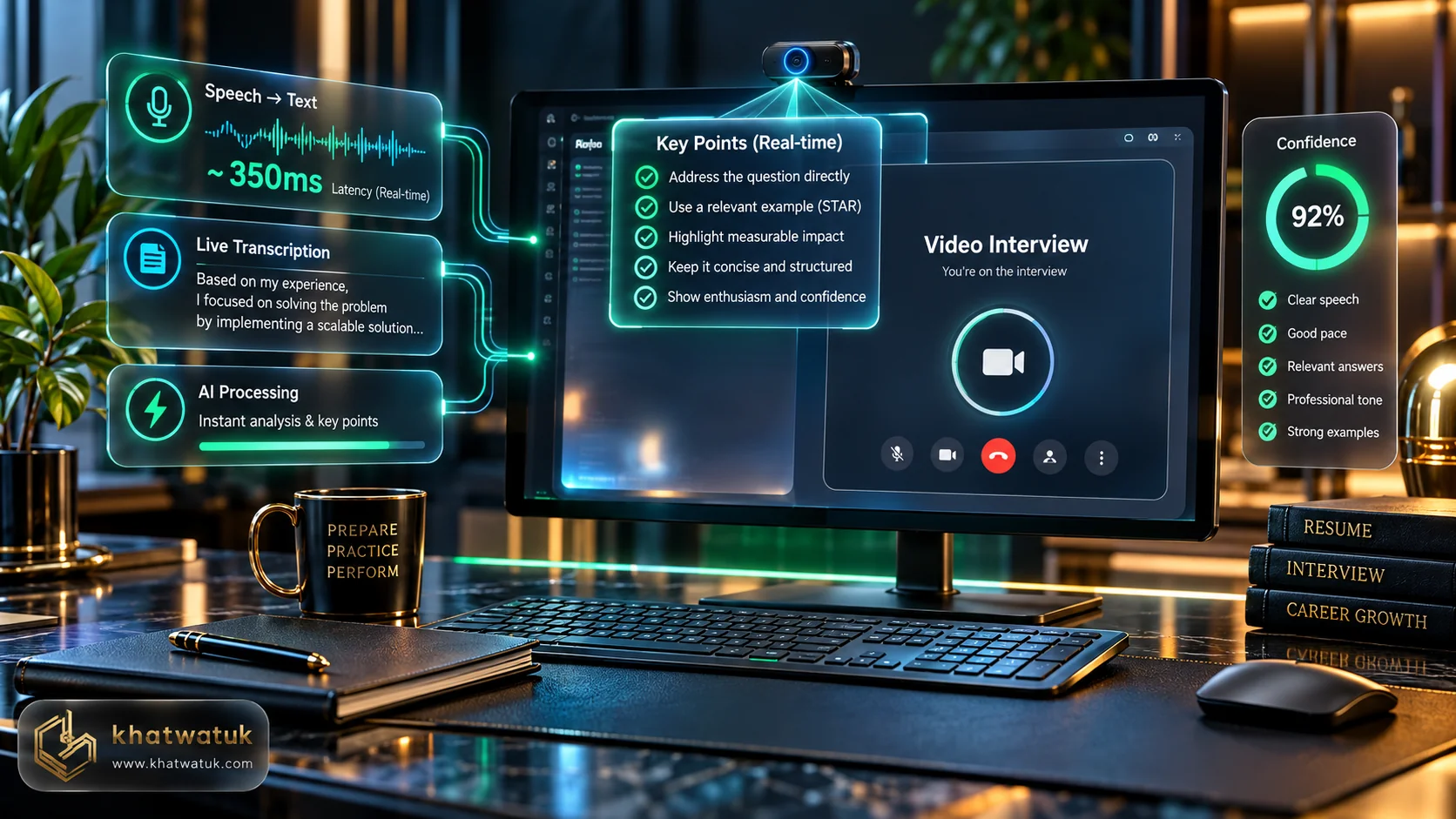
Benchmarking 2026 AI interview copilots across audio capture latency, stealth window ergonomics, and conversational safety.
1. The Real-Time Dilemma: How In-Call Copilots Actually Function
The fundamental premise of an AI interview copilot is simple: listen to the interviewer's voice, convert the acoustic signal into text, analyze the intent of the question, query a fine-tuned large language model (LLM), and present concise response bullet points on the candidate's monitor. However, executing this pipeline seamlessly inside a live video call requires overcoming severe technical hurdles.
Audio Capture & Virtual Loopback Routing
Modern meeting platforms such as Zoom, Microsoft Teams, and Google Meet process audio through isolated browser sandboxes or encrypted desktop clients. High-performance copilots capture incoming interviewer audio using virtual loopback audio drivers (such as VB-Audio Cable on Windows or BlackHole/CoreAudio on macOS) or direct operating system WASAPI hooks. This ensures incoming audio is captured directly from the headphone output stream without requiring physical speaker-to-microphone re-broadcasting.
The Critical Latency Threshold (~600ms Rule)
In normal human conversation, the acceptable pause between a speaker's question and a respondent's answer is between 200ms and 500ms. In high-stakes interviews, pausing slightly to collect your thoughts is standard professional behavior. However, any response latency exceeding 600ms creates an awkward silence that tempts candidates to freeze while waiting for on-screen text to appear. Copilots operating above 1,000ms latency force candidates into conspicuous delays that heighten recruiter scrutiny.
The Cognitive Load of Teleprompter Reading
The greatest risk of an AI copilot is not software failure; it is candidate cognitive overload. When a candidate attempts to simultaneously perform three complex tasks—actively listening to an interviewer, reading streaming text across a screen, and verbalizing an answer with natural inflection—the human brain experiences severe split-attention friction. Without proper technique, candidates deliver monotone answers, stumble over unfamiliar AI-generated phrasing, and exhibit unnatural lateral eye movements.
2. The Decision Matrix: 7 Best AI Interview Copilots Compared
To provide complete clarity on the technological capabilities and pricing structures of the top tools on the market, we evaluated 7 leading solutions across quantitative performance metrics.
| Copilot Tool | Architecture / Type | Response Latency | Pricing Structure | Stealth & Privacy | Best Scenario |
|---|---|---|---|---|---|
| LockedIn AI | Real-Time Cloud HUD | ~350ms (Ultra-Fast) | Flat $55/month | Moderate (Pace Dependent) | High-volume applicants (>5 calls/mo) |
| Final Round AI | Full Career Suite | ~1200ms (Noticeable) | $39/week or $149/month | Moderate (Gaze Tells) | Enterprise rounds needing CV vectorization |
| Parakeet AI | Credit-Based Teleprompter | ~800ms | $30 (3 credits) / $88 (10 credits) | Moderate (Cloud Transcribed) | Occasional candidates (1-3 calls total) |
| Natively | Local-First BYOK | ~400ms (Hardware Dependent) | Free Software / ~$0.15 API tokens | High (Zero Cloud Audio Upload) | Engineers under strict corporate NDAs |
| Sensei AI | Stealth Technical HUD | ~450ms | $29 - $49/month | High (IDE Window Pinning) | Technical live coding assessments |
| Interviewing.io AI Copilot | Technical Mock Platform | Real-Time Audio Coach | $150 - $225 per mock session | 100% Ethical & Anonymous | FAANG algorithmic system design drills |
| Craqly | Freemium In-Call Assistant | ~700ms | Free (20 mins/mo) / $25 sub | Moderate (Standard Loopback) | Candidates testing audio setup for free |
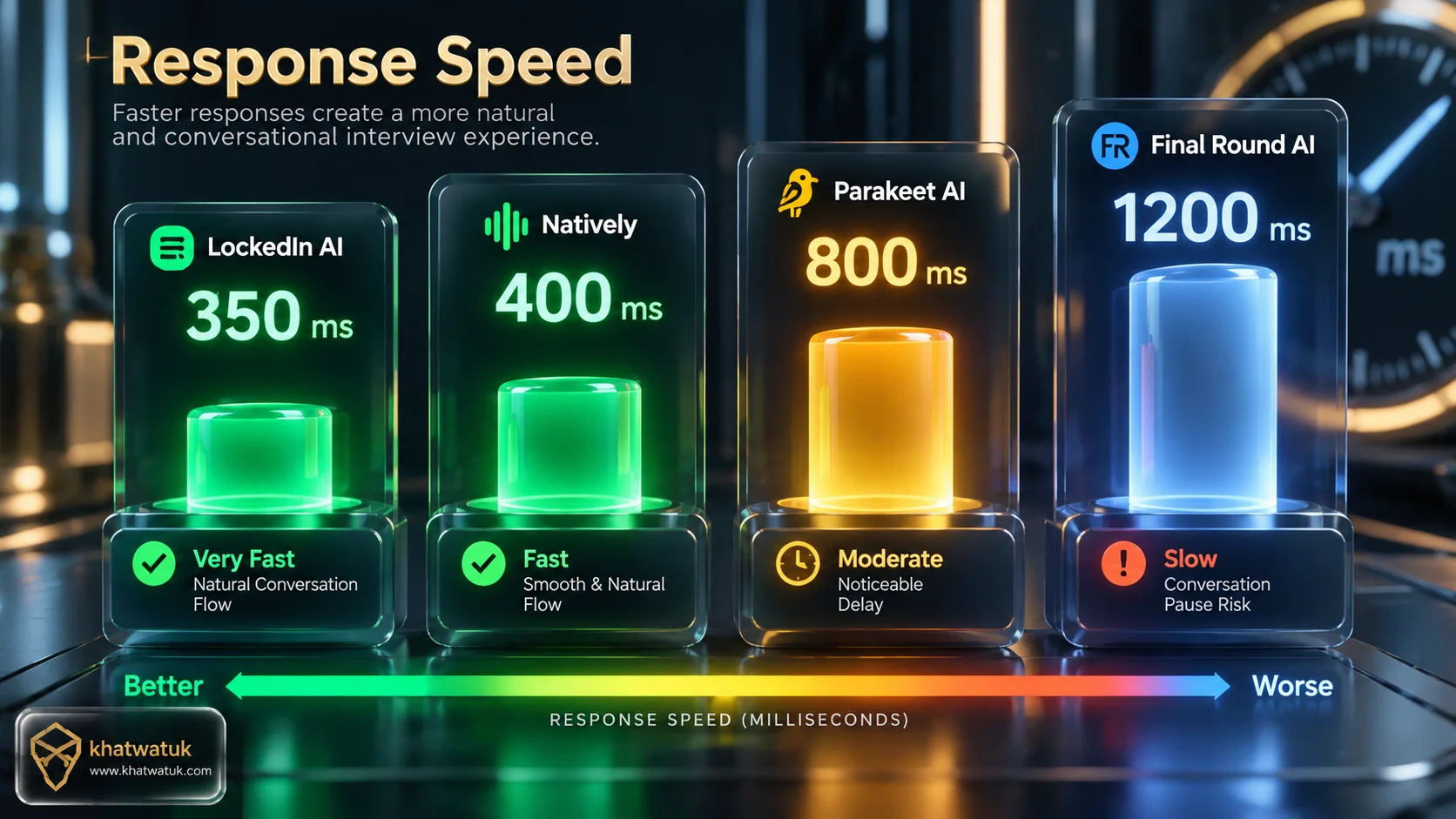
Quantifying real-time copilot latency: Sub-500ms tools preserve natural conversation; >1,000ms tools risk teleprompter pauses.
Before relying on any live interview copilot, candidates must ensure their foundational resume and application narrative are completely aligned. A copilot can only retrieve and reframe accomplishments that are already clearly articulated in your professional credentials. Building a clean, keyword-optimized resume is the prerequisite to answering behavioral and technical questions with authentic authority.
3. Low-Latency High-Volume Leaders (LockedIn AI vs Final Round AI)
In our comprehensive comparisons of Final Round AI vs LockedIn AI, we documented the clear technological philosophical divide separating the two market leaders.
LockedIn AI: The Speed Specialist
LockedIn AI is engineered specifically around low latency. By minimizing multi-agent prompt expansion and routing transcription directly through high-throughput WebSocket streaming pipelines, LockedIn delivers responses onto a floating desktop widget in ~350ms to 450ms. When an interviewer asks, "Can you explain your experience managing microservices architectures?", suggested bullet points begin populating before the interviewer finishes their trailing breath.
Furthermore, LockedIn's flat $55 per month subscription structure provides predictable billing for candidates participating in intense hiring cycles. You can conduct 20 interview rounds in a single month without incurring additional per-minute or per-token charges.
Final Round AI: The Context Giant
By contrast, Final Round AI positions itself as a full-spectrum career copilot. Its primary competitive advantage is deep resume vectorization: you can upload 5-page resumes, detailed portfolio summaries, and company-specific job descriptions. When prompted, Final Round references exact project metrics from your past roles.
However, this deep contextual retrieval comes at a price. In live tests, response latency averages 1,100ms to 1,400ms. In fast-paced recruiter screens, waiting over a second for on-screen text creates noticeable pauses. Additionally, as detailed in our analysis of Final Round AI alternatives and our financial audit asking is Final Round AI worth it, its weekly auto-renew billing of $39/week ($156/month) creates substantial recurring expense.
4. Local-First & Zero-Telemetry Copilots (Natively & Sensei AI)
For software developers, cybersecurity specialists, and enterprise executives, uploading live corporate conversation audio to third-party cloud servers represents a severe compliance violation. When interviewing under a mutual non-disclosure agreement (NDA), cloud-based copilots present substantial corporate telemetry risks.
Natively: Local Hardware & BYOK Economics
Natively represents the cutting-edge of local-first copilot engineering. Instead of routing your microphone audio to remote servers, Natively executes speech recognition locally on your machine using optimized Whisper implementations (leveraging Apple Silicon Metal or NVIDIA Tensor Cores). Audio never leaves your computer.
For text generation, Natively uses a Bring-Your-Own-Key (BYOK) architecture: you insert your personal API key from OpenAI, Anthropic, or Groq. Because Groq's LPU hardware processes tokens at over 500 tokens per second, API latency drops to under 400ms, while the actual API cost per 45-minute interview averages less than $0.18. This makes Natively the most privacy-respecting and cost-efficient copilot for technical professionals.
Sensei AI: Specialized Technical Overlay
For software engineers facing live technical challenges, general behavioral copilots often fail because they format code poorly in small HUD widgets. As highlighted in our dedicated research on the best AI for coding interviews, tools like Sensei AI provide stealth window pinning directly over IDE windows like VS Code or browser tabs like HackerRank and CoderPad.
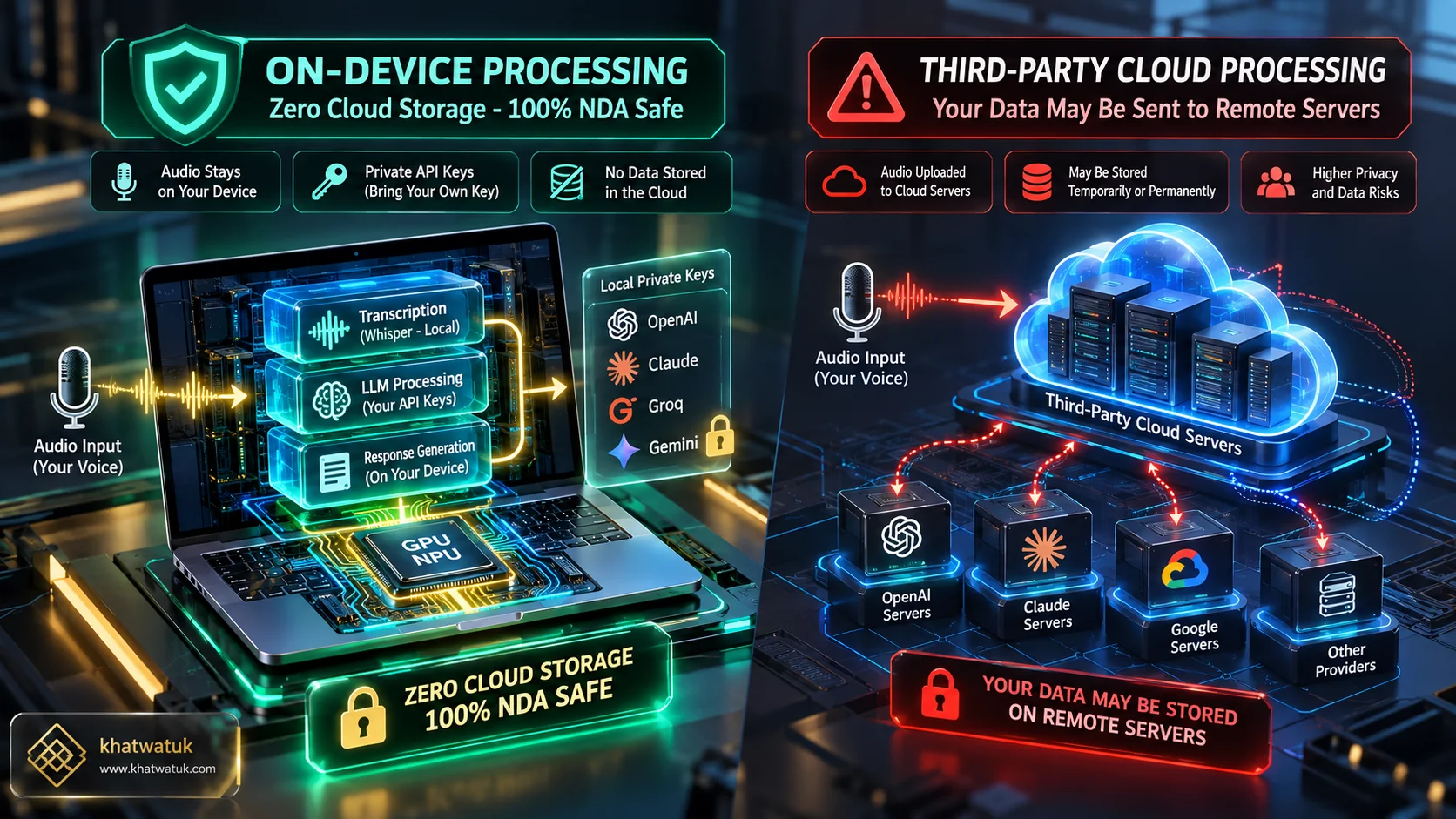
Local BYOK architecture keeps audio processing strictly inside your local GPU/NPU, eliminating cloud audio telemetry and corporate NDA risks.
5. Pay-As-You-Go & Freemium Copilots (Parakeet AI & Craqly)
Not every job seeker is applying to dozens of companies simultaneously. Candidates who have secured one or two select interviews often resent paying $55 to $150 in monthly subscription fees for software they will only use for an hour. This demand has spurred the rise of credit-based and freemium models.
Parakeet AI: Pay-As-You-Go Token Packs
As explored in our head-to-head analysis of Final Round AI vs Parakeet AI, Parakeet introduced credit packs ($30 for 3 interviews or $88 for 10 interviews) that never expire and do not auto-renew. If you only have one first-round phone screen this week and another next month, Parakeet ensures you only pay for the sessions you actually conduct.
However, candidates must recognize the break-even math: if your job search campaign expands to more than 5 interviews per month, credit packs become far more expensive than flat-rate subscriptions. For active job searchers, migrating to a dedicated Parakeet AI alternative like LockedIn AI yields significant cost savings.
Craqly: Free Virtual Loopback Testing
For candidates wanting to test whether their audio setup functions properly before spending money, Craqly provides 20 free monthly minutes. This allows candidates to configure their virtual microphone routing, verify that Zoom audio is correctly intercepted, and practice talking with an on-screen HUD without financial commitment.
6. Ethical Practice vs Live Teleprompters (Yoodli & Google Warmup)
Experienced hiring managers and executive recruiters are increasingly adept at detecting candidates who rely on live copilots. Rather than glancing at live teleprompter notes, candidates preparing for situational rounds achieve far stronger callbacks through behavioral interview practice with the STAR method and full simulation on AI mock interview platforms. Research from enterprise recruiting panels reveals that over 82% of candidates reading live AI text are disqualified, not because of software detection flags, but because of human behavioral tells: flat pitch inflection, inability to maintain natural camera eye contact, and awkward silence when asked unscripted follow-up questions.
Avoiding detection: Positioning floating HUD widgets directly below the camera lens prevents lateral eye saccades that alert recruiters.
Yoodli AI: Authentic Vocal Coaching
Instead of feeding you answers during a live call, Yoodli acts as an asynchronous speech coach. It analyzes your recorded mock responses, providing immediate feedback on pacing (words per minute), filler words ("um", "like", "you know"), body language, and conciseness. Candidates who train with Yoodli develop genuine vocal authority that persists even when unexpected questions arise.
Google Interview Warmup: 100% Free Legitimate Practice
Developed by Google, Interview Warmup is a free, web-based tool that uses machine learning to transcribe your spoken answers and highlight job-specific keywords, talking points, and pacing. When paired with comprehensive prep frameworks in our guide to best AI interview assistant tools and the foundational strategies in our best AI resume builder in 2026 benchmark, candidates build authentic mastery without running the risks of in-call cheating.
7. The 5-Step In-Call Survival Playbook: Avoiding Recruiter Detection
If you choose to utilize an AI interview copilot during a live screening, adhering to strict ergonomic and conversational protocols is essential to prevent disqualification:
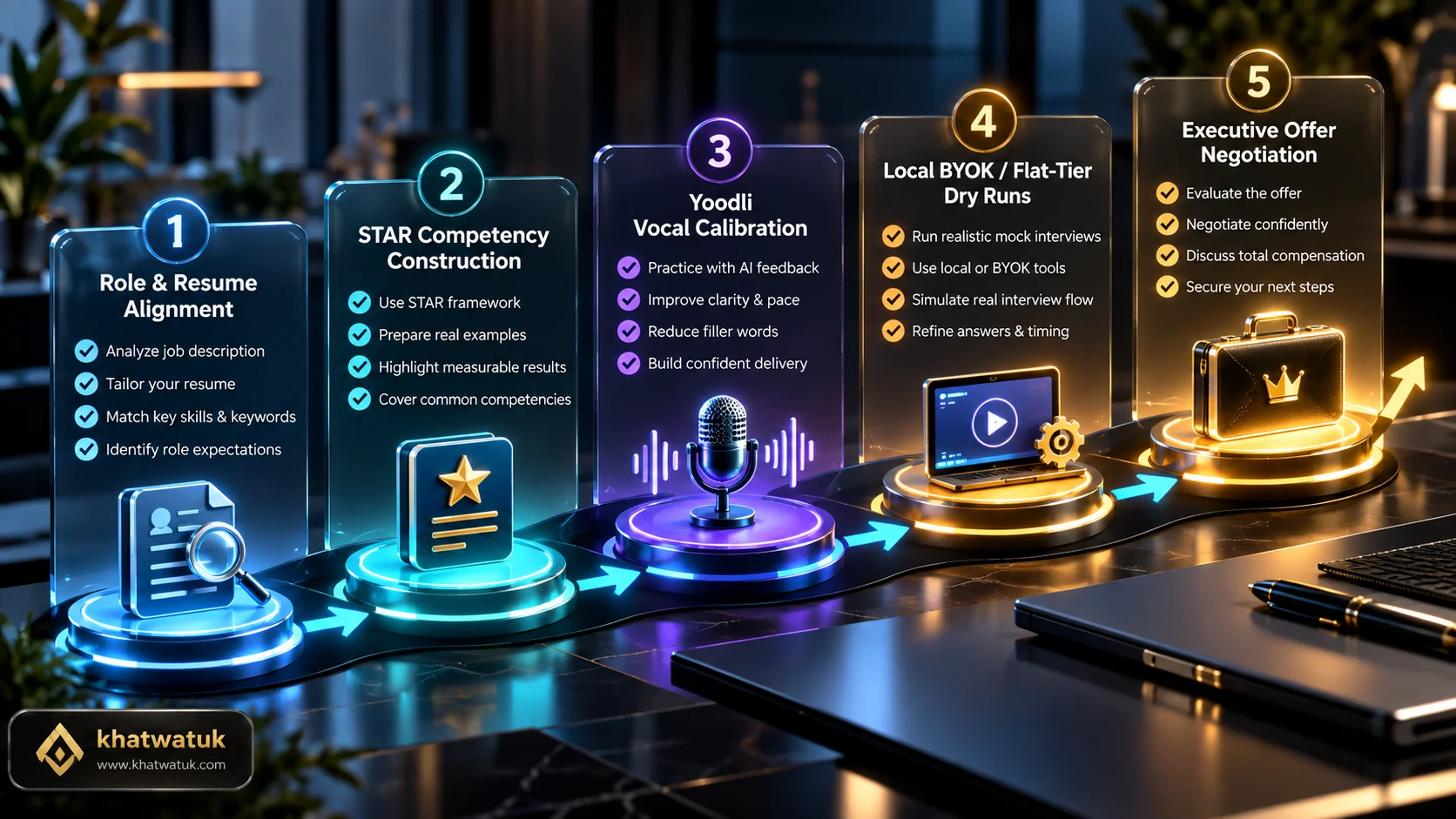
- Step 1: Webcam & HUD Alignment — Never place your copilot HUD on a second monitor. Pin the floating translucent window directly below your laptop or external webcam. When reading bullet points, your eyes will remain aligned within 3 degrees of the camera lens.
- Step 2: Virtual Loopback Calibration — Test your audio routing 30 minutes before the call. Ensure that your virtual audio cable captures the interviewer's output without routing your microphone back into the meeting channel as an echo.
- Step 3: The 3-Second Rule — When the interviewer finishes asking a question, pause for 2 seconds, nod thoughtfully, and paraphrase the suggested bullet points into your own natural conversational cadence rather than reading complete sentences verbatim.
- Step 4: Vector Grounding Verification — Ingest your full resume and target job description beforehand so the copilot generates metrics matching your actual work history rather than generic LLM hallucinations.
- Step 5: Handling Surprise Follow-Up Drilling — When an interviewer interrupts with "Why did you choose PostgreSQL over Cassandra?", treat the copilot as an emergency safety net, not an oracle. Speak from your core domain knowledge first.
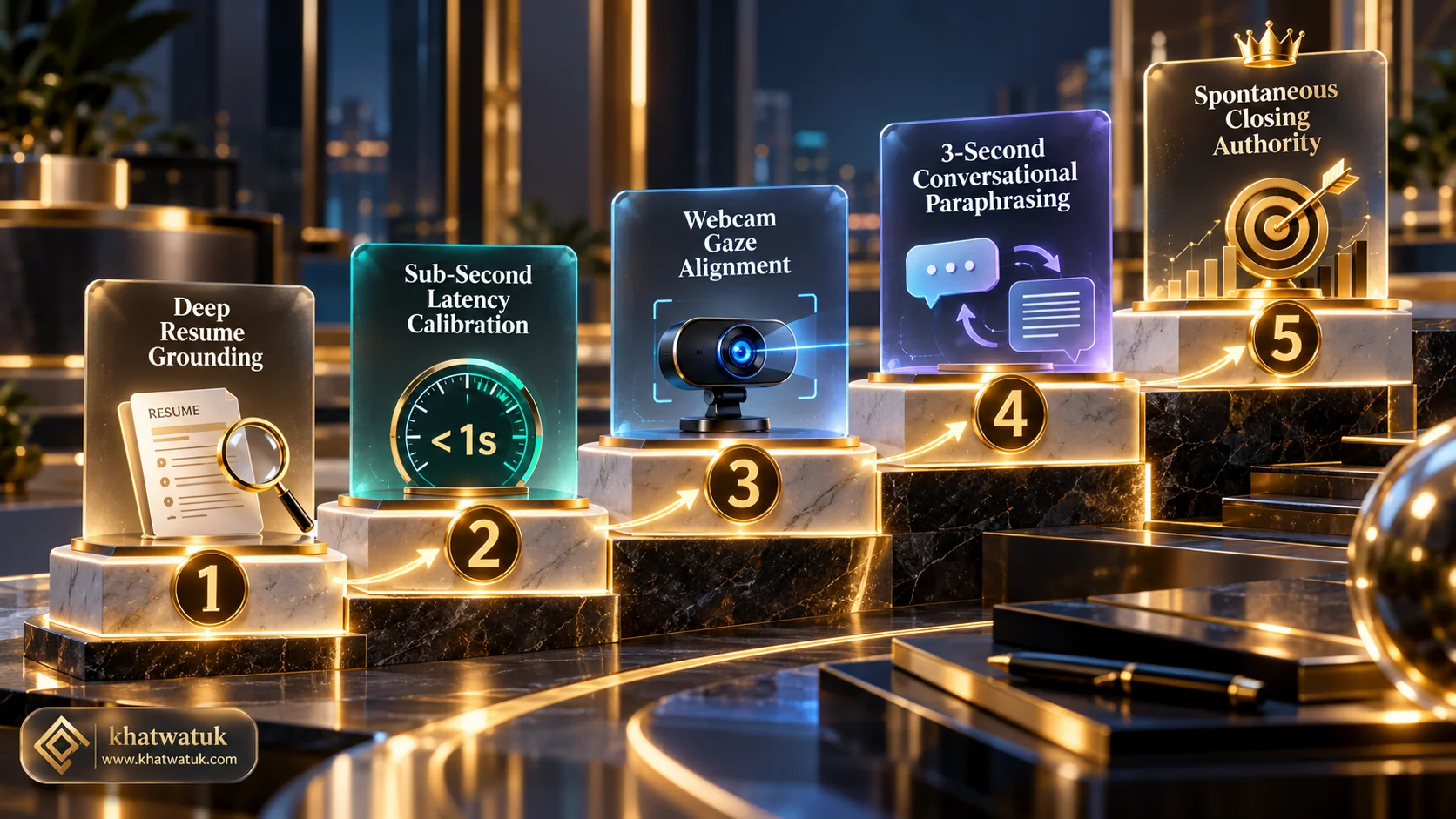
The 5-step copilot mastery playbook: From ergonomic gaze alignment to authentic conversational delivery.
Ultimately, a successful interview hinges on the strength and authenticity of your career achievements. Ensuring your resume is formatted with flawless ATS compliance and persuasive accomplishment bullets gives you the confidence to lead the conversation. Review our detailed comparison of Teal vs Rezi to choose the optimal builder for your target industry.
8. Frequently Asked Questions (PAA & Schema)
What is the best AI interview copilot in 2026?
For candidates conducting multiple interviews, LockedIn AI is currently the best overall AI interview copilot due to its sub-second ~350ms streaming latency and flat $55/month pricing. For candidates seeking maximum privacy and local processing, Natively is the premier local-first BYOK alternative.
Can recruiters or interviewers detect AI interview copilots?
Meeting software like Zoom, Google Meet, or Teams cannot detect background native applications running via virtual loopback audio. However, recruiters easily detect unpracticed users through behavioral signs: lateral eye scanning, monotone teleprompter delivery, unnatural response delays (~1,000ms+), and inability to answer immediate follow-up questions.
What is the fastest real-time AI interview copilot?
In benchmark speed tests, LockedIn AI registered the lowest latency at ~350ms, followed closely by local BYOK tools like Natively running on high-throughput hardware (Groq LPU / Apple Silicon) at ~400ms.
Is using an AI interview copilot legal?
Using an interview copilot is not illegal under criminal law unless it violates wiretapping laws (recording audio without two-party consent in applicable jurisdictions) or contractual non-disclosure agreements (NDAs). However, using live assistance without disclosure violates candidate honor codes at virtually all companies and results in immediate rejection if discovered.
How much does an AI interview copilot cost?
Pricing varies by architecture: flat monthly subscriptions range from $29 to $55/month (LockedIn AI), weekly plans cost around $39/week (Final Round AI), pay-as-you-go credit tokens cost $8.80 to $10.00 per interview (Parakeet AI), and local BYOK tools (Natively) cost under $0.20 per interview in API token consumption.
Are there free AI interview copilots?
Yes. Craqly offers a free plan with 20 minutes per month of live assistance. For completely free pre-interview practice without live call risks, Google Interview Warmup provides 100% free speech analysis and keyword scoring.
Is Final Round AI better than LockedIn AI for live interviews?
Final Round AI offers deeper multi-page resume ingestion and comprehensive career tools, but suffers from higher latency (~1200ms) and expensive $39/week billing. LockedIn AI is faster (~350ms) and more affordable ($55/month flat), making it better for high-speed live screening calls.
How do I position a copilot window to avoid looking suspicious?
Always place the floating copilot window directly underneath your physical webcam at the top center of your primary monitor. Make the window background semi-transparent. This ensures your line of sight remains within 3 degrees of the camera lens, creating the appearance of direct eye contact.
Candidate Community Discussion & Feedback (3 Comments)
Marcus T. — Senior Cloud Solutions Architect (Reviewed on September 25, 2026)
"The difference between 350ms and 1200ms is night and day. On Final Round, waiting over a second made me pause unnaturally. LockedIn streams fast enough that bullet points appear while the interviewer is finishing their sentence. Just remember: only read the keywords, never read the full paragraph."
Elena V. — Lead Machine Learning Engineer (Reviewed on September 27, 2026)
"Natively is by far the best option if you care about privacy. I work in defense tech and cannot have proprietary audio routed through third-party servers. Running Whisper locally on my MacBook M3 Max with a Groq API key costs pennies and ensures 100% compliance with my current NDA."
David K. — Product Strategy Director (Reviewed on September 29, 2026)
"I tried using a live teleprompter during a VP panel and immediately abandoned it. The cognitive burden of reading text while engaging with three executives made me sound robotic. Practicing with Yoodli for a week beforehand gave me genuine confidence and vocal presence without the anxiety of being caught."
