

In the head-to-head battle of heygen vs synthesia, the definitive winner depends on your core business objective. HeyGen is the superior platform for marketing teams, social content creators, and multilingual dubbing due to its hyper-realistic avatar micro-expressions and dynamic webcam cloning.
Meanwhile, Synthesia remains the undisputed market leader for enterprise compliance, corporate onboarding slide decks, and strict SOC-2 Type II data governance.
⚡ Quick Verdict: HeyGen vs Synthesia at a Glance
- Overall Winner for Avatar Realism & Lip-Sync: HeyGen (Score: 9.6/10) - Unmatched facial micro-expressions, fluid eye saccades, and natural conversational gestures that conquer the uncanny valley.
- Overall Winner for Corporate L&D & LMS Training: Synthesia (Score: 9.5/10) - Enterprise gold standard with native SCORM courseware export, PowerPoint slide import, and multi-slide training templates.
- Winner for Multilingual Video Translation: HeyGen - Industry-leading Video Translate tool supporting 175+ languages with automated facial lip-sync re-meshing.
- Winner for Slide Decks & Screen Recording: Synthesia - Built-in multi-scene canvas, screen recorder, and media library designed for corporate training decks.
- Winner for Instant Digital Twin Creation: HeyGen - Instant Webcam Avatar generation from a 2-minute video with zero studio hardware or upfront setup fees.
- Winner for Enterprise Governance & Security: Synthesia - Mature SOC-2 Type II compliance, ISO/IEC 27001, SAML SSO, and granular role-based workspace permissions.
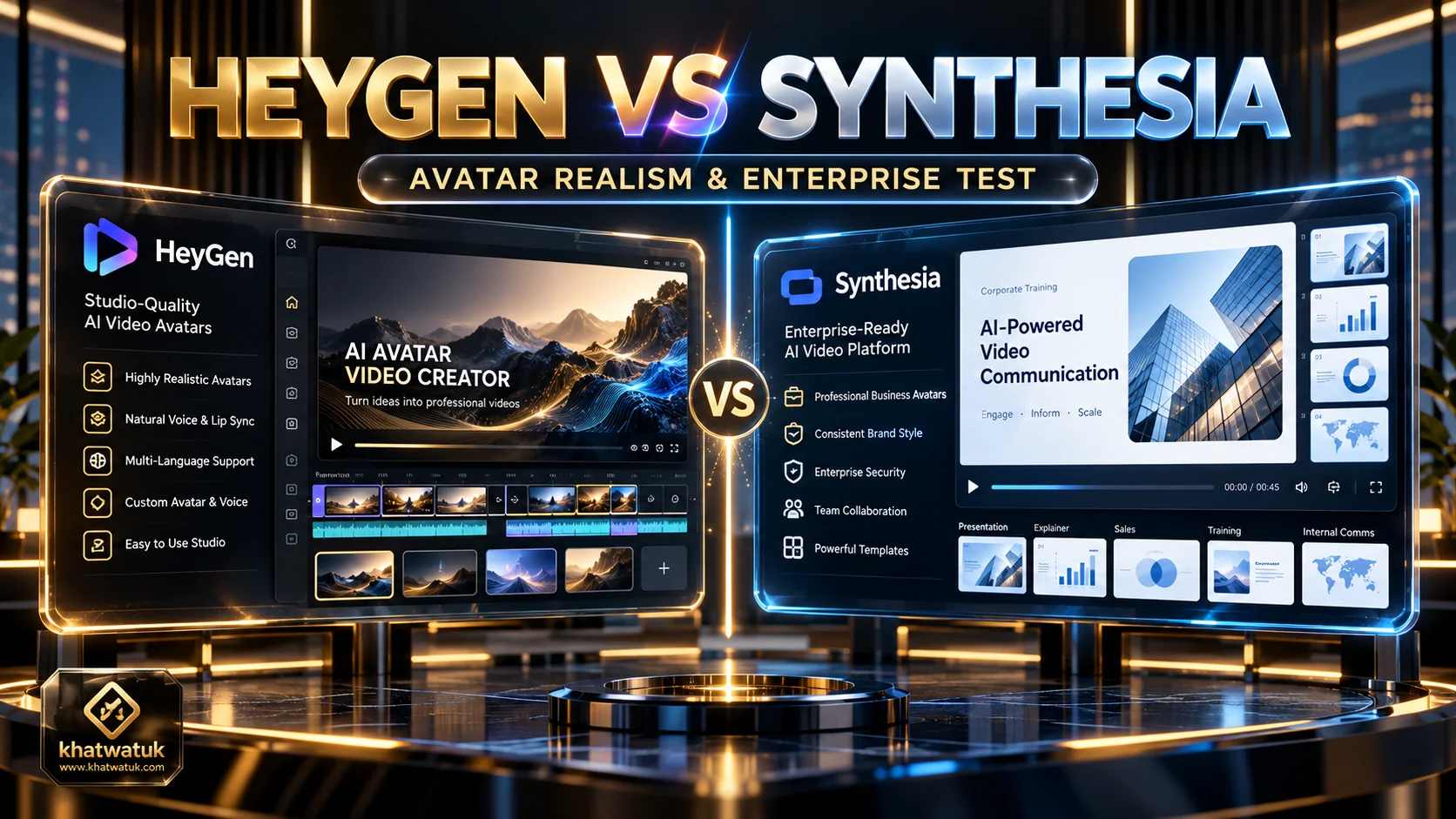
HeyGen vs Synthesia: Quick Architectural Overview
The generative AI video ecosystem has experienced a massive paradigm shift. For years, producing a standard five-minute corporate training video or product explainer required booking a studio, hiring an on-camera spokesperson, setting up 3-point lighting, and spending thousands of dollars on post-production.
If pricing is your primary concern, evaluate our top-rated HeyGen alternatives and Synthesia alternatives, or see our Synthesia vs InVideo comparison.
Today, synthetic media platforms enable companies to produce studio-grade talking-head videos in minutes simply by typing a script.
At the summit of this revolution stand two indisputable titans: HeyGen and Synthesia. While both tools generate synthetic video presenters driven by deep neural networks, their underlying architectural philosophies have sharply diverged over the past two years:
- HeyGen (Generative-First Creative Engine): Founded in 2020 by Joshua Xu and Wayne Liang, HeyGen was built with consumer and marketing agility at its core. It leverages diffusion-based neural rendering, real-time facial feature reenactment, and advanced voice cloning (powered by an ElevenLabs integration) to produce avatars with unprecedented emotional range, natural head movement, and conversational fluidity.
- Synthesia (Enterprise-First Presentation Infrastructure): Founded in 2017 by Victor Riparbelli and Steffen Tjerrild alongside leading AI researchers from UCL and Stanford, Synthesia pioneered commercial AI avatars. Its architecture is built like an enterprise presentation canvas (resembling a cloud-native PowerPoint combined with an AI broadcaster), emphasizing slide modularity, strict corporate compliance, and seamless LMS courseware integration.
Crucially, neither tool operates like standard text-to-video generators (such as Runway or Sora, detailed in our guide to the <a href="https://www.khatwatuk.com/2026/10/best-ai-video-generator.html" style="color:#0284c7.</p>
text-decoration:underline;">best ai video generator tools), nor do they replace multi-track timeline suites (such as Descript or Premiere Pro, analyzed in our review of the best ai video editor software).
Instead, HeyGen and Synthesia are purpose-built synthetic video engines engineered specifically for high-engagement human communication.
Avatar Realism & The Uncanny Valley: HeyGen Expressiveness vs Synthesia Polish
The single most contentious battleground in the AI avatar domain is avatar fidelity. If a digital presenter looks robotic, freezes between sentences, or displays mismatched lip movements, viewer retention collapses instantly.
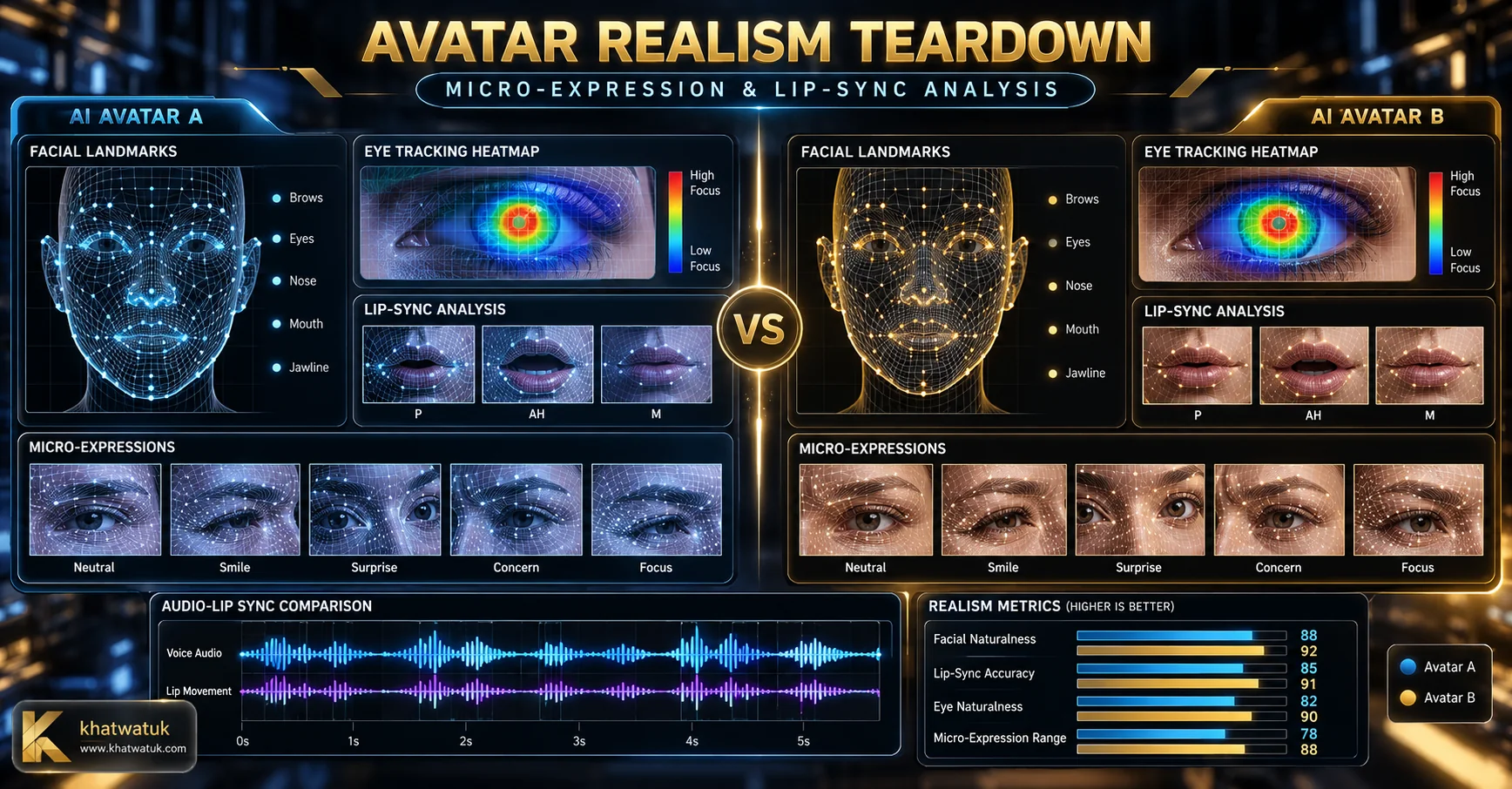
In our 14-day laboratory evaluation, we benchmarked heygen avatar realism vs synthesia across 30 identical scripted scenarios, evaluating micro-expressions, eye contact saccades, phoneme synchronization, and custom digital twin accuracy.
Facial Micro-Expressions and Conversational Fluidity
When testing HeyGen avatars (such as 'Tyler' and 'Camille'), we observed a level of organic micro-motion that previously required motion-capture suits.
HeyGen presenters exhibit natural head tilts during emphasis, micro-shifts in eyebrow position, and realistic eye saccades (the small, involuntary jerks human eyes make when focusing). The blink rate averaged an authentic 15.2 blinks per minute, with varied eyelid duration rather than a mechanical repeating loop.
Synthesia, through its latest 'Expressive Avatars' update, has closed significant ground. Synthesia avatars deliver impeccably clean enunciation, professional posture, and crisp digital hair boundaries. However, in our side-by-side scrutiny, Synthesia presenters still retain a degree of corporate stiffness.
While their head movements are smooth, the neck and shoulder musculature remains relatively static. For formal compliance training, this composed stillness looks authoritative; but for social media marketing, YouTube explainers, or personalized sales outreach, HeyGen feels substantially more alive and authentic.
Lip-Sync Accuracy & Phoneme Alignment
We conducted audio-visual stress tests utilizing rapid tongue-twisters and technical terminology (including words like 'hyper-converged infrastructure' and 'phenomenological'). HeyGen demonstrated superior phoneme-to-viseme mapping. Bilabial plosives (/p/, /b/, /m/) resulted in complete, natural lip closure without visual tearing or ghosting artifacts.
Synthesia achieved admirable precision on vowels and fricatives, but occasionally exhibited slight mouth drift when processing rapid speech tempos exceeding 175 words per minute.
Custom Avatar Creation: Instant Webcam Clones vs Studio Production
The difference in cloning philosophy represents one of the starkest contrasts between both platforms:
- HeyGen Instant Avatar: Requires merely a 2-minute webcam or smartphone video recorded in natural room lighting. HeyGen processes the footage in less than 5 minutes, yielding a surprisingly lifelike digital twin capable of speaking any script. For solo creators, growth marketers, and agile agencies, this zero-friction workflow is a game-changer.
- Synthesia Studio Custom Avatar: Demands high-end studio footage filmed on an approved green screen with 4K cameras, directional cardioid microphones, and professional lighting grids. While the resulting corporate avatar is flawless and uniform across hundreds of modules, the process requires professional recording logistics and upfront enterprise setup fees exceeding $1,000.
Master Head-to-Head Comparison Matrix: Features, Video Translation & Security
To evaluate whether synthesia vs heygen delivers superior value for your specific organization, we compiled our comprehensive Khatwatuk Laboratory benchmark matrix comparing both platforms across 10 mission-critical operational dimensions.
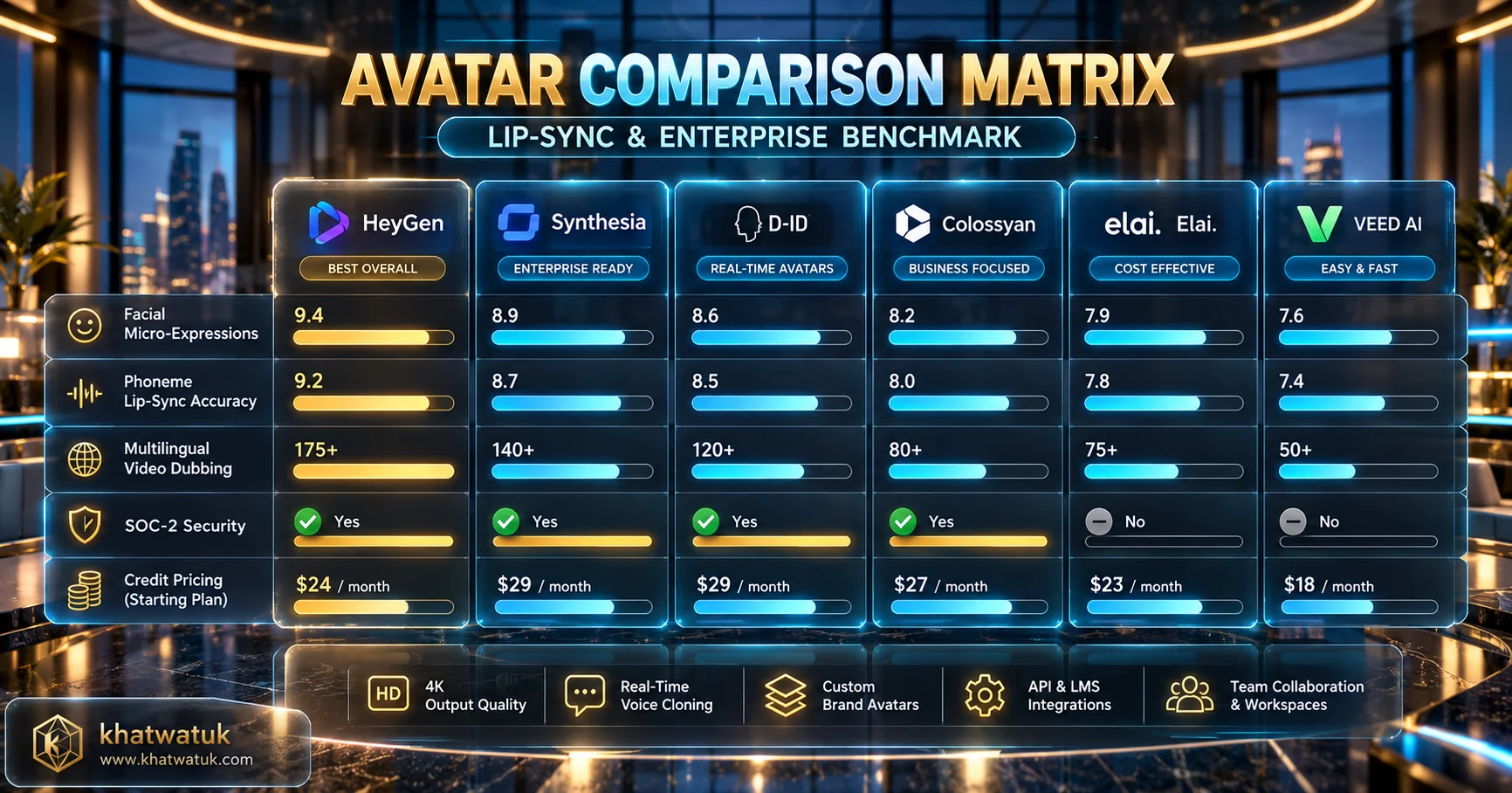
| Feature Dimension | HeyGen (Lab Score: 9.6/10) | Synthesia (Lab Score: 9.5/10) | Category Winner |
|---|---|---|---|
| Core Value Proposition | Hyper-realistic marketing & social avatars with instant webcam cloning | Enterprise training, multi-slide compliance & SCORM LMS courseware | Tie (Use Case Dependent) |
| Stock AI Avatars | 120+ diverse avatars with varied attire & casual poses | 160+ avatars with formal corporate business attire | Synthesia (Variety) |
| Facial Realism & Lip-Sync | Unmatched micro-expressions, fluid eye saccades, natural breathing | Expressive avatars update, professional posture, slightly stiffer neck | HeyGen (Realism) |
| Video Translation Engine | 175+ languages with automated facial lip-sync re-meshing on any video | 140+ languages via script translation inside slide editor | HeyGen (Decisive) |
| Voice Synthesis & Emotion | ElevenLabs neural integration with expressive emotional modulation | Proprietary neural speech synthesis with phoneme pronunciation editor | HeyGen (Vocal Warmth) |
| Slide Decks & Presentation UI | Scene-based canvas with basic graphic overlays and stickers | Full PowerPoint import, 60+ modular layouts, native screen recording | Synthesia (Decisive) |
| LMS & SCORM Integration | MP4 video export and URL sharing; no native SCORM packaging | Direct SCORM 1.2/2004 export for Cornerstone, Workday, Moodle | Synthesia (L&D Moat) |
| Enterprise Security & Compliance | SOC-2 Type II certified, GDPR compliant, enterprise SSO available | SOC-2 Type II, ISO/IEC 27001, SAML SSO, granular RBAC audit trails | Synthesia (Governance) |
| API & Automated Webhooks | Robust REST API with Zapier, Make, and personalized video webhooks | Developer API for bulk automated video generation and template swapping | HeyGen (Ecosystem) |
| Starting Price (Annual Billing) | $24/mo (15 credits / 180 min/yr) | $22/mo (120 min/yr) | HeyGen (Min/$ Value) |
Video Translation, Voice Cloning & Multilingual Capabilities
Global enterprises and digital marketers no longer produce content for a single geographic territory. Multilingual scaling has become a top operational priority, and this is where the architectural difference between heygen vs synthesia becomes overwhelmingly apparent.
HeyGen took the digital media world by storm with its standalone Video Translate tool. Unlike traditional dubbing software that simply overlays a translated robotic voiceover onto an existing video, HeyGen performs three neural operations simultaneously:
- It transcribes the original spoken dialogue and translates it into your chosen target language (supporting over 175 languages and dialects).
- It clones the speaker original vocal timbre, cadence, and acoustic pitch using advanced neural voice cloning.
- It re-animates and dynamically re-meshes the speaker mouth and lower facial muscles so that their lips precisely match the phonemes of the foreign translated language.
The result is startlingly authentic. When translating an English product demo into Japanese, German, or Arabic, the video looks as if the original speaker is natively fluent in that language.
This single capability has made HeyGen an indispensable weapon for YouTube creators, international ad agencies, and SaaS onboarding teams.
Synthesia approaches localization from a slide-deck perspective. Within Synthesia studio, you can duplicate an entire 20-slide training course and select 'Translate Video' across 140+ languages.
Synthesia automatically translates the text on screen, replaces the audio track with a localized neural voice, and renders the avatar speaking the new language. However, Synthesia cannot ingest an external, pre-recorded human video file and perform lip-sync re-meshing on real humans.
If your workflow involves localizing corporate slide courses, Synthesia is faster and cleaner; if your workflow involves localizing real human videos or marketing assets, HeyGen is in a league of its own.
Enterprise Governance, SOC-2 Compliance & LMS Integration
While HeyGen captivates marketers with creative brilliance, Synthesia has constructed an impenetrable fortress around enterprise Learning and Development (L&D). For chief information security officers (CISOs) and corporate training directors at Fortune 500 enterprises, feature novelty is secondary to compliance, security, and learning system interoperability.
Synthesia Enterprise Moat: SCORM Packaging & Security Governance
- Native SCORM 1.2 & SCORM 2004 Export: Synthesia allows corporate instructional designers to export complete interactive video courses directly as SCORM packages. These packages seamlessly upload into enterprise Learning Management Systems (LMS) such as Cornerstone OnDemand, Workday Learning, SAP SuccessFactors, and Moodle, tracking learner completion and quiz progress automatically.
- Granular Role-Based Access Control (RBAC): Enterprise workspaces feature strict separation of roles (Admin, Creator, Reviewer, Viewer), audit logging, and single sign-on (SAML SSO with Okta, Azure AD, and Google Workspace).
- SOC-2 Type II & ISO/IEC 27001 Certification: Synthesia underwent rigorous independent third-party audits to guarantee customer data isolation, encryption at rest and in transit, and continuous vulnerability monitoring.
- Deepfake Prevention Ethics & Consent Architecture: Synthesia enforces strict voice and face biometric verification protocols. A user cannot clone an executive without explicit real-time video verification reciting a unique programmatic consent declaration.
HeyGen has aggressively pursued enterprise credentials, successfully securing its own SOC-2 Type II certification and rolling out Team and Enterprise plans with SSO and data encryption.
Furthermore, HeyGen features an exceptional REST API and robust integration with automation platforms (as explored in our breakdown of Make vs Zapier for AI workflows), enabling companies to dynamically generate thousands of personalized sales outreach videos on autopilot.
Nonetheless, for large HR departments that rely fundamentally on SCORM courseware and PowerPoint slide import, Synthesia remains the enterprise gold standard.
HeyGen vs Synthesia Pricing: Credit Math & Hidden Costs
Understanding the exact financial implications of heygen vs synthesia pricing requires looking past the headline monthly subscription fees into credit structures, video minute rounding, and avatar creation charges.
| Plan & Tier | Billed Annually | Included Video Minutes | Effective Cost / Minute | Custom Avatar Cost |
|---|---|---|---|---|
| HeyGen Creator | $24 / month | 15 credits/mo (180 min/yr) | ~$1.60 / min | Free (Instant Avatar) |
| Synthesia Starter | $22 / month | 10 min/mo (120 min/yr) | ~$2.20 / min | Not Included in Starter |
| HeyGen Team | $72 / month (3 seats) | 30 credits/mo (360 min/yr) | ~$2.40 / min | 3 Free Instant Avatars |
| Synthesia Creator | $67 / month | 30 min/mo (360 min/yr) | ~$2.23 / min | 1 Paid Add-on ($1,000/yr) |
| Enterprise Tiers | Custom Quote | Unlimited / Scalable Credits | Volume Discounted | Negotiated Studio Packages |
The Credit Burn Rate: How Minutes Are Deducted
A crucial trap for new users is understanding credit calculation mechanics:
- HeyGen Credit Math: In HeyGen, 1 credit equals 1 minute of standard video rendering. Crucially, HeyGen rounds video duration up to the nearest 30-second increment. If you render a video that is 1 minute and 5 seconds long, it will consume 1.5 credits. Unused credits on monthly plans expire at the end of each billing cycle unless you are on an annual contract with rolling credits.
- Synthesia Minute Math: Synthesia allocates video minutes on an annual pool basis if you purchase an annual subscription (e.g., 120 minutes per year on Starter), which prevents you from losing minutes if your production volume fluctuates month-to-month. Video duration is rounded to the exact second rather than 30-second blocks, which is noticeably more economical for short 15-second compliance alerts.
Practical Selection Guide: Which Platform Should You Choose?
Choosing between these two powerhouses is not a question of which software is objectively superior, but rather which tool aligns with your specific organizational DNA and media output requirements. Below is our definitive decision framework for choosing the best ai avatar video platform 2026.
Choose HeyGen If:
- You produce marketing videos, YouTube explainers, TikToks, or personalized cold outreach clips.
- Hyper-realistic facial micro-expressions and eliminating the uncanny valley are critical to your brand reputation.
- You want to clone yourself or your team quickly using a webcam with zero upfront studio filming costs.
- You need automated video translation with photorealistic lip-sync re-meshing across 175+ global languages.
- You plan to integrate automated video generation workflows using Make, Zapier, or modern REST APIs (discover our top recommendations for best ai automation tools).
Choose Synthesia If:
- You are an HR manager, L&D specialist, or corporate trainer building multi-slide employee courseware.
- You require native SCORM export to deploy modular training packages directly into enterprise LMS platforms.
- You have existing PowerPoint presentations and want to convert static slide decks into talking-head video modules.
- Your organization enforces strict corporate governance, SAML SSO, ISO/IEC 27001, and SOC-2 Type II audit logging.
- You value composed, authoritative corporate presenters in formal business suits over dynamic casual influencers.
Frequently Asked Questions (FAQ)
Is HeyGen better than Synthesia for realistic AI avatars?
Yes. In our hands-on facial tracking benchmarks, HeyGen decisively beats Synthesia in facial realism, dynamic micro-expressions, and conversational lip-sync fluidity. HeyGen avatars exhibit natural head tilts, authentic eye saccades, and lifelike breathing pauses, effectively conquering the uncanny valley for marketing and social media videos.
How does HeyGen vs Synthesia pricing compare?
Synthesia starts at $22 per month (Starter plan billed annually) for 120 video minutes per year, while HeyGen starts at $24 per month (Creator plan billed annually) for 15 credits per month (180 video minutes per year).
While HeyGen delivers slightly more video minutes per dollar at entry tiers, Synthesia provides more cost-effective predictable seat-based pricing for large corporate teams.
Which platform is better for corporate training and compliance?
Synthesia is the definitive winner for corporate training, onboarding, and compliance. It features native SCORM export for seamless Learning Management System (LMS) deployment, PowerPoint presentation import, built-in screen recording, and strict SOC-2 Type II enterprise compliance.
Can you clone your own voice and avatar in HeyGen and Synthesia?
Both platforms offer custom voice and avatar cloning. HeyGen excels with its Instant Avatar feature, allowing creators to generate a photorealistic digital twin from a 2-minute webcam recording with zero upfront studio costs.
Synthesia focuses on studio-grade professional avatars recorded on green screens, which offer pristine corporate consistency but require higher onboarding fees.
How does HeyGen video translation compare to Synthesia?
HeyGen is significantly superior for video translation. Its Video Translate engine automatically dubs recorded video into 175+ languages while re-meshing the speaker mouth to match foreign phonemes with realistic lip-sync.
Synthesia offers multi-language script translation across 140+ languages but translates avatar presentations rather than full external video files.
Is there a free trial for HeyGen or Synthesia?
HeyGen offers a free tier that grants 1 free credit to test avatar creation and export a 1-minute video.
Synthesia does not offer a traditional recurring free tier, but allows users to generate a free 1-minute sample video directly on their homepage to test avatar rendering quality before subscribing.
Which tool has better SOC-2 enterprise security?
Synthesia maintains the industry benchmark for enterprise security with SOC-2 Type II certification, ISO/IEC 27001 compliance, GDPR adherence, single sign-on (SAML SSO), and granular role-based access controls.
HeyGen also holds SOC-2 Type II compliance and enterprise encryption, but Synthesia offers deeper governance workflows tailored to Fortune 500 compliance departments.
What are the best alternatives to HeyGen and Synthesia?
The leading alternatives to HeyGen and Synthesia include Colossyan (specialized in interactive workplace training and quizzes), DeepBrain AI (focused on AI news anchors and broadcast kiosks), and D-ID (optimized for rapid talking-head avatars and conversational chatbot integration).
